Ancient Agriculture Farming — Reading Comprehension
Rate this
Present
Present in classroom. No work saved
Assign
Classroom with student accounts, Track progress
Quick Play
No student accounts, assign with a link
Grades
6
7
8
PRINT+DIGITAL RESOURCE
This learning resource is available in interactive and printable formats. The interactive worksheet can be played online and assigned to students. The Printable PDF version can be downloaded and printed for completion by hand.
This passage explores the transformative impact of farming on ancient societies, examining how the Neolithic Revolution led to food surpluses, the rise of civilizations, new social structures, and technological innovation. Students will learn about specific examples like Mesopotamia and ancient Egypt, archaeological evidence such as Sumerian tablets and Egyptian irrigation systems, and the lasting significance of agriculture in shaping human history. The passage features rich academic vocabulary, a reading comprehension quiz, writing prompts, and graphic organizers, along with a Spanish translation and read-aloud audio. Activities align with CA HSS 6.2 and CCSS RH.6-8.2, supporting the development of key historical thinking and literacy skills. Ideal for students examining ancient civilizations and the roots of modern society.
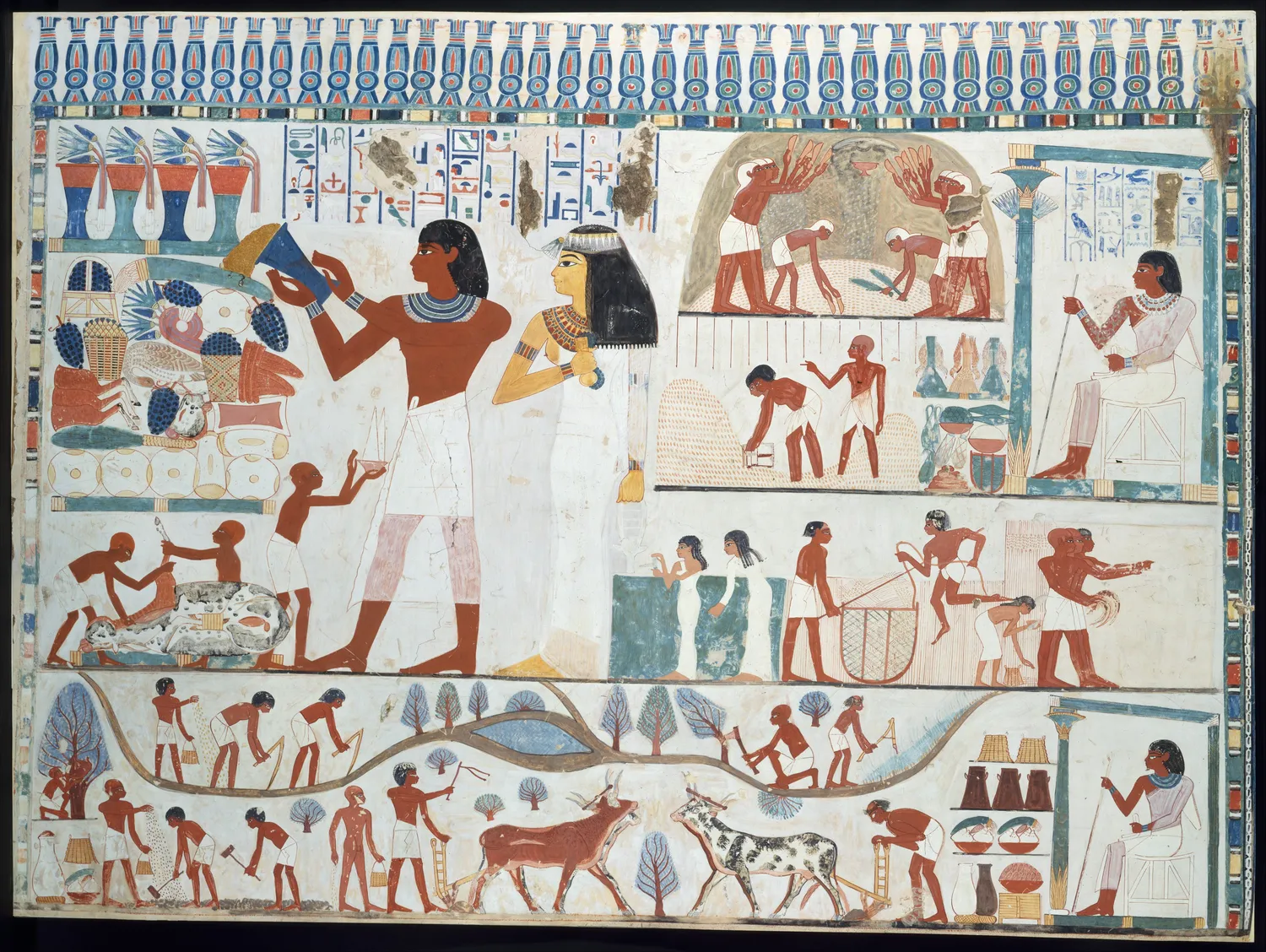
Farming was one of the most important developments in human history. The shift from hunting and gathering to farming, often called the Neolithic Revolution, began around 10,000 BCE in different parts of the world. This change allowed people to settle in one place and produce a food surplus, meaning they grew more food than they immediately needed. As a result, ancient societies could support larger populations and develop more complex ways of life.
Early farming began independently in several regions, including the Fertile Crescent (modern Iraq and Syria), ancient China, and Mesoamerica. In Mesopotamia, by around 7000 BCE, people domesticated wheat and barley. Archaeological evidence such as clay tablets from Sumer shows that early farmers used simple tools like wooden plows and developed irrigation systems to control water from rivers like the Tigris and Euphrates. In Egypt, farmers depended on the annual flooding of the Nile River, using canals and dikes to spread water to their fields. These innovations helped increase crop yields and made it possible to support the world's first cities and city-states.
The rise of farming had far-reaching effects on ancient societies. With a steady food surplus, not everyone had to farm. Some people became artisans, making pottery or tools, while others became priests, scribes, or rulers. This led to the development of a social hierarchy, where people had different roles and levels of power. Written records from ancient Sumer, such as the cuneiform tablets, show that farmers paid taxes to support temples and leaders. In ancient China, the Shang dynasty (c. 1600–1046 BCE) organized large-scale farming and used bronze tools, as seen in archaeological finds.
Over time, farming techniques improved. Farmers learned to rotate crops, domesticate animals for labor and food, and invent new tools. These changes allowed ancient civilizations to expand, trade, and build monuments like the Egyptian pyramids, which required huge amounts of food to support workers. However, farming also had challenges, such as droughts, floods, and disputes over land and water. Despite these obstacles, agriculture remained the foundation of most ancient economies and continues to shape societies today.
The development of farming marked a turning point in history. It enabled the growth of civilizations, new forms of government, and advances in technology and culture. Understanding farming’s role helps explain why ancient societies could build cities, develop writing, and create lasting cultural achievements.
Interesting Fact: Ancient Sumerian farmers invented the earliest known plow around 3500 BCE, which made planting seeds much easier and faster.
When did the Neolithic Revolution begin?
Around 10,000 BCE1000 CE500 BCE2000 CE
Which river did Egyptian farmers depend on?
NileAmazonYangtzeMississippi
What did Sumerian farmers invent around 3500 BCE?
The plowThe wheelThe bowPaper
How did food surplus affect ancient societies?
Enabled larger populationsDecreased tradeReduced city growthStopped farming
Why was irrigation important?
It brought water to cropsIt built pyramidsIt made potteryIt recorded history
What role did artisans have?
Made pottery/toolsLed armiesFarmed cropsBuilt canals
Farming led to the rise of city-states. True or false?
TrueFalse
What does 'food surplus' mean?
Extra food not immediately neededFood for only one familyA lack of foodCooking new foods
Perfect For:
👩🏫 Teachers
• Reading comprehension practice
• Auto-graded assessments
• Literacy skill development
👨👩👧👦 Parents
• Reading practice at home
• Comprehension improvement
• Educational reading time
🏠 Homeschoolers
• Reading curriculum support
• Independent reading practice
• Progress monitoring
Reading Features:
📖
Reading Passage
Engaging fiction or nonfiction text
❓
Comprehension Quiz
Auto-graded questions
📊
Instant Feedback
Immediate results and scoring
📄
Printable Version
Download for offline reading
🔊
Read Aloud
Voice-over with word highlighting
Reviews & Ratings
No reviews yet. Be the first to share your experience!
Related Content
Ancient Civilizations and the Environment
This engaging history reading passage explores how ancient civilizations such as Mesopotamia, Egypt, and the Maya adapte...
Gender Roles in Ancient Civilizations
This engaging history reading passage explores the roles of men and women in various ancient civilizations, including Me...
Writing Prompts Ancient Civilizations
Step into the shoes of an archaeologist with this engaging worksheet focused on ancient civilizations. Students will be ...
W.5.2.A-2W.5.1.CW.5.1.D
Power and Authority in Ancient Civilizations
This passage explores the roles of men in positions of power within ancient civilizations, focusing on their authority i...
Ancient Monarchy
This reading passage explores the concept of monarchy in ancient civilizations, focusing on the origins, structure, and ...
Evidence in Ancient History
This engaging history reading passage investigates how archaeologists and historians discover clues about how ancient pe...
Ancient Theocracy
This engaging history reading passage explores the concept of theocracy in ancient civilizations, where priests and reli...
Ancient Mathematics
This passage explores the essential role of mathematics in ancient civilizations, including Mesopotamia, Egypt, Greece, ...
Ancient Canaan
This educational passage explores the land of Canaan, the historical homeland of the ancient Israelites. Students will l...
Ancient Money Barter
This passage explores the fascinating evolution from barter to the earliest coins in ancient civilizations, focusing on ...
Ancient Science and Medicine
This comprehensive reading passage explores the development of science and medicine in ancient civilizations, including ...
Ancient Literature
This passage explores the importance of ancient stories and poems from civilizations such as Greece, India, and Israel. ...
Ancient Writing Systems
This engaging history reading passage explores the origins and evolution of ancient writing systems, including cuneiform...
Geography of Ancient Israel
This passage explores the rich geography of Ancient Israel, focusing on how landforms, climate, and natural resources sh...
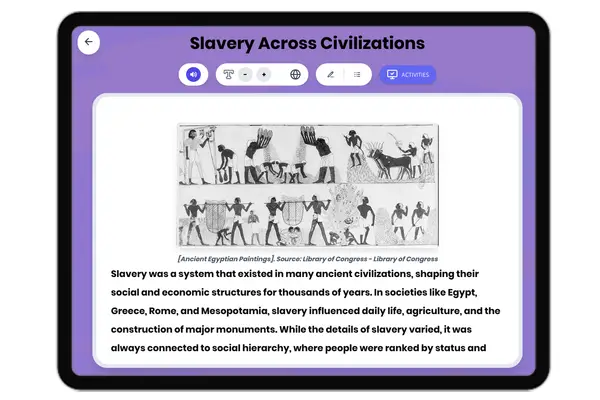
Slavery Across Civilizations
This detailed history reading passage explores the role and impact of slavery across several ancient civilizations, incl...
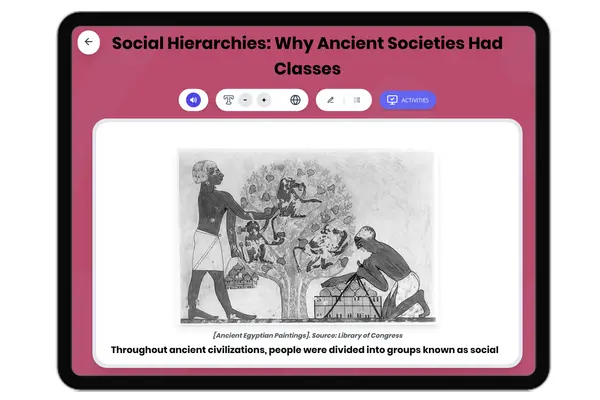
Social Classes in Ancient Societies
This passage explores the concept of social hierarchies in ancient civilizations, focusing on why societies such as Meso...
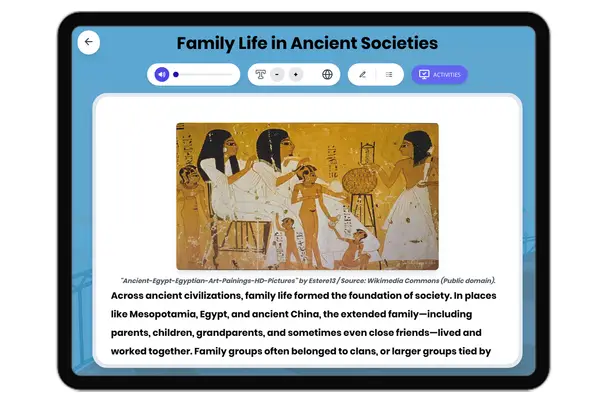
Social structures in Ancient World
This passage explores the organization and significance of family life in ancient societies, focusing on how extended fa...
Polytheism and Monotheism in Ancient Times
This passage explores the religious beliefs of ancient civilizations, focusing on the differences and similarities betwe...
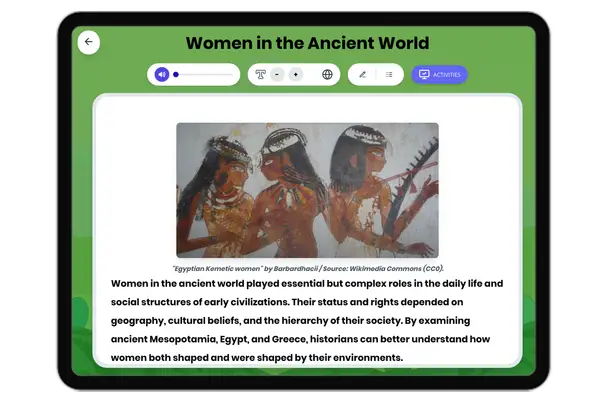
Women in Ancient Societies
This reading passage explores the complex roles of women in the ancient world, focusing on civilizations such as Mesopot...