Ancient Mathematics
Interactive passage with audio narration, comprehension questions, and printable PDF.
By completing this purchase you agree to our Terms of Use and Privacy Policy. Your subscription renews automatically until you cancel. You can cancel anytime from your account settings. All sales are final and non-refundable. Digital content is available for download in your account immediately upon purchase.
What's included
Ancient Mathematics preview and details
About this printable Ancient Mathematics reading passage (Grades 6-8)
Sample passage and quiz from Ancient Mathematics
Reading passage and comprehension quiz preview
Ancient Mathematics
Wikimedia Commons
Throughout ancient history, mathematics played an essential role in the development of civilizations. Early societies such as Mesopotamia, Egypt, Greece, and the Maya used mathematics not only for solving problems but also to organize their societies, build impressive structures, and understand the universe. These ancient cultures created sophisticated systems for counting, measuring, and tracking time, which influenced later generations and are still studied by historians and mathematicians today.
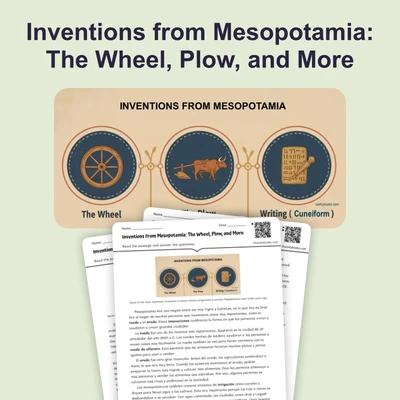
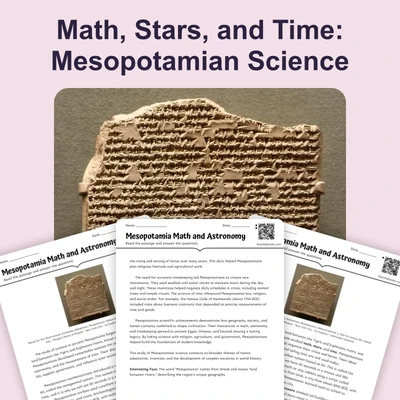
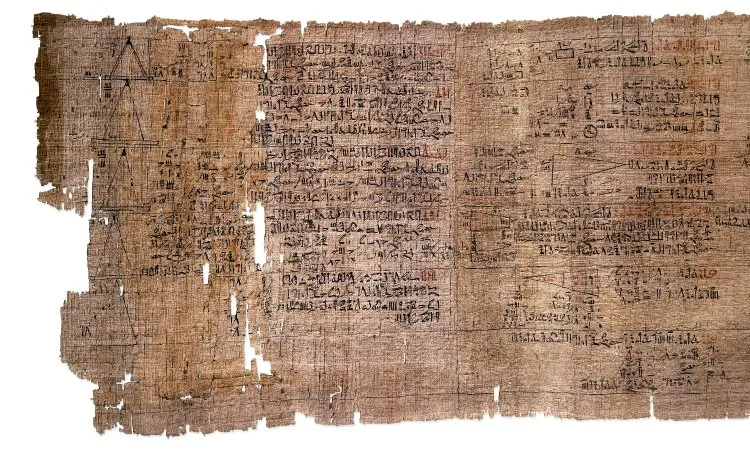
In Mesopotamia, located between the Tigris and Euphrates rivers, people developed one of the world’s first written numeral systems around 3200 BCE. They used a base-60 system, which allowed for complex calculations. Clay tablets, such as the Plimpton 322 tablet from Babylon (c. 1800 BCE), show their advanced understanding of geometry for dividing land and building temples. In ancient Egypt, mathematics was vital for constructing massive monuments like the pyramids of Giza around 2600 BCE. Egyptian texts, such as the Rhind Mathematical Papyrus, reveal that scribes used multiplication, fractions, and basic equations to solve everyday problems and plan construction projects. Both societies needed accurate measurement and calculation to manage agriculture and distribute resources, especially after flooding of rivers changed the land.
Mathematics also played a key part in astronomy, the study of stars and planets. Ancient Greeks, such as Pythagoras and Euclid, made groundbreaking discoveries in geometry and used mathematical reasoning to study the cosmos. The Maya of Central America developed a complex calendar system that combined astronomy and mathematics, accurately predicting solar eclipses and the movement of planets. Their use of the concept of zero was highly advanced for their time. These achievements were often recorded in codices, stone carvings, and other artifacts that archaeologists study today.
As civilizations interacted through trade and conquest, mathematical ideas spread across regions and evolved. For example, the concept of zero, developed in ancient India, influenced later Arabic and European mathematics. Despite differences in writing and methods, all ancient societies relied on math to support daily life, from keeping track of time and trade to building roads and temples. The continuity and change in mathematical knowledge show how human curiosity and necessity shaped history.
Understanding how ancient people used mathematics helps us recognize the connections between human needs, scientific discovery, and cultural development. Studying ancient math shows the ongoing impact of early innovations on modern life, from our clocks and calendars to architecture and engineering.
Interesting Fact: Some ancient Mesopotamian tablets include the earliest known multiplication tables, showing that students were practicing math over 4,000 years ago!
Comprehension quiz (8 questions)
1. Which civilization used a base-60 system?
2. What did the Maya predict using math?
3. What is Plimpton 322?
4. Why was math important after river floods?
5. How did math ideas spread?
6. What is one way math affected daily life?
7. The Egyptians used math for building pyramids. True or false?
8. What does 'geometry' mean?
Perfect for the way you teach
- Build comprehension skills
- Auto-graded quiz
- Differentiated reading
- Read together at home
- Improve fluency
- Quiet reading time
- Reading curriculum support
- Independent practice
- Track Lexile growth