Simple Machines: How They Work
Interactive passage with audio narration, comprehension questions, and printable PDF.
By completing this purchase you agree to our Terms of Use and Privacy Policy. Your subscription renews automatically until you cancel. You can cancel anytime from your account settings. All sales are final and non-refundable. Digital content is available for download in your account immediately upon purchase.
What's included
Simple Machines: How They Work preview and details
About this printable Simple Machines: How They Work science reading passage, NGSS-aligned (Grades 4-5)
Sample passage and quiz from Simple Machines: How They Work
Reading passage and comprehension quiz preview
Simple Machines: How They Work
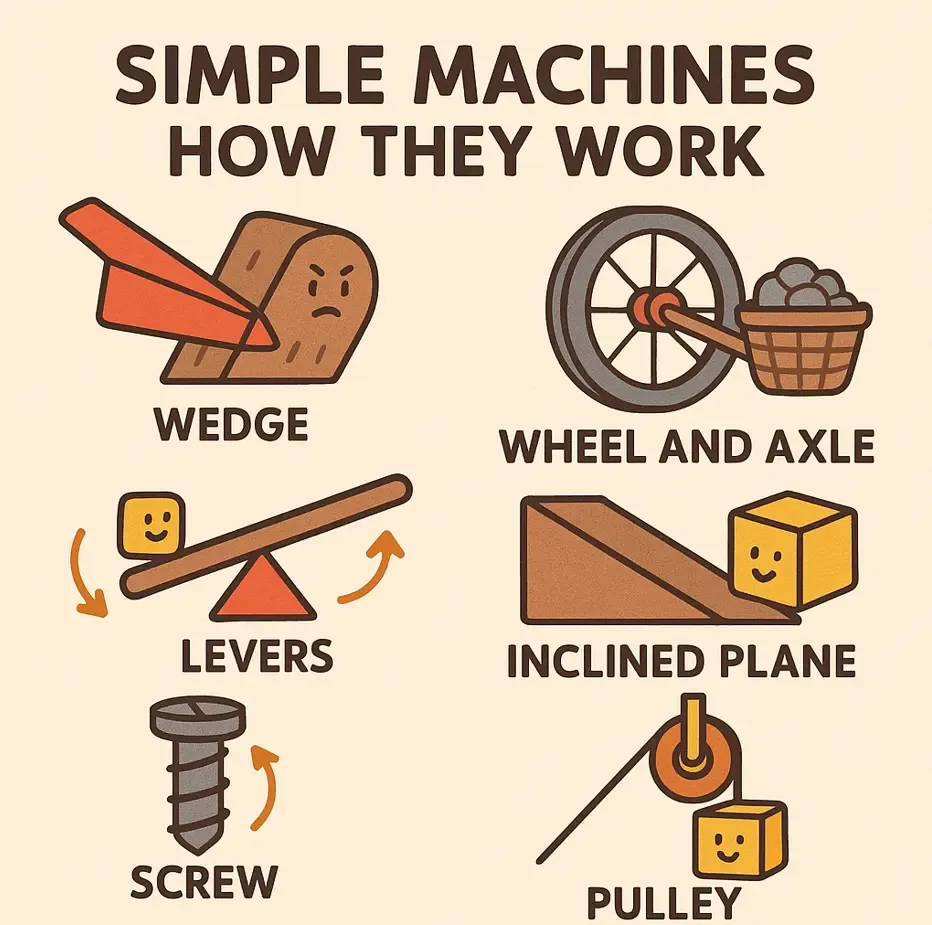
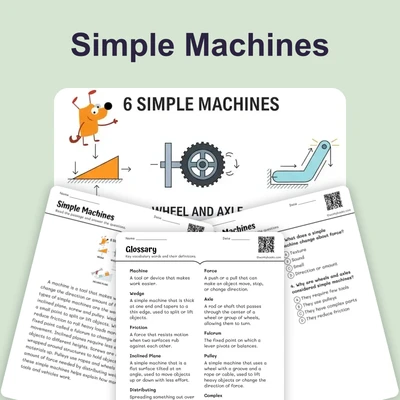
A machine is a tool that makes work easier. Simple machines change the direction or amount of force needed to do work. Six types of simple machines are the wedge, wheel and axle, lever, inclined plane, screw and pulley. Wedges concentrate force on a small point to split or lift objects. Wheels with attached axles reduce friction to roll heavy loads more easily. Levers use a fixed point called a fulcrum to change direction and speed up movement. Inclined planes require less effort to slowly raise objects to different heights. Screws are inclined planes wrapped around structures to hold objects together or lift materials up. Pulleys use ropes and wheels to reduce the amount of force needed by distributing weight. Understanding these simple machines helps explain how many complex modern tools and vehicles work.
Comprehension quiz (6 questions)
1. A machine is a tool that makes ______ easier.
2. Simple machines change the _______ or _______ of force needed to do work.
3. Six types of simple machines are the wedge, wheel and ______, ______, inclined plane, _______ and pulley.
4. Wheels with axles reduce ________ to move loads more easily.
5. Levers use a fixed point called a ________ to change direction of movement.
6. Pulleys use ropes and wheels to ________ effort by distributing weight.
Common Core standards for Simple Machines: How They Work
Determine the main idea of a text and explain how it is supported by key details; summarize the text.
Explain events, procedures, ideas, or concepts in a historical, scientific, or technical text, including what happened and why, based on specific information in the text.
Determine the meaning of general academic and domain-specific words or phrases in a text relevant to a grade 4 topic or subject area.
Quote accurately from a text when explaining what the text says explicitly and when drawing inferences from the text.
Explain the relationships or interactions between two or more individuals, events, ideas, or concepts in a historical, scientific, or technical text based on specific information in the text.
Determine the meaning of general academic and domain-specific words and phrases in a text relevant to a grade 5 topic or subject area.
Perfect for the way you teach
- Build comprehension skills
- Auto-graded quiz
- Differentiated reading
- Read together at home
- Improve fluency
- Quiet reading time
- Reading curriculum support
- Independent practice
- Track Lexile growth