Sound Waves and Vibrations — Reading Comprehension
Rate this|
1
Premium Resource
Present
Present in classroom. No work saved
Assign
Classroom with student accounts, Track progress
Quick Play
No student accounts, assign with a link
Grades
3
4
5
6
PRINT+DIGITAL RESOURCE
This learning resource is available in interactive and printable formats. The interactive worksheet can be played online and assigned to students. The Printable PDF version can be downloaded and printed for completion by hand.
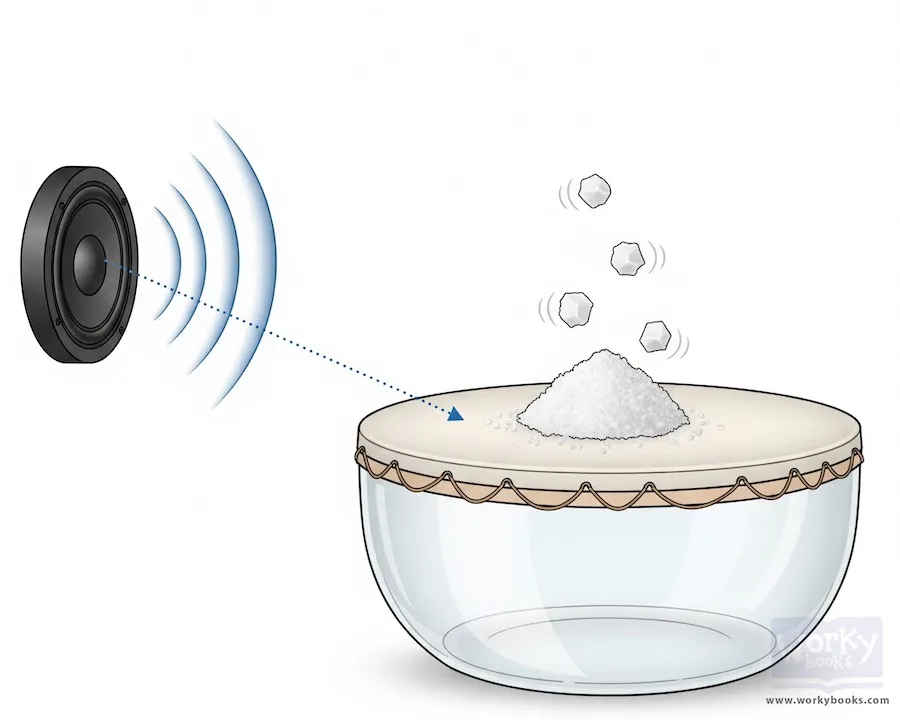
This passage and assessment are designed for a 4th-grade science class to explore the disciplinary core concept of PS4.A: Wave Properties. The content focuses on the Sound Wave Experiment, using a speaker and salt on a rubber sheet to model how a sound wave makes particles vibrate. The passage, written in a simple and engaging tone, explains key terms like vibrations, amplitude, and wavelength. It uses the analogy of a pebble in a pond to help students visualize how sound travels in waves. The experiment section provides a hands-on example that connects the abstract concept of sound waves to a tangible observation—the bouncing salt. This helps students understand how waves can transfer energy and cause objects to move. The multiple-choice questions are structured to assess a range of cognitive skills, from simple recall (DOK 1) to inferential thinking (DOK 2) and practical application (DOK 3). This lesson plan aligns with the Next Generation Science Standards (NGSS) and provides a comprehensive approach to teaching the properties of waves.
CONTENT PREVIEW
Expand content preview
Sound Waves and Vibrations
All sounds begin with something moving back and forth quickly. This movement is called a vibration. When you pluck a guitar string, hit a drum, or talk, something vibrates. These vibrations push against the air around them, causing tiny air particles to move. The moving air particles push against others, creating a sound wave that travels through the air.
Think of sound waves like invisible ripples. When you drop a stone into a pond, you see waves spreading out. In the same way, when something vibrates, it makes ripples in the air that spread out until they reach your ear.
When the sound wave reaches your ear, it makes your eardrum vibrate. Your eardrum is a thin piece of skin inside your ear. These vibrations travel to your brain, which understands them as sound.
Sound waves have special properties. Frequency is how many times something vibrates each second. Higher frequency means a higher pitch, like a whistle. Lower frequency means a lower pitch, like a drum. Amplitude is how big the vibrations are. Bigger amplitude makes a louder sound. Smaller amplitude makes a softer sound.
Sound can travel through different materials. It usually travels through air, but it can also move through water (like when whales sing) or solids (try putting your ear on a desk and tapping it). However, sound can't travel through nothing. Space is silent because there is no air or other material for sound waves to move through.
Musical instruments make sound in special ways. Guitars use vibrating strings. Flutes and trumpets use columns of vibrating air. Drums use vibrating surfaces. Each instrument vibrates at different frequencies to make different notes.
Interesting Fact: Whales can communicate with each other across miles of ocean using sound waves that travel through water!
What starts all sounds?
VibrationsElectricityLightHeat
What does frequency affect?
PitchColorShapeSpeed
What does amplitude control?
LoudnessTasteTemperatureSize
What happens if you pluck a rubber band?
It vibrates and makes soundIt gets hotterIt changes colorIt grows
Where does the sound wave go after your eardrum vibrates?
To your brainTo your noseTo your stomachTo your eyes
Can sound travel through space?
No, there is no airYes, easilyOnly if it's loudOnly with music
Sound waves are like ripples in a pond.
TrueFalse
What word means 'how high or low a sound is'?
PitchFrequencyVibrationAmplitude
Perfect For:
👩🏫 Teachers
• Reading comprehension practice
• Auto-graded assessments
• Literacy skill development
👨👩👧👦 Parents
• Reading practice at home
• Comprehension improvement
• Educational reading time
🏠 Homeschoolers
• Reading curriculum support
• Independent reading practice
• Progress monitoring
Reading Features:
📖
Reading Passage
Engaging fiction or nonfiction text
❓
Comprehension Quiz
Auto-graded questions
📊
Instant Feedback
Immediate results and scoring
📄
Printable Version
Download for offline reading
🔊
Read Aloud
Voice-over with word highlighting
Reviews & Ratings
No reviews yet. Be the first to share your experience!
Related Content
How Speed Affects Energy
This Grade 4 physical science reading passage introduces students to the relationship between speed and kinetic energy, ...
NGSS 4-PS3-2
Science Vocabulary
This worksheet on domain-specific words will help students learn some science vocabulary. Students will be asked to matc...
L.3.6L.3.4.A
How Electric Current Transfers Energy
This 250-word reading passage introduces fourth-grade students to the concept of energy transfer through electric curren...
NGSS 4-PS3-2
What Is Potential Energy
This 250-word reading passage introduces fourth-grade students to the fundamental concept of potential energy aligned wi...
NGSS 4-PS3-1
Simple Machines Science Report
This science writing task requires students to clearly explain how three simple machines work using precise domain-speci...
W.5.4
What Is Energy
This engaging 250-word reading passage introduces fourth-grade students to the fundamental concept of energy as outlined...
NGSS 4-PS3-1
Work and Energy
This science reading passage for grades 6-8 introduces students to the concepts of work and energy, aligned with NGSS st...
MS-PS3-1
Motion Energy
This NGSS-aligned science passage for 4th graders focuses on the disciplinary core concept of Motion Energy (PS1.A). It'...
Energy Transformation
This middle school science passage aligned to NGSS standard MS-PS3-5 explains the concept of energy transformation—the p...
MS-PS3-5
Heat Energy Transfer
This Grade 4 physical science reading passage explores heat energy transfer aligned to NGSS standard 4-PS3-2 and Discipl...
NGSS 4-PS3-2
Thermal Energy
This comprehensive passage explores the concept of thermal energy, aligning with NGSS standards MS-PS3-3 and MS-PS3-4. S...
MS-PS3-3MS-PS3-4
Beach Day Science
This passage addresses NGSS K-PS3-1 by comparing temperature differences in materials exposed to sunlight versus shade. ...
K-PS3-1RL.1.1
How Circuits Convert Energy
This 250-word reading passage introduces Grade 4 students to the concept of energy conversion in electric circuits, alig...
NGSS 4-PS3-2
Sound Energy
This engaging science passage, titled "What is Sound Energy?", is designed for 4th-grade students and aligns with the NG...
What Happens When Cars Collide
This 250-word reading passage introduces fourth-grade students to the concept of energy transfer and transformation duri...
NGSS 4-PS3-3
Energy Transformations
This engaging middle school science passage explores the concept of energy transformations, aligning with NGSS standards...
MS-PS3-1MS-PS3-2MS-PS3-5
Pool Table Physics
The Pool Table Physics reading passage is a highly engaging educational resource designed for fourth-grade science stude...
Energy Transfer
This NGSS-aligned science passage introduces middle school students to the concept of energy transfer, aligned to standa...
MS-PS3-5
Where Does Our Energy Come From
This 250-word reading passage aligns with NGSS standard ESS3.A and introduces fourth-grade students to the fundamental c...
NGSS 4-ESS3-1
The Future of Energy
This engaging science passage for grades 6-8, aligned with NGSS standards MS-PS3-4, MS-ESS3-3, and MS-ESS3-4, introduces...