The Apollo 11 Crew
Interactive passage with audio narration, comprehension questions, and printable PDF.
By completing this purchase you agree to our Terms of Use and Privacy Policy. Your subscription renews automatically until you cancel. You can cancel anytime from your account settings. All sales are final and non-refundable. Digital content is available for download in your account immediately upon purchase.
What's included
The Apollo 11 Crew preview and details
About this printable The Apollo 11 Crew reading passage (Grades 5-8)
Sample passage and quiz from The Apollo 11 Crew
Reading passage and comprehension quiz preview
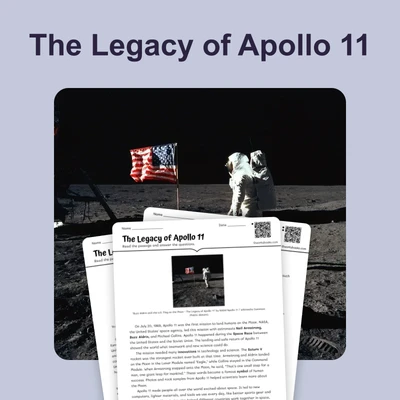
The Apollo 11 Crew
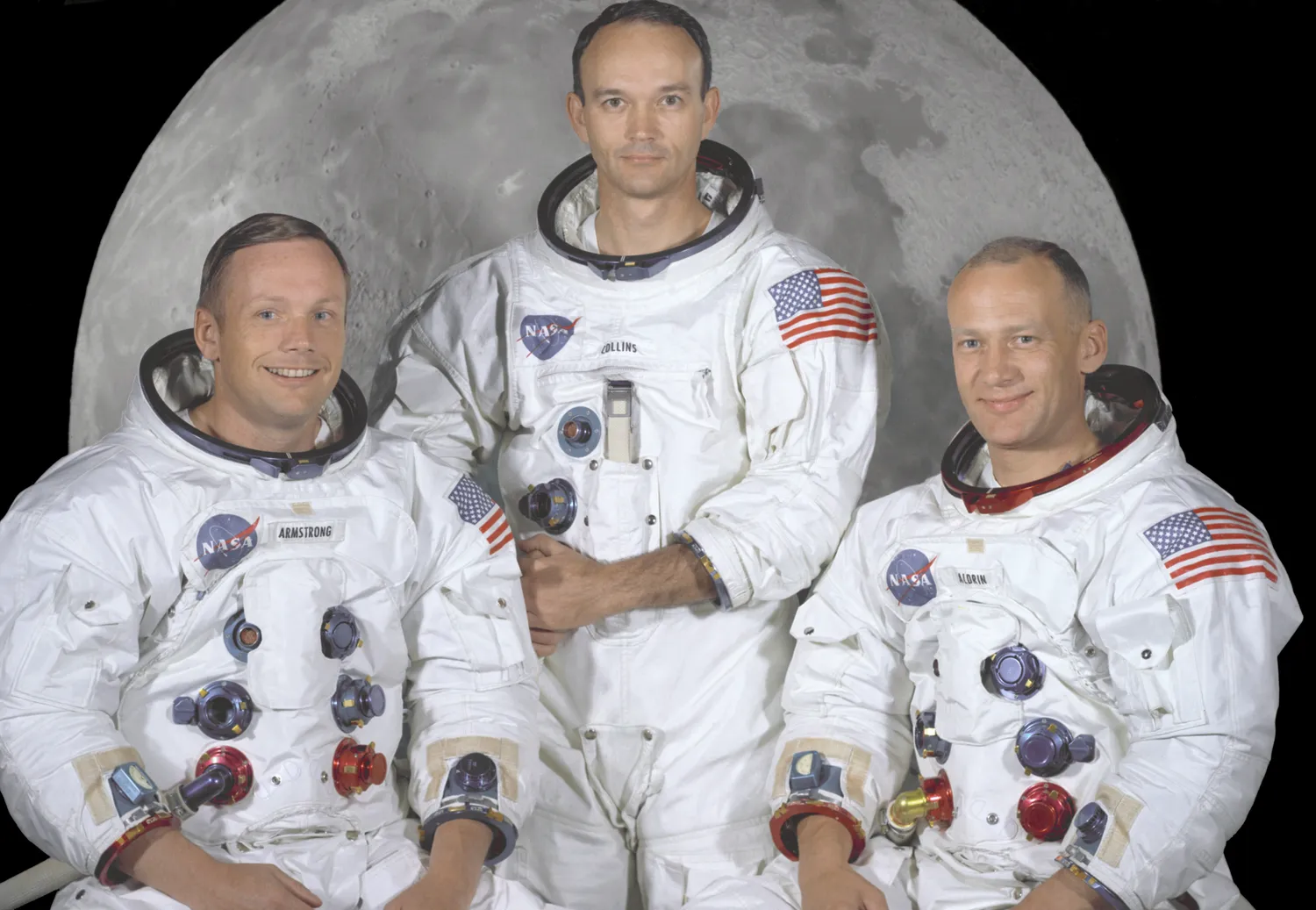
"The Apollo 11 Prime Crew" by NASA / Wikimedia Commons (Public domain).
The Apollo 11 mission was a turning point in world history. On July 16, 1969, three American astronauts—Neil Armstrong, Buzz Aldrin, and Michael Collins—left Earth on a journey to the Moon. Their spacecraft, Saturn V, launched from Kennedy Space Center in Florida, watched by millions around the world. These men were chosen after years of training and selection by NASA, the United States' space agency, because of their skills, experience, and ability to work as a team.
Neil Armstrong served as the commander of Apollo 11. Born in Ohio in 1930, Armstrong was a skilled pilot and engineer. Before joining NASA, he was a test pilot for the U.S. Navy and flew in the Korean War. Armstrong's calm personality and technical knowledge were key reasons NASA selected him to lead this historic mission. On July 20, 1969, Armstrong became the first human to step onto the Moon's surface, famously saying, “That’s one small step for man, one giant leap for mankind.” This moment was broadcast live, making it one of the most iconic events in history.
Buzz Aldrin, the lunar module pilot, was also highly qualified. He was born in New Jersey in 1930 and earned a doctorate in astronautics from MIT. Aldrin's expertise in orbital mechanics—the science of how objects move in space—helped the team plan their landing and return. Aldrin joined Armstrong on the Moon, collecting rock samples and conducting experiments. His work provided scientists with new insights about the composition of the Moon and its history.
Michael Collins, the command module pilot, stayed in lunar orbit while Armstrong and Aldrin walked on the surface. Collins was born in Italy in 1930, where his father served in the military. As an Air Force test pilot, he trained for years before becoming an astronaut. Collins’s role was vital: he operated the spacecraft that would bring all three astronauts safely back to Earth. His ability to remain focused and calm in isolation demonstrated the importance of every team member’s responsibilities.
Primary sources such as the astronauts’ journals and NASA mission transcripts reveal the challenges they faced. For example, during the lunar landing, Armstrong had to manually steer the module to a safe spot, with only seconds of fuel left. This decision-making under pressure was crucial for the mission’s success. Archaeological analysis of Moon rocks collected by Aldrin and Armstrong has also deepened our understanding of the Moon’s formation and the solar system.
The Apollo 11 mission changed how people viewed exploration and science. It inspired new generations to pursue careers in technology and engineering. The teamwork, courage, and careful planning of Armstrong, Aldrin, and Collins demonstrated the heights humans can reach through cooperation and innovation. Their accomplishment showed the world that space exploration was possible, marking a new era in human history.
The story of Apollo 11 connects to world history by showing how geography, technology, and human ambition can reshape what is possible. It reminds us of the importance of collaboration, careful preparation, and learning from both success and failure.
Interesting Fact: The astronauts left a plaque on the Moon that reads, “We came in peace for all mankind.”
Comprehension quiz (8 questions)
1. Who was Apollo 11's commander?
2. Where did Apollo 11 launch from?
3. When did Armstrong walk on the Moon?
4. Why was Aldrin important to the mission?
5. What did Collins do during the Moon landing?
6. How did teamwork help Apollo 11 succeed?
7. Armstrong and Aldrin both walked on the Moon.
8. What is 'composition'?
Perfect for the way you teach
- Build comprehension skills
- Auto-graded quiz
- Differentiated reading
- Read together at home
- Improve fluency
- Quiet reading time
- Reading curriculum support
- Independent practice
- Track Lexile growth