This learning resource is available in interactive and printable formats. The interactive worksheet can be played online and assigned to students. The Printable PDF version can be downloaded and printed for completion by hand.
This engaging passage explores the historical and technological significance of Apollo 11, the first mission in which humans landed on the Moon. Students will learn about the mission's context, the technological innovations it sparked, and its ongoing impact on science, society, and global inspiration. The passage incorporates primary sources, such as Neil Armstrong's words and images from the mission, and addresses change over time in space exploration. Activities include a multiple-choice quiz, writing prompts, and graphic organizers to deepen understanding. This resource aligns with CA HSS 7.11.7 and CCSS RI.6.2, making it perfect for interdisciplinary learning. Read aloud audio and a full Spanish translation are included to support diverse learners.
CONTENT PREVIEW
Expand content preview
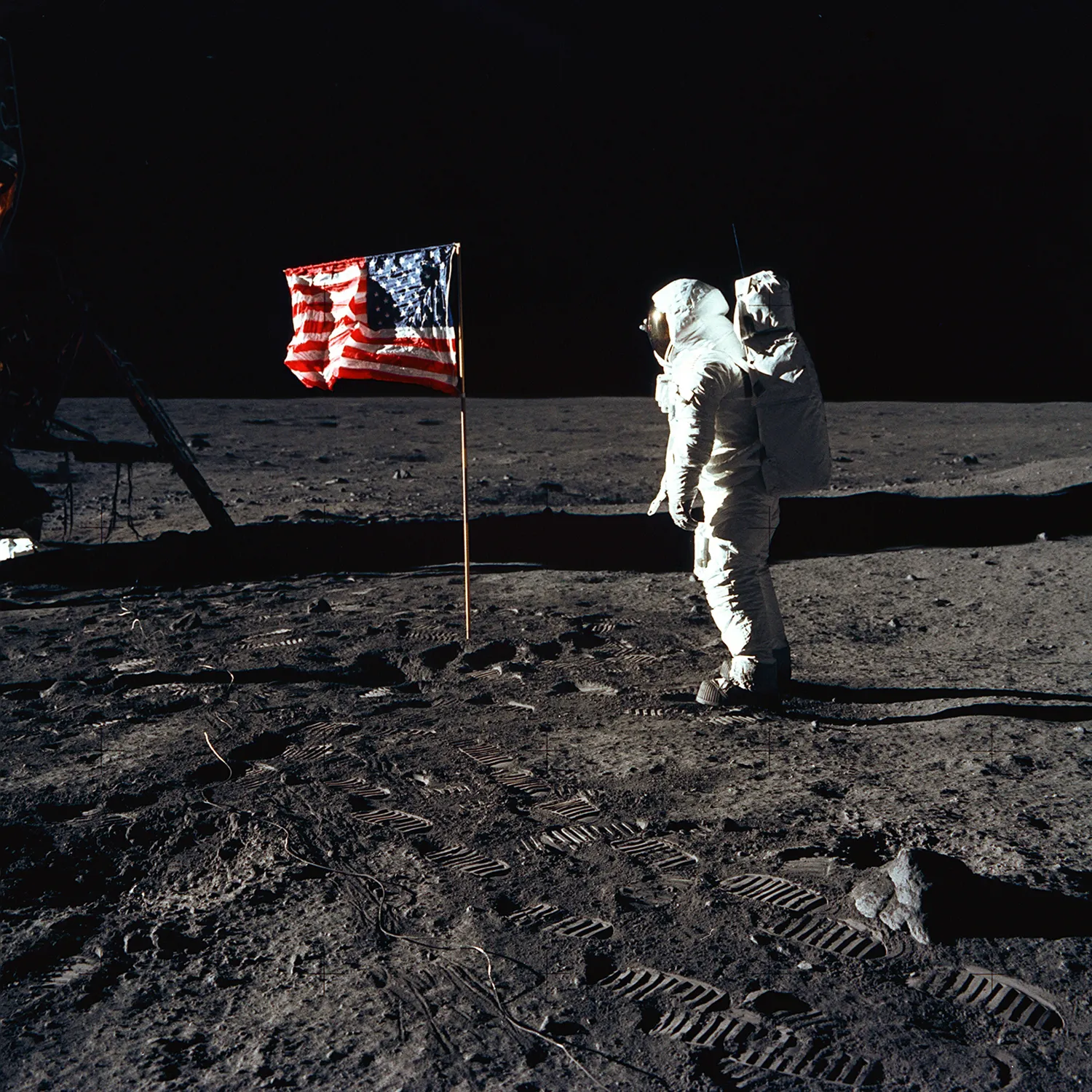
"Buzz Aldrin and the U.S. Flag on the Moon - The Legacy of Apollo 11" by NASA/Apollo 11 / Wikimedia Commons (Public domain).
On July 20, 1969, Apollo 11 became the first mission to land humans on the Moon, forever changing the course of world history. The mission was led by NASA, the United States' space agency, and included astronauts Neil Armstrong, Buzz Aldrin, and Michael Collins. This achievement was the result of years of intense international competition known as the Space Race between the United States and the Soviet Union. The successful landing and return of Apollo 11’s crew showed the world what human determination and technological creativity could accomplish.
The Apollo 11 mission required extraordinary innovation in technology and science. Engineers designed the Saturn V rocket, which was the most powerful rocket ever built at that time. The Lunar Module, called "Eagle," allowed Armstrong and Aldrin to land on the Moon’s surface while Collins orbited above in the Command Module. Armstrong’s first words as he stepped onto the Moon, “That’s one small step for a man, one giant leap for mankind,” became a symbol of human achievement. Photographs and rock samples collected during the mission provided primary sources for scientists to study the Moon’s history and geology.
Apollo 11 not only advanced scientific knowledge but also inspired new generations around the world. The mission led to improvements in computers, materials, and other technologies that are still used today. For example, the development of lighter materials for space travel influenced products on Earth, such as athletic equipment and medical devices. The mission also encouraged international cooperation in space, eventually leading to projects like the International Space Station.
The legacy of Apollo 11 continues to shape modern space exploration and our understanding of the universe. Today, space agencies from many countries work together to explore Mars and beyond, building on the knowledge gained from Apollo missions. The courage and teamwork shown by the Apollo 11 crew remind us that great challenges can be overcome through collaboration and perseverance.
The story of Apollo 11 connects to world history themes of competition, technological change, and human curiosity about the unknown. It demonstrates how geography—such as the distance to the Moon—challenges societies to develop new solutions and inspires people to reach for new frontiers.
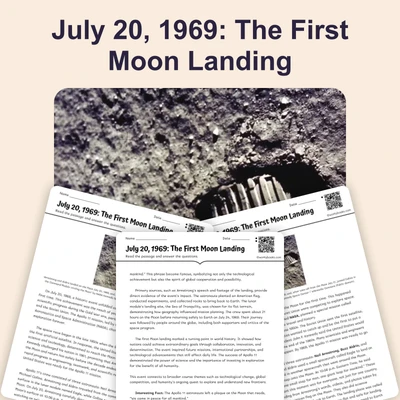
Interesting Fact: The footprints left by Apollo 11 astronauts are still on the Moon today, because there is no wind or water to erase them.
Who was the first person to step on the Moon?
Neil ArmstrongBuzz AldrinMichael CollinsYuri Gagarin
What was the name of Apollo 11's rocket?
Saturn VFalcon 9GeminiAtlas
In what year did Apollo 11 land on the Moon?
1969195719721961
Why did Apollo 11 inspire new generations?
It showed teamwork and innovationIt ended all warsIt was the first satelliteIt brought back animals
What is one effect of Apollo 11 innovations?
Better materials for sports gearInvention of the telephoneBuilding the Great WallDiscovery of America
How did Apollo 11 impact international cooperation?
Led to joint space projectsCreated new countriesStarted the Space RaceBuilt the first car
Apollo 11 footprints are still on the Moon.
TrueFalse
What does 'innovation' mean?
A new idea or inventionA type of rockA famous astronautA space station
Perfect For:
👩🏫 Teachers
• Reading comprehension practice
• Auto-graded assessments
• Literacy skill development
👨👩👧👦 Parents
• Reading practice at home
• Comprehension improvement
• Educational reading time
🏠 Homeschoolers
• Reading curriculum support
• Independent reading practice
• Progress monitoring
Reading Features:
📖
Reading Passage
Engaging fiction or nonfiction text
❓
Comprehension Quiz
Auto-graded questions
📊
Instant Feedback
Immediate results and scoring
📄
Printable Version
Download for offline reading
🔊
Read Aloud
Voice-over with word highlighting
Reviews & Ratings
No reviews yet. Be the first to share your experience!
Related Content
Watching History Unfold: Broadcasting the Moon Landing
This engaging world history reading passage explores how the live television broadcast of the Apollo 11 Moon landing on ...
Black History Month Word Search
RF.4.3RF.5.3L.4.4L.5.4
Events Leading to World War II
This passage explores the complex causes of World War II, focusing on the interwar period, the Treaty of Versailles, the...
Easy Black History Month Word Search
RF.4.3RF.5.3L.4.4L.5.4
Dirty Dog!—Sequence of Events
This short story on how to wash a dog is perfect for teaching event sequencing and following steps! The steps for how to...
RI.3.8
PB Sandwich—Event Sequencing
This worksheet on event sequencing provides a short story that is in the correct chronological order. A jumbled up versi...
RL.3.3RI.3.1RL.3.3
Informational Text —Event Sequencing
This passage is perfect for teaching students how to follow steps in a text. In the passage, two siblings decide to make...
RI.3.3RI.3.8RL.2.5
Mission Control: The Team Behind the Moon Landing
This engaging world history passage focuses on the vital contributions of Mission Control in Houston during the moon lan...
Adam and Eve Word Search: Actions and Events
Word search on Adam and Eve Word Search: Actions and Events! Vocabulary practice aligned to Common Core standards!
L.K.1.CL.1.5L.2.5L.3.5
Spacesuits: Technology for Survival
This history reading passage examines the critical role spacesuits played in the survival of astronauts during space exp...
"We Came in Peace": Plaque Left on the Moon
This world history reading passage explores the historical context and significance of the plaque left by Apollo 11 astr...
Causes of World War I
This comprehensive history reading passage explores the complex causes of World War I, focusing on alliances, nationalis...
The Apollo 11 Crew
This passage delves into the remarkable journey of the Apollo 11 crew—Neil Armstrong, Buzz Aldrin, and Michael Collins—w...
July 20, 1969: The First Moon Landing
This comprehensive history reading passage explores the historic first Moon landing on July 20, 1969, led by Neil Armstr...
Trench Warfare in World War I
This comprehensive history reading passage explores the realities of life in the trenches during World War I, aligned to...
American History Word Search
Word search on American History Word Search! Vocabulary practice aligned to Common Core standards!
L.K.5.AL.1.5.AL.2.5.AL.3.5.A
Word Families: —ight Words
This word families worksheet focuses on -ight words and is designed to help 4th-grade students practice their reading an...
RF.4.4
Medieval Words in English
This engaging history reading passage examines the evolution of the English language during the Middle Ages, focusing on...
Worky World! Capitalize Locations
This capitalization sheet will help students to practice capitalizing geographic locations. Illustrated on the sheet is ...