Watching History Unfold: Broadcasting the Moon Landing
Interactive passage with audio narration, comprehension questions, and printable PDF.
By completing this purchase you agree to our Terms of Use and Privacy Policy. Your subscription renews automatically until you cancel. You can cancel anytime from your account settings. All sales are final and non-refundable. Digital content is available for download in your account immediately upon purchase.
What's included
Watching History Unfold: Broadcasting the Moon Landing preview and details
About this printable Watching History Unfold: Broadcasting the Moon Landing reading passage (Grades 5-8)
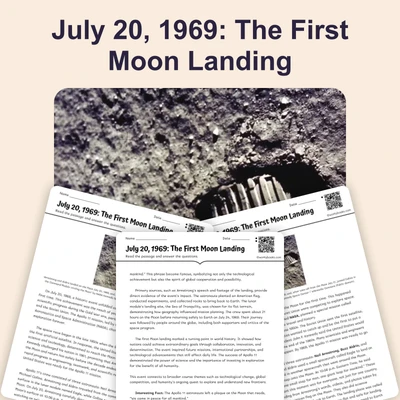
Sample passage and quiz from Watching History Unfold: Broadcasting the Moon Landing
Reading passage and comprehension quiz preview
Watching History Unfold: Broadcasting the Moon Landing

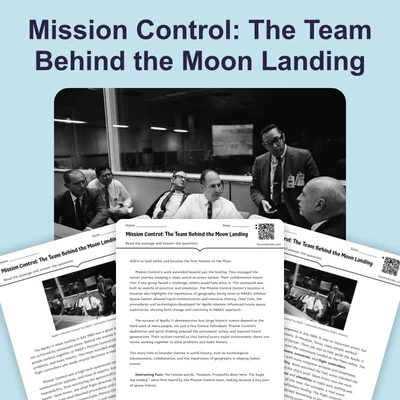
"Apollo 11 mission officials relax after Apollo 11 liftoff" by NASA / Wikimedia Commons (Public domain).
On July 20, 1969, over 600 million people around the world watched as American astronaut Neil Armstrong became the first human to step onto the Moon. This historic event, known as the Apollo 11 Moon landing, was not only a major achievement in science and technology, but also a turning point in the history of broadcasting. For the first time, live television made it possible for people in different countries to share a single moment as it happened. This global broadcast changed how the world experienced important events and brought people together in a new way.
The success of the Moon landing broadcast depended on several innovations in technology. NASA worked with television networks and international partners to transmit live images from the Moon to Earth. Special cameras, called slow-scan television cameras, were designed to work in the harsh conditions on the lunar surface. The video signal was first sent from the Moon to tracking stations in Australia and California. From there, it was relayed by satellites across the globe. Engineers had to overcome challenges such as signal delay, interference, and the need to convert the images into a format that televisions could display. Primary source documents, such as NASA mission reports and news archives, show how these technical problems were solved in real time.
Broadcasting the Moon landing was a worldwide effort that involved cooperation between countries and organizations. In Australia, the Parkes Radio Telescope and the Honeysuckle Creek tracking station played crucial roles in receiving the first images from the Moon. The BBC in the United Kingdom, along with networks in Japan, France, and the Soviet Union, coordinated with American broadcasters to share the live feed. This was a significant change from earlier events, when news often took hours or days to travel across continents. The Moon landing became one of the first truly global media events, as people from different nations watched and reacted together. Newspapers and personal diaries from 1969 describe how families gathered around their televisions, regardless of time zone, to witness history unfolding before their eyes.
The impact of the broadcast went beyond technology. For many, seeing the Moon landing live created a powerful sense of connection and possibility. It inspired new dreams in science, exploration, and communication. Over time, the event influenced how the media covers major stories, setting a standard for live reporting and international cooperation. The Moon landing broadcast also showed how technology could shape public opinion and unite people in moments of achievement or crisis. Today, historians view the event as an example of how innovation and global communication can change societies.
By bringing the world together for a single moment, the live broadcast of the 1969 Moon landing connected people across geographic, political, and social boundaries. It marked a turning point in both media history and human imagination, showing how technological progress can create shared experiences that shape our understanding of the world.
Interesting Fact: The words "That's one small step for man, one giant leap for mankind," spoken by Neil Armstrong, were heard live by millions and are still remembered around the world today.
Comprehension quiz (8 questions)
1. When did the Apollo 11 Moon landing occur?
2. Who was the first person to walk on the Moon?
3. How many people watched the Moon landing live?
4. Why was the Moon landing broadcast important?
5. How did satellites help the broadcast?
6. What impact did the broadcast have on society?
7. The Moon landing was broadcast live. True or false?
8. What does 'innovation' mean in the passage?
Perfect for the way you teach
- Build comprehension skills
- Auto-graded quiz
- Differentiated reading
- Read together at home
- Improve fluency
- Quiet reading time
- Reading curriculum support
- Independent practice
- Track Lexile growth