Events Leading to World War II
Interactive passage with audio narration, comprehension questions, and printable PDF.
By completing this purchase you agree to our Terms of Use and Privacy Policy. Your subscription renews automatically until you cancel. You can cancel anytime from your account settings. All sales are final and non-refundable. Digital content is available for download in your account immediately upon purchase.
What's included
Events Leading to World War II preview and details
About this printable Events Leading to World War II reading passage (Grades 5-8)
Sample passage and quiz from Events Leading to World War II
Reading passage and comprehension quiz preview
The Causes of World War II
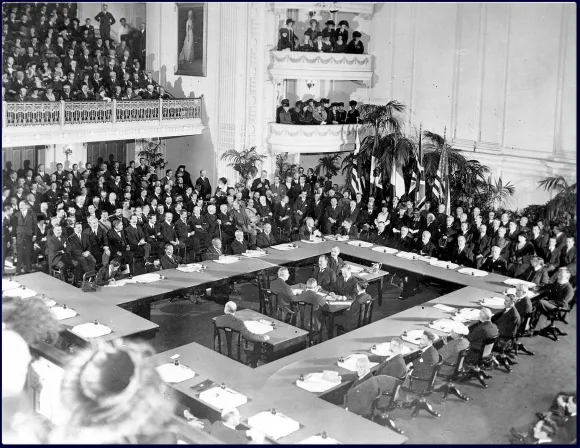
"Treaty of Versailles" by http://iconicphotos.files.wordpress.com/2009/04/c-000242.jpg / Wikimedia Commons (Public domain).
World War II began in September 1939, but its causes can be traced to events and decisions made much earlier in the twentieth century. The conflict involved many nations and resulted in immense destruction, but understanding why it started helps explain the world we live in today. Several major factors contributed to the outbreak of this global war.
One key factor was the Treaty of Versailles, signed in 1919 at the end of World War I. This treaty placed heavy reparations—payments for war damages—on Germany and took away its territories. Many Germans felt that the treaty was too harsh and unfair. According to the treaty's Article 231, also known as the “war guilt clause,” Germany was forced to accept full responsibility for starting World War I. This created deep resentment among the German people and weakened their economy. In the years that followed, high unemployment and poverty fueled anger and a desire for change.
The rise of totalitarian leaders was another crucial cause. In Germany, Adolf Hitler and the Nazi Party promised to restore Germany’s power and pride. Hitler’s speeches, which were widely published and broadcast, blamed Jews, communists, and the Treaty of Versailles for Germany’s problems. Primary sources, such as Hitler’s 1938 speech in Berlin, show how he used propaganda to build support. Similar dictatorships rose in Italy under Benito Mussolini and in Japan under military leaders. These governments rejected democracy and used violence and fear to control their people.
Another cause was the policy of appeasement by Britain and France. In the 1930s, these countries allowed Germany to break several rules of the Treaty of Versailles, hoping to avoid another war. For example, in 1936, Hitler sent troops into the Rhineland, a region that was supposed to remain demilitarized. Britain and France did not stop him. In 1938, Hitler demanded and received the Sudetenland, part of Czechoslovakia, after the Munich Agreement. A famous photograph shows British Prime Minister Neville Chamberlain shaking hands with Hitler. Many historians believe appeasement encouraged further aggression.
Geography also played a role. Germany’s central location in Europe allowed it to quickly invade neighboring countries. Additionally, the failure of the League of Nations, an international organization meant to keep peace, meant there was no strong force to stop aggressive nations. When Germany invaded Poland on September 1, 1939, Britain and France finally declared war, marking the start of World War II.
Understanding the causes of World War II is important because it shows how political decisions, economic conditions, and international relations can lead to conflict. By learning about these causes, students can connect the past to present-day issues of war and peace.
This unit will help you explore how the lessons of the 1930s relate to other themes in world history, such as the impact of leadership and the importance of international cooperation.
Interesting Fact: In 1938, British newspapers celebrated the Munich Agreement as bringing “peace for our time,” but this peace lasted less than a year before war began.
Comprehension quiz (8 questions)
1. When did World War II begin?
2. Who became leader of Germany in 1933?
3. What was the Treaty of Versailles?
4. Why did appeasement encourage Hitler?
5. How did geography help Germany?
6. What happened after Germany invaded Poland?
7. Appeasement is giving in to avoid conflict.
8. What is a dictatorship?
Perfect for the way you teach
- Build comprehension skills
- Auto-graded quiz
- Differentiated reading
- Read together at home
- Improve fluency
- Quiet reading time
- Reading curriculum support
- Independent practice
- Track Lexile growth