"We Came in Peace": Plaque Left on the Moon — Reading Comprehension
Rate this
Premium Resource
Present
Present in classroom. No work saved
Assign
Classroom with student accounts, Track progress
Quick Play
No student accounts, assign with a link
Grades
5
6
7
8
PRINT+DIGITAL RESOURCE
This learning resource is available in interactive and printable formats. The interactive worksheet can be played online and assigned to students. The Printable PDF version can be downloaded and printed for completion by hand.
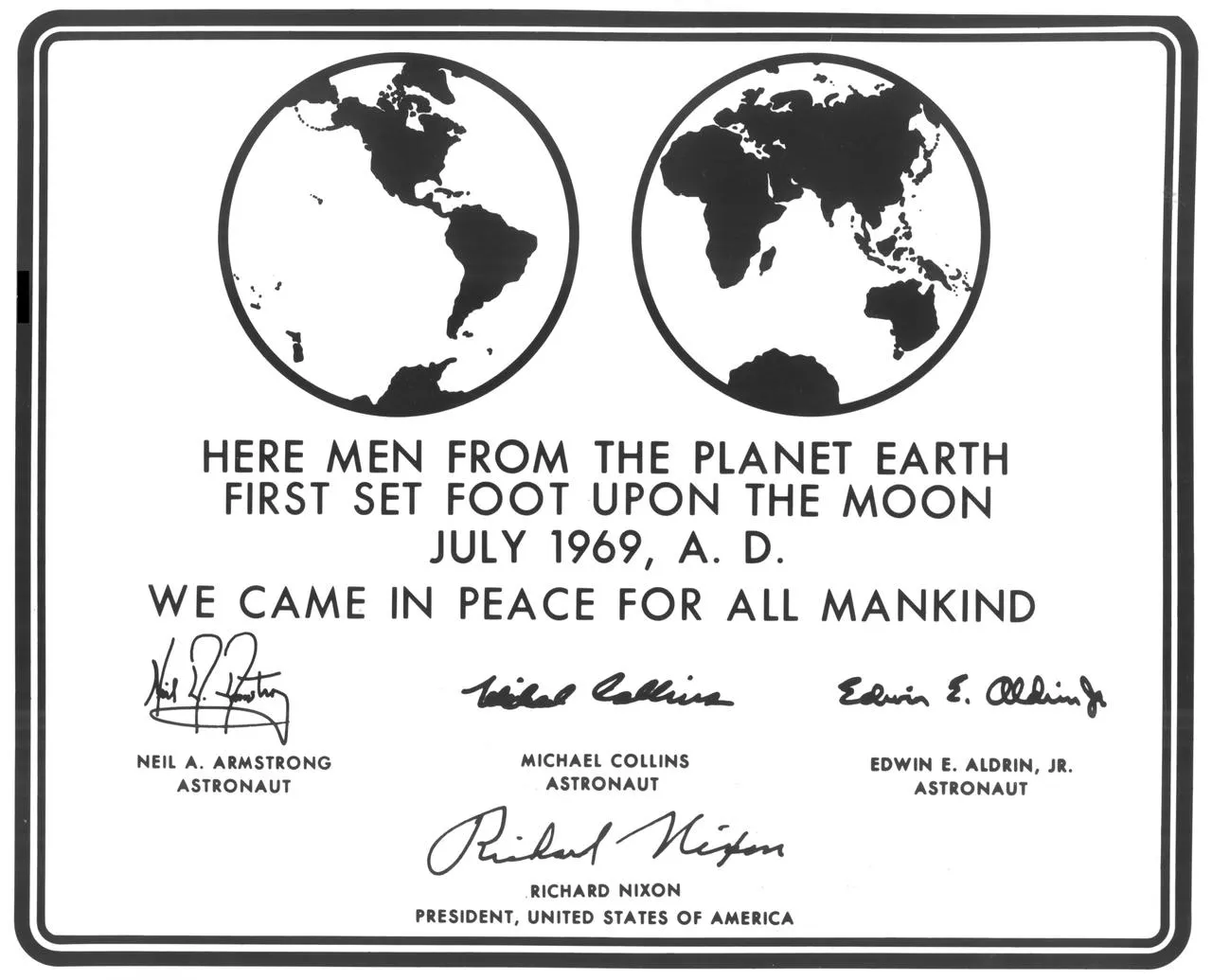
This world history reading passage explores the historical context and significance of the plaque left by Apollo 11 astronauts on the Moon in 1969. Students will learn how the plaque, reading 'We came in peace for all mankind,' and other objects like the American flag and mission badges, were intended to symbolize peaceful exploration and human achievement. The passage connects the event to broader themes of scientific progress, international cooperation, and symbolism in world history. The lesson includes a glossary of key terms, a Spanish translation, differentiated reading support, comprehension and writing activities, and graphic organizers. Activities encourage students to analyze cause and effect, cite evidence, and consider the broader impact on global history. This passage and its activities align with history and ELA standards HSS 7.11 and CCSS RI.6-8. Read aloud audio and Spanish translation support are provided.
CONTENT PREVIEW
Expand content preview
"Saturn Apollo Program" / NASA (Public domain).
On July 20, 1969, Apollo 11 astronauts Neil Armstrong and Buzz Aldrin became the first humans to walk on the Moon. As part of their historic mission, they placed a metal plaque on the lunar surface. This plaque carried a powerful message: "We came in peace for all mankind." Along with the plaque, the astronauts left behind an American flag and several items representing the hopes and achievements of humanity.
The Apollo 11 mission was the result of years of effort by thousands of people working for NASA, the United States space agency. The mission launched from Kennedy Space Center in Florida on July 16, 1969, and landed in the Sea of Tranquility, a flat region on the Moon. The plaque, which was attached to the lunar module's leg, included the signatures of Armstrong, Aldrin, Michael Collins, and U.S. President Richard Nixon. The words on the plaque were carefully chosen to express that the Moon landing was a mission for all people, not just Americans. Official NASA documents show that this message was discussed by scientists, engineers, and politicians before the mission.
The objects left on the Moon have deep symbolic meaning. The American flag represents the technological achievement of the United States, while the plaque emphasizes international cooperation and peaceful intentions. In addition to the plaque and flag, Apollo 11 left other items, such as a silicon disk with greetings from 73 world leaders, mission badges, and a memorial for fallen astronauts and cosmonauts. These artifacts serve as a kind of time capsule, showing future visitors the values and goals of the time. Archaeological evidence from later missions confirms the plaque and flag remain on the Moon, though the flag may have faded or fallen.
The decision to leave peaceful messages reflects the context of the Cold War, when the United States and the Soviet Union competed in the space race. Despite political rivalry, the plaque’s message reached beyond national pride. It was meant to inspire unity and hope for peaceful exploration. The act of leaving these symbols marked a change from exploration for conquest to exploration for knowledge and cooperation. Over time, the Moon landing has become a symbol of human achievement and international goodwill.
The legacy of the Apollo 11 plaque continues to influence space missions and international treaties today. It reminds us that exploration can unite people across borders and cultures. The plaque’s message connects to broader themes in world history, such as the power of symbols, the importance of peaceful intentions, and the potential for science to bring people together.
Interesting Fact: The plaque also shows a map of Earth’s continents, symbolizing the unity of all people on our planet.
Who were the first people to walk on the Moon?
Neil Armstrong and Buzz AldrinMichael Collins and Buzz AldrinRichard Nixon and Neil ArmstrongJohn Glenn and Michael Collins
What message was written on the plaque?
"We came in peace for all mankind""Victory for America""To the Moon and back""Apollo 11: Our Mission"
Where did Apollo 11 land on the Moon?
Sea of TranquilityMare ImbriumOcean of StormsTycho Crater
Why was the plaque left on the Moon?
To show peace and unityTo claim land for the USATo test new materialsTo mark a secret base
What does the American flag represent on the Moon?
U.S. technological achievementClaiming landInternational lawA time capsule
How did the plaque's message reflect Cold War tensions?
It focused on peace, not rivalryIt challenged the Soviet UnionIt demanded territoryIt showed military strength
The plaque is still on the Moon. True or false?
TrueFalse
What does "symbolic" mean in the passage?
Representing ideas or feelingsA type of metalA space agencyA Moon crater
Perfect For:
👩🏫 Teachers
• Reading comprehension practice
• Auto-graded assessments
• Literacy skill development
👨👩👧👦 Parents
• Reading practice at home
• Comprehension improvement
• Educational reading time
🏠 Homeschoolers
• Reading curriculum support
• Independent reading practice
• Progress monitoring
Reading Features:
📖
Reading Passage
Engaging fiction or nonfiction text
❓
Comprehension Quiz
Auto-graded questions
📊
Instant Feedback
Immediate results and scoring
📄
Printable Version
Download for offline reading
🔊
Read Aloud
Voice-over with word highlighting
Reviews & Ratings
No reviews yet. Be the first to share your experience!
Related Content
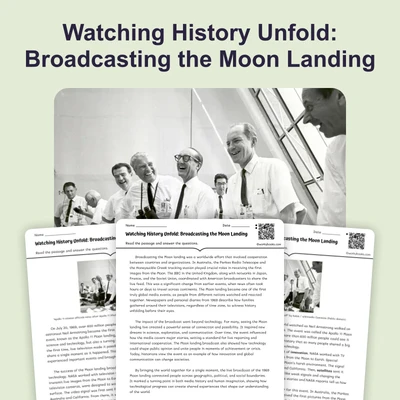
Watching History Unfold: Broadcasting the Moon Landing
This engaging world history reading passage explores how the live television broadcast of the Apollo 11 Moon landing on ...
Black History Month Word Search
RF.4.3RF.5.3L.4.4L.5.4
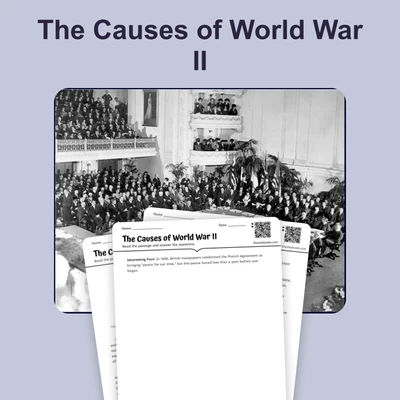
Events Leading to World War II
This passage explores the complex causes of World War II, focusing on the interwar period, the Treaty of Versailles, the...
Easy Black History Month Word Search
RF.4.3RF.5.3L.4.4L.5.4
Dirty Dog!—Sequence of Events
This short story on how to wash a dog is perfect for teaching event sequencing and following steps! The steps for how to...
RI.3.8
PB Sandwich—Event Sequencing
This worksheet on event sequencing provides a short story that is in the correct chronological order. A jumbled up versi...
RL.3.3RI.3.1RL.3.3
Informational Text —Event Sequencing
This passage is perfect for teaching students how to follow steps in a text. In the passage, two siblings decide to make...
RI.3.3RI.3.8RL.2.5
Mission Control: The Team Behind the Moon Landing
This engaging world history passage focuses on the vital contributions of Mission Control in Houston during the moon lan...
Adam and Eve Word Search: Actions and Events
Word search on Adam and Eve Word Search: Actions and Events! Vocabulary practice aligned to Common Core standards!
L.K.1.CL.1.5L.2.5L.3.5
Spacesuits: Technology for Survival
This history reading passage examines the critical role spacesuits played in the survival of astronauts during space exp...
The Legacy of Apollo 11
This engaging passage explores the historical and technological significance of Apollo 11, the first mission in which hu...
Causes of World War I
This comprehensive history reading passage explores the complex causes of World War I, focusing on alliances, nationalis...
The Apollo 11 Crew
This passage delves into the remarkable journey of the Apollo 11 crew—Neil Armstrong, Buzz Aldrin, and Michael Collins—w...
July 20, 1969: The First Moon Landing
This comprehensive history reading passage explores the historic first Moon landing on July 20, 1969, led by Neil Armstr...
Trench Warfare in World War I
This comprehensive history reading passage explores the realities of life in the trenches during World War I, aligned to...
American History Word Search
Word search on American History Word Search! Vocabulary practice aligned to Common Core standards!
L.K.5.AL.1.5.AL.2.5.AL.3.5.A
Word Families: —ight Words
This word families worksheet focuses on -ight words and is designed to help 4th-grade students practice their reading an...
RF.4.4
Medieval Words in English
This engaging history reading passage examines the evolution of the English language during the Middle Ages, focusing on...
Worky World! Capitalize Locations
This capitalization sheet will help students to practice capitalizing geographic locations. Illustrated on the sheet is ...