This engaging passage tells the story of the First Thanksgiving Celebration, focusing on the Pilgrims and Wampanoag people in Plymouth in 1621. Students learn about the challenges the Pilgrims faced, how the Wampanoag helped them, and how their cooperation led to the famous harvest feast. The passage uses clear language, a chronological sequence, and highlights themes of unity and problem-solving. It integrates key vocabulary for literacy development, includes a Spanish translation, and offers a read aloud audio option. Activities feature a reading comprehension quiz, writing prompts, and a timeline to support understanding. Aligned with the C3 Framework for Social Studies and Common Core ELA standards, this resource supports teachers in building foundational history knowledge while building reading skills.
Written by Workybooks TeamPublished by Workybooks
Preview
Sample passage and quiz content
CONTENT PREVIEW
Expand content preview
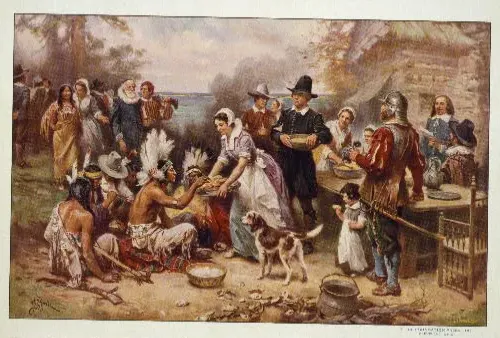
The first Thanksgiving 1621 Source: Library of Congress - Ferris, Jean Leon Gerome, 1863-1930
The First Thanksgiving Celebration took place in the fall of 1621 in Plymouth, a small settlement in New England. The Pilgrims had come to America from England the year before. They wanted religious freedom and a new life. The first winter was very hard. Many Pilgrims became sick, and some died. When spring came, the survivors worked with hope to plant crops and build homes.
The Pilgrims were not alone. The Wampanoag people had lived in the region for thousands of years. A Wampanoag man named Squanto helped the Pilgrims learn how to plant corn, fish, and hunt local animals. With this help, the Pilgrims had a better harvest in their second year.
After the successful harvest, the Pilgrims wanted to give thanks. They invited the Wampanoag, including their leader Massasoit, to join them in a great feast. About 90 Wampanoag people and 50 Pilgrims came together. The celebration lasted for three days.
The First Thanksgiving was not exactly like the holiday we know today. The meal included foods that were available in the area. There was deer, brought by the Wampanoag, and wild birds, but probably no turkey. Corn, beans, squash, seafood, and nuts were also shared. People played games and enjoyed time together, showing respect and friendship.
This celebration was important because it showed cooperation and gratitude. The Pilgrims and Wampanoag worked together to survive. Their shared meal was a symbol of peace and unity. Although there were later challenges, the First Thanksgiving reminds us of the strength found in helping each other.
The story of Thanksgiving became part of American tradition. Today, many people gather with family and friends to share food and give thanks, just as the Pilgrims and Wampanoag did that autumn in Plymouth.
Interesting Fact: The First Thanksgiving lasted for three days and included many outdoor games and activities for everyone.
When did the First Thanksgiving happen?
1621177614921800
Who helped the Pilgrims grow food?
WampanoagFrenchSpanishDutch
Where did the First Thanksgiving take place?
PlymouthJamestownNew YorkBoston
Why was the First Thanksgiving important?
It showed cooperationIt started a warIt was a protestIt was a wedding
What foods were at the First Thanksgiving?
Deer and cornPizza and friesRice and chickenHamburgers
Determine the main idea of a text and explain how it is supported by key details; summarize the text.
RI.4.3
Explain events, procedures, ideas, or concepts in a historical, scientific, or technical text, including what happened and why, based on specific information in the text.
Who it's for
Perfect for the way you teach
Teachers
Build comprehension skills
Auto-graded quiz
Differentiated reading
Parents
Read together at home
Improve fluency
Quiet reading time
Homeschoolers
Reading curriculum support
Independent practice
Track Lexile growth
Topics
First ThanksgivingPilgrimsWampanoaghistory readingC3 FrameworkCommon CorePlymouthfeastharvest
Reviews & Ratings
No reviews yet. Be the first to share your experience!
More reading you might love
19 more
Identify Main Idea Graphic Organizer
This graphic organizer on main idea includes space to write the main idea and three supporting details.
RI.1.2RI.2.2RI.3.2RI.4.2
Main Idea and Suporting Details Graphic Organizer
This graphic organizer on main idea includes space to write the main idea and three supporting details.
RI.1.2RI.2.2RI.3.2RI.4.2
Snorkeling & Scuba Diving
RI.2.2RI.2.6RI.2.10RF.2.4.A
Main Idea and Details Graphic Organizer
This graphic organizer on main idea includes space to write the main idea and three supporting details.
RI.1.2RI.2.2RI.3.2RI.4.2
The Space Needle
Students read a passage about the history and features of Seattle's Space Needle, then answer comprehension questions to...
RI.4.2
The Rubik's Cube
RI.2.2RI.2.6RI.2.10RF.2.4.A
Graphic Organizer for Main Idea
This graphic organizer on main idea includes space to write the main idea and three supporting details.
RI.1.2RI.2.2RI.3.2RI.4.2
Pollination: A Crucial Ecosystem Service
Explore the vital role of pollination beyond plant reproduction, as it sustains ecosystems by ensuring food security, pr...
RI.4.2RI.4.3RI.4.4RI.5.1
The States of Matter: Solid
Discover the differences between solids, liquids and gases by exploring how their particles are arranged and move. This ...
RI.4.2RI.4.3RI.4.4RI.5.1
What is a Simple Machine
Discover the power of simple machines! This informational text explores how basic tools like levers, pulleys and incline...
RI.4.2RI.4.3RI.4.4RI.5.1
How Do Scientists Study Past Climates?
Students will analyze how tools like ice cores and tree rings provide scientific evidence about Earth’s historical clima...
RI.4.1RI.4.2RI.4.3.4.RI.4.74-ESS2-2
The Role of Pollinators in Nature
Learn about the fascinating world of pollinators and discover their crucial role in the reproductive process of flowerin...
RI.4.2RI.4.3RI.4.4RI.5.1
Seed Dispersal: How Plants Travel
Plants may seem stationary, but their seeds have amazing ways to travel! Explore the fascinating world of seed dispersal...
RI.4.2RI.4.3RI.4.4RI.5.1
Earth Day and Types of Pollution
Earth Day is coming! Get ready to learn about pollution and test your knowledge. Click for a free reading passage and qu...
RI.4.1RI.4.2ESS3.CESS3.A
Earth Day and Green Initiatives
Celebrate Earth Day with this fun and educational activity! Students will begin by reading a short passage that explains...
RI.4.1RI.4.2ESS3.CESS3.A
Exploring Space: Rockets and Spacecraft
Space exploration has been one of humanity's greatest achievements, made possible by rockets and spacecraft. Rockets act...
RI.4.4RI.4.2
The Water Cycle
The water cycle describes how water continuously moves through our planet via evaporation, condensation, precipitation, ...
RI.4.4RI.4.2
The Nitrogen Cycle
The nitrogen cycle describes how nitrogen moves through the air, soil, and living organisms. It involves processes like ...
RI.4.4RI.4.2
The Life Cycle of a Frog
The frog's life cycle takes it from water to land in amazing stages. Starting as eggs, they hatch into tadpoles, grow le...