The Liberty Bell Rings for Freedom — Reading Comprehension
Rate this
Premium Resource
Present
Present in classroom. No work saved
Assign
Classroom with student accounts, Track progress
Quick Play
No student accounts, assign with a link
Grades
3
4
5
Standards
D2.HIS.1-3.3-5
RI.4.1
RI.4.4
RI.4.5
PRINT+DIGITAL RESOURCE
This learning resource is available in interactive and printable formats. The interactive worksheet can be played online and assigned to students. The Printable PDF version can be downloaded and printed for completion by hand.
This engaging history reading passage, 'The Liberty Bell Rings for Freedom,' introduces students to the story and significance of the Liberty Bell during the founding of the United States. Aligned with the C3 Framework and Common Core standards, this resource covers the bell’s origins, its role during the Declaration of Independence, and its enduring symbol of liberty. Students will learn about key events, figures, and vocabulary while developing literacy skills. The passage features a clear chronological narrative, a glossary, and is enhanced with a timeline, Spanish translation, and read aloud audio support. Activities include comprehension quizzes and writing prompts designed to deepen understanding, promote analysis, and connect history to present-day ideas of freedom and unity. This passage is ideal for building foundational knowledge about American symbols and the Revolutionary era.
CONTENT PREVIEW
Expand content preview
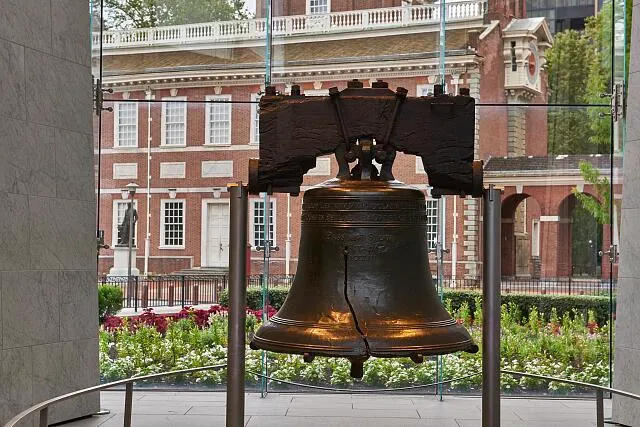
The Liberty Bell at Independence National Historical Park, Library of Congress
The Liberty Bell stands in Philadelphia, Pennsylvania and is one of the most famous symbols of American independence. The bell was made in 1752 for the Pennsylvania State House, which is now called Independence Hall.
The bell was ordered from a foundry in England. When it arrived in Philadelphia, people found a crack in it. Local metalworkers tried to fix the bell by melting and recasting it. After it was fixed, the bell rang to call lawmakers to meetings and to alert citizens to important news. The bell's loud sound could be heard all over the city.
On July 8, 1776, the Liberty Bell rang to celebrate the first public reading of the Declaration of Independence. This was a very important moment. The bell called people together and announced that the colonies were now free from British rule.
Over time, the Liberty Bell was used for many events. It rang to mark the end of the Revolutionary War and to celebrate the signing of the Constitution. People saw it as a sign of freedom and unity. But the bell cracked again in the early 1800s. Each time it was rung, the crack grew bigger. In 1846, the bell was rung for George Washington's birthday, but the crack became so large that the bell could not ring anymore.
Even though it cannot ring, the Liberty Bell became a powerful symbol for many Americans. In the 1800s, people fighting to end slavery used the image of the cracked bell as a sign of hope and freedom. The words "Proclaim LIBERTY Throughout All the Land" are written on the bell. These words come from the Bible and remind people of the promise of freedom.
Today, millions of people visit the Liberty Bell each year. They come to learn about the history of the United States and to remember the struggles and dreams of early Americans. The bell is a reminder that freedom is important and that even something broken can have great meaning.
Interesting Fact: The Liberty Bell weighs about 2,080 pounds and is made mostly of copper and tin.
Where is the Liberty Bell?
PhiladelphiaBostonNew YorkWashington, D.C.
What year was the Liberty Bell made?
1752177618461800
Why did the Liberty Bell stop ringing?
It was stolenIt crackedIt meltedIt was lost
What did the Liberty Bell symbolize?
FreedomMoneyWarFood
Who used the bell as a symbol to end slavery?
AbolitionistsFarmersSoldiersTeachers
Why was the bell rung on July 8, 1776?
To announce freedomTo warn of fireTo celebrate a birthdayTo end a war
The Liberty Bell is made of gold. True or false?
TrueFalse
What does 'recast' mean in the passage?
To melt and remakeTo ring loudlyTo polish metalTo break apart
Perfect For:
👩🏫 Teachers
• Reading comprehension practice
• Auto-graded assessments
• Literacy skill development
👨👩👧👦 Parents
• Reading practice at home
• Comprehension improvement
• Educational reading time
🏠 Homeschoolers
• Reading curriculum support
• Independent reading practice
• Progress monitoring
Reading Features:
📖
Reading Passage
Engaging fiction or nonfiction text
❓
Comprehension Quiz
Auto-graded questions
📊
Instant Feedback
Immediate results and scoring
📄
Printable Version
Download for offline reading
🔊
Read Aloud
Voice-over with word highlighting
Reviews & Ratings
No reviews yet. Be the first to share your experience!
Related Content
Pueblos: Desert Homes of the Southwest
This engaging U.S. history reading passage explores the Pueblos, the unique desert homes of the Southwest. Students will...
D2.HIS.1-3.3-5RI.4.1RI.4.2RI.4.4
The Shot Heard Round the World
This engaging history reading passage explores the story of the Shot Heard Round the World, a key event that started the...
D2.HIS.1-3.3-5RI.4.1RI.4.3RI.4.4
Creating the American Flag
This engaging reading passage explores the creation of the American flag, highlighting its importance as a national symb...
D2.HIS.1-3.3-5RI.4.3RI.4.4W.4.2
Building Washington D.C., Our Capital
This history reading passage explores the building of Washington D.C., the capital of the United States. Students will l...
D2.HIS.1-3.3-5D2.HIS.14.3-5RI.4.3RI.4.4
The Battle of Gettysburg and Lincoln's Address
This engaging U.S. History reading passage explores the Battle of Gettysburg and Abraham Lincoln's famous Gettysburg Add...
D2.HIS.1-3.3-5RI.4.3RI.4.4W.4.2
Pearl Harbor: America Enters the War
This engaging reading passage introduces students to the historic event of Pearl Harbor and America’s entry into World W...
D2.HIS.1-3.3-5RI.4.3RI.5.2
The Internet Connects the World
This reading passage explores the fascinating story of how the Internet connects people across the globe and changed the...
D2.HIS.1-3.3-5RI.4.1RI.4.3RI.4.4
Snorkeling & Scuba Diving
RI.2.2RI.2.6RI.2.10RF.2.4.A
Polar Bears and Climate
This informational text on polar bears is a great way to practice reading comprehension. Students will read the passage ...
RI.4.1W.4.72-LS4-1RF.4.4
Climate and Water Cycle
W.4.2.ARI.4.4RI.4.1
Earthquakes and Infrastructure
Get this worksheet about the effects of earthquakes on infrastructure. The worksheet includes an informational passage t...
W.4.7RI.4.1ESS3B
The Rubik's Cube
RI.2.2RI.2.6RI.2.10RF.2.4.A
Understanding Climate Action Context Clues
Understanding Climate Action" worksheet, aligned with CCS L.4.4.A and NGSS. This resource introduces key concepts such a...
L.4.4.ARI.4.1RI.4.4
Earthquake and buildings
Download this worksheet on the impact of earthquakes on buildings. The informational text included in this worksheet is ...
RI.4.1ESS3BW.4.7RF.4.4
How Do Scientists Study Past Climates?
Students will analyze how tools like ice cores and tree rings provide scientific evidence about Earth’s historical clima...
RI.4.1RI.4.2RI.4.3.4.RI.4.74-ESS2-2
Earth Day and Types of Pollution
Earth Day is coming! Get ready to learn about pollution and test your knowledge. Click for a free reading passage and qu...
RI.4.1RI.4.2ESS3.CESS3.A
Earth Day and Green Initiatives
Celebrate Earth Day with this fun and educational activity! Students will begin by reading a short passage that explains...
RI.4.1RI.4.2ESS3.CESS3.A
Sunspots and Solar Flares
This quiz is designed to test your understanding of the fascinating phenomena of sunspots and solar flares, as described...
RI.4.1RI.4.4RI.5.1ESS1.A
How might climate change affect animals?
This passage explains to children how climate change impacts animal life. It uses specific examples like polar bears los...