This engaging reading passage explores the creation of the American flag, highlighting its importance as a national symbol during the fight for independence. Students will learn about Betsy Ross, the flag’s early designs, and the reasons for its red, white, and blue colors. The story follows the timeline of the flag’s creation and its adoption by the Continental Congress. Key vocabulary words are included to support literacy, and the passage is written in clear, accessible language. Activities include a reading comprehension quiz, writing prompts, and a timeline to help students understand the flag’s significance and the events surrounding its creation. The passage is aligned with the C3 Framework and Common Core standards, making it a valuable resource for classrooms. Audio read-aloud and a full Spanish translation are available, supporting diverse learners and bilingual classrooms. This resource helps students connect the past with the present while strengthening their reading and history skills.
Written by Workybooks TeamPublished by Workybooks
Preview
Sample passage and quiz content
CONTENT PREVIEW
Expand content preview
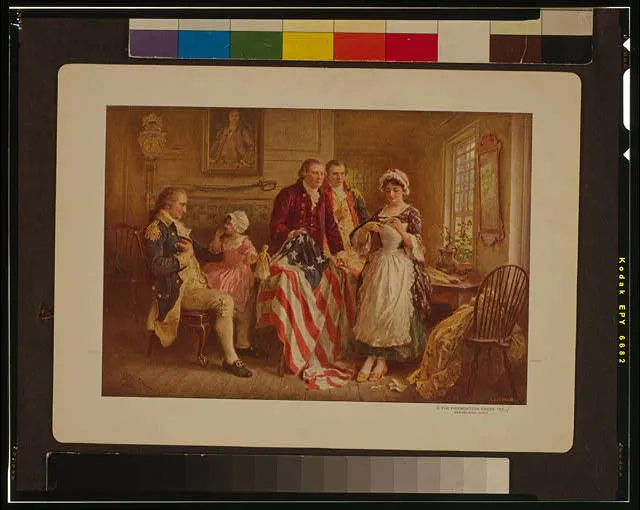
Betsy Ross, 1777 Source: Library of Congress - Ferris, Jean Leon Gerome
The American flag was created as a powerful symbol for the new United States. In 1776, after the colonies declared independence from Great Britain, leaders wanted a flag that would show their unity. The flag would help people feel proud and remind them that they were now one nation.
In June 1777, the Continental Congress made an important decision. They passed a law that described the first official flag. This flag had thirteen stripes, red and white, to represent the original thirteen colonies. In the corner, it had a blue field with thirteen white stars. Each star stood for one colony. The flag was meant to bring people together and show their hope for the future.
Betsy Ross is a famous name connected to the flag. She was a skilled seamstress in Philadelphia. Some stories say she sewed the first flag after meeting with George Washington and other leaders. While we do not know every detail, Betsy Ross is remembered as an important part of the flag’s history.
As the United States grew, more states joined the nation. Each time a new state joined, a star was added to the flag. Today, the flag has fifty stars for fifty states, but it still has thirteen stripes for the original colonies. The flag is sometimes called the "Stars and Stripes." It is used in many important events, such as parades and celebrations, and is flown at government buildings and schools.
The American flag is more than just cloth. It stands for the country’s ideals of freedom, bravery, and unity. When people see the flag, they often feel patriotism, which means pride in their country. The flag reminds Americans of the struggles and hopes of the people who built the nation.
Over time, the flag has changed as the country has grown. But it still stands for unity and the promise of freedom for all. The story of the American flag helps remind us of the values that helped shape the United States.
Interesting Fact: The American flag is sometimes called "Old Glory." This nickname was first used by a ship captain named William Driver in 1831.
The first coloniesThe first presidentsEvery stateImportant battles
What happens when a new state joins?
A new star is addedA new stripe is addedA new color is addedA new leader is chosen
Why did leaders want a flag?
Show unityStart a warWin a gameMake a new law
What does the flag stand for?
Freedom and unityOnly one stateA famous shipMoney
The flag is called 'Stars and Stripes.' True or false?
TrueFalse
What is 'patriotism'?
Pride in your countrySewing flagsStarting a colonyMaking laws
Curriculum
Common Core standards covered
RI.4.3
Explain events, procedures, ideas, or concepts in a historical, scientific, or technical text, including what happened and why, based on specific information in the text.
RI.4.4
Determine the meaning of general academic and domain-specific words or phrases in a text relevant to a grade 4 topic or subject area.
W.4.2
Write informative/explanatory texts to examine a topic and convey ideas and information clearly.
Who it's for
Perfect for the way you teach
Teachers
Build comprehension skills
Auto-graded quiz
Differentiated reading
Parents
Read together at home
Improve fluency
Quiet reading time
Homeschoolers
Reading curriculum support
Independent practice
Track Lexile growth
Topics
American flagBetsy RossU.S. historyRevolutionnational symbolsC3 FrameworkCommon Corereading passage
Reviews & Ratings
No reviews yet. Be the first to share your experience!
More reading you might love
19 more
Pueblos: Desert Homes of the Southwest
This engaging U.S. history reading passage explores the Pueblos, the unique desert homes of the Southwest. Students will...
D2.HIS.1-3.3-5RI.4.1RI.4.2RI.4.4
The Shot Heard Round the World
This engaging history reading passage explores the story of the Shot Heard Round the World, a key event that started the...
D2.HIS.1-3.3-5RI.4.1RI.4.3RI.4.4
The Liberty Bell Rings for Freedom
This engaging history reading passage, 'The Liberty Bell Rings for Freedom,' introduces students to the story and signif...
D2.HIS.1-3.3-5RI.4.1RI.4.4RI.4.5
Building Washington D.C., Our Capital
This history reading passage explores the building of Washington D.C., the capital of the United States. Students will l...
D2.HIS.1-3.3-5D2.HIS.14.3-5RI.4.3RI.4.4
The Battle of Gettysburg and Lincoln's Address
This engaging U.S. History reading passage explores the Battle of Gettysburg and Abraham Lincoln's famous Gettysburg Add...
D2.HIS.1-3.3-5RI.4.3RI.4.4W.4.2
Pearl Harbor: America Enters the War
This engaging reading passage introduces students to the historic event of Pearl Harbor and America’s entry into World W...
D2.HIS.1-3.3-5RI.4.3RI.5.2
Informational Text —Healthy Teeth and Gums
RI.4.10RI.4.3RF.4.4RF.4.4.A
Informational Text —Migratory Birds
Engage young minds with this worksheet that delves into the wonders of migratory birds. Learn about their extraordinary ...
RI.4.10RI.4.3RF.4.4RF.4.4.A
Informational Text —All About Dentists
Students read an informational text explaining what dentists do and how they are trained. Aligned to RI.4.3-2
RI.4.10RI.4.3RF.4.4RF.4.4.A
The Role of Pollinators in Nature
Learn about the fascinating world of pollinators and discover their crucial role in the reproductive process of flowerin...
RI.4.2RI.4.3RI.4.4RI.5.1
Pollination: A Crucial Ecosystem Service
Explore the vital role of pollination beyond plant reproduction, as it sustains ecosystems by ensuring food security, pr...
RI.4.2RI.4.3RI.4.4RI.5.1
Seed Dispersal: How Plants Travel
Plants may seem stationary, but their seeds have amazing ways to travel! Explore the fascinating world of seed dispersal...
RI.4.2RI.4.3RI.4.4RI.5.1
The States of Matter: Solid
Discover the differences between solids, liquids and gases by exploring how their particles are arranged and move. This ...
RI.4.2RI.4.3RI.4.4RI.5.1
What is a Simple Machine
Discover the power of simple machines! This informational text explores how basic tools like levers, pulleys and incline...
RI.4.2RI.4.3RI.4.4RI.5.1
Bats in the Night
This informative first-grade reading passage delves into the intriguing world of bats, highlighting their nocturnal natu...
RI.3.1RI.4.4RI.4.3
What is Milky Way
This engaging passage introduces Grade 4-5 students to the Milky Way, our home galaxy. Students will learn that the Milk...
5-ESS1-15-ESS1-2RI.3.1RI.3.4
Andromeda Galaxy
This engaging science passage introduces Grade 4-5 students to the Andromeda Galaxy, our closest large galactic neighbor...
5-ESS1-15-ESS1-2RI.3.1RI.3.4
Malala Yousafzai
This Grade 4-5 science reading passage introduces students to Malala Yousafzai, a courageous young woman from Pakistan w...
NGSSRI.3.1RI.3.2RI.4.3
Understanding Biological Evolution and Diversity
This passage addresses the NGSS standard 3-LS4-2 focusing on biological evolution and the unity and diversity of life. T...