Pearl Harbor: America Enters the War — Reading Comprehension
Rate this
Premium Resource
Present
Present in classroom. No work saved
Assign
Classroom with student accounts, Track progress
Quick Play
No student accounts, assign with a link
Grades
3
4
5
Standards
D2.HIS.1-3.3-5
RI.4.3
RI.5.2
PRINT+DIGITAL RESOURCE
This learning resource is available in interactive and printable formats. The interactive worksheet can be played online and assigned to students. The Printable PDF version can be downloaded and printed for completion by hand.
This engaging reading passage introduces students to the historic event of Pearl Harbor and America’s entry into World War II. Aligned with the C3 Framework and Common Core ELA standards, the text uses clear, simple language and a chronological structure to help young learners understand the sequence of events, key figures, and the cause-and-effect relationship that led to the United States joining the war. The passage highlights themes of bravery, unity, and national problem-solving. Included are a glossary of key vocabulary words, a timeline of major events, and multiple activities: a comprehension quiz, writing prompts that encourage critical thinking and personal connections, and a full Spanish translation. With an authentic historical image and read aloud audio, this resource is perfect for building foundational literacy and history knowledge.
CONTENT PREVIEW
Expand content preview
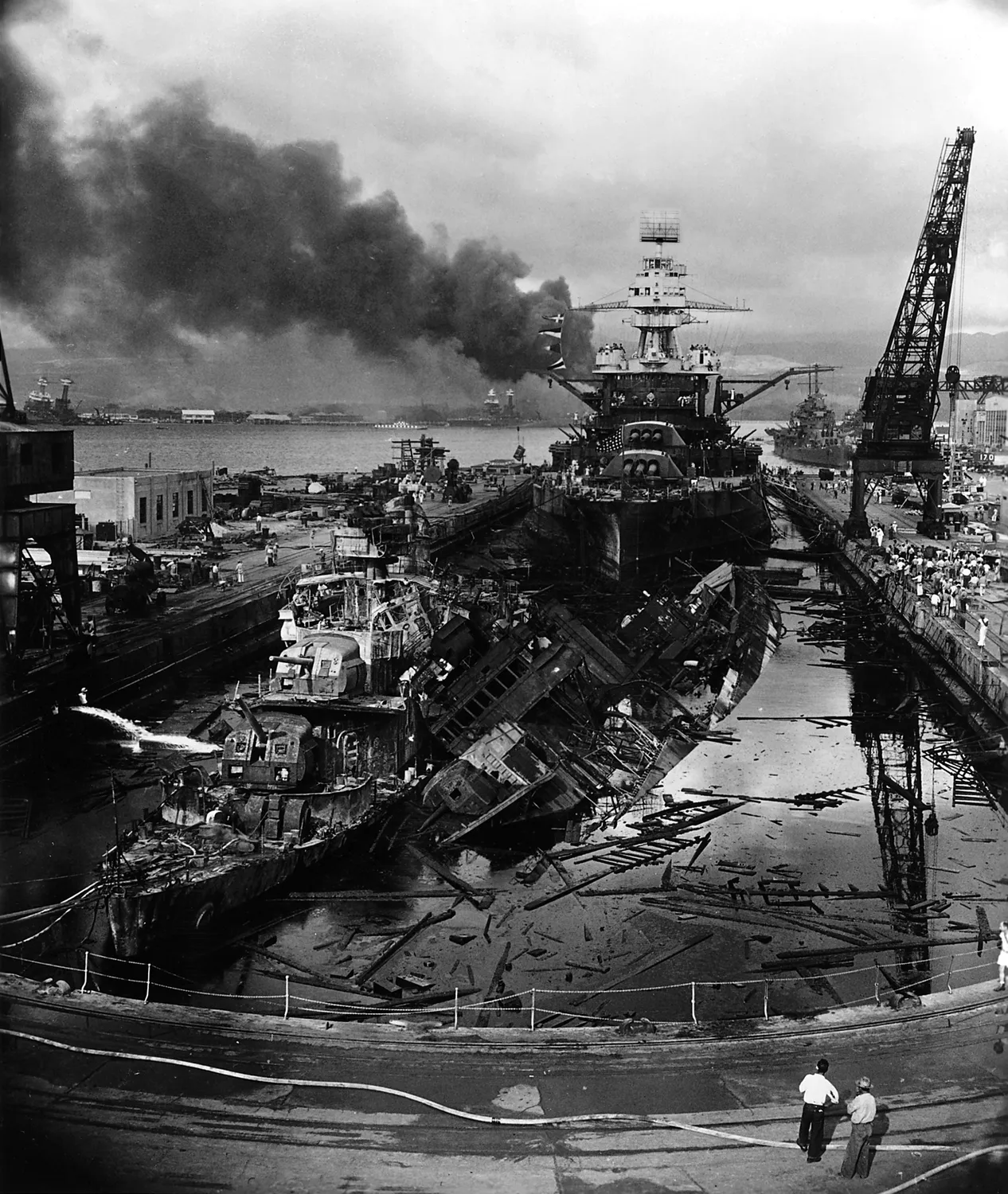
USS Downes (DD-375), USS Cassin (DD-372) and USS Pennsylvania (BB-38) in Dry Dock No. 1 at the Pearl Harbor Naval Shipyard, 7 December 1941 (306533).jpg Source: Wikimedia Commons - Photographer's Mate Harold Fawcett, U.S. Navy (photo 80-G-19943)
On December 7, 1941, the United States was attacked at Pearl Harbor, a U.S. Navy base in Hawaii. Early that morning, Japanese planes suddenly appeared in the sky. Without warning, they dropped bombs and fired torpedoes at ships and airplanes on the ground. The attack shocked everyone at the base.
Many of the U.S. Navy’s battleships and airplanes were destroyed. Over 2,400 Americans were killed, and many more were wounded. The attack lasted only about two hours, but its effects were huge. The surprise attack was carefully planned by Japan. Their leaders wanted to weaken the U.S. Navy so that Japan could expand its power in the Pacific Ocean.
President Franklin D. Roosevelt spoke to the nation the next day. He called December 7, 1941, "a date which will live in infamy." This means it would be remembered for something very bad. People all across America were shocked and saddened by the news. Many felt scared, but most became determined to help their country.
After the attack, the United States declared war on Japan. This meant America entered World War II. Soon, other countries joined the fight, and the war spread around the world. The attack on Pearl Harbor caused Americans to come together. People from many backgrounds worked in factories, joined the military, and helped each other. The country showed great unity and bravery.
During the war, Americans solved problems and faced new challenges. They built new ships and airplanes quickly. Women worked in jobs that were once only for men. The nation’s hard work helped to win the war. Pearl Harbor changed history by bringing America into World War II and showing how people can work together in hard times.
Interesting Fact: After the attack, people across America held blood drives and collected supplies to help the wounded in Hawaii.
When did Pearl Harbor get attacked?
December 7, 1941July 4, 1776November 11, 1918June 6, 1944
Who attacked Pearl Harbor?
GermanyJapanItalyFrance
Where is Pearl Harbor located?
CaliforniaHawaiiFloridaTexas
Why did Japan attack Pearl Harbor?
To weaken U.S. NavyFor goldTo help AmericaBy mistake
What did President Roosevelt call December 7, 1941?
A day of peaceA day of happinessA date which will live in infamyA day for celebration
What happened after the attack?
America declared war on JapanJapan surrenderedThe war endedNothing changed
The attack lasted about two hours. True or false?
TrueFalse
What does 'bravery' mean?
Having courageBeing angryRunning awayBeing famous
Perfect For:
👩🏫 Teachers
• Reading comprehension practice
• Auto-graded assessments
• Literacy skill development
👨👩👧👦 Parents
• Reading practice at home
• Comprehension improvement
• Educational reading time
🏠 Homeschoolers
• Reading curriculum support
• Independent reading practice
• Progress monitoring
Reading Features:
📖
Reading Passage
Engaging fiction or nonfiction text
❓
Comprehension Quiz
Auto-graded questions
📊
Instant Feedback
Immediate results and scoring
📄
Printable Version
Download for offline reading
🔊
Read Aloud
Voice-over with word highlighting
Reviews & Ratings
No reviews yet. Be the first to share your experience!
Related Content
Pueblos: Desert Homes of the Southwest
This engaging U.S. history reading passage explores the Pueblos, the unique desert homes of the Southwest. Students will...
D2.HIS.1-3.3-5RI.4.1RI.4.2RI.4.4
The Shot Heard Round the World
This engaging history reading passage explores the story of the Shot Heard Round the World, a key event that started the...
D2.HIS.1-3.3-5RI.4.1RI.4.3RI.4.4
Creating the American Flag
This engaging reading passage explores the creation of the American flag, highlighting its importance as a national symb...
D2.HIS.1-3.3-5RI.4.3RI.4.4W.4.2
The Liberty Bell Rings for Freedom
This engaging history reading passage, 'The Liberty Bell Rings for Freedom,' introduces students to the story and signif...
D2.HIS.1-3.3-5RI.4.1RI.4.4RI.4.5
Building Washington D.C., Our Capital
This history reading passage explores the building of Washington D.C., the capital of the United States. Students will l...
D2.HIS.1-3.3-5D2.HIS.14.3-5RI.4.3RI.4.4
The Battle of Gettysburg and Lincoln's Address
This engaging U.S. History reading passage explores the Battle of Gettysburg and Abraham Lincoln's famous Gettysburg Add...
D2.HIS.1-3.3-5RI.4.3RI.4.4W.4.2
The Internet Connects the World
This reading passage explores the fascinating story of how the Internet connects people across the globe and changed the...
D2.HIS.1-3.3-5RI.4.1RI.4.3RI.4.4
Informational Text —Healthy Teeth and Gums
RI.4.10RI.4.3RF.4.4RF.4.4.A
Informational Text —Migratory Birds
Engage young minds with this worksheet that delves into the wonders of migratory birds. Learn about their extraordinary ...
RI.4.10RI.4.3RF.4.4RF.4.4.A
Informational Text —All About Dentists
Students read an informational text explaining what dentists do and how they are trained. Aligned to RI.4.3-2
RI.4.10RI.4.3RF.4.4RF.4.4.A
The Role of Pollinators in Nature
Learn about the fascinating world of pollinators and discover their crucial role in the reproductive process of flowerin...
RI.4.2RI.4.3RI.4.4RI.5.1
Pollination: A Crucial Ecosystem Service
Explore the vital role of pollination beyond plant reproduction, as it sustains ecosystems by ensuring food security, pr...
RI.4.2RI.4.3RI.4.4RI.5.1
Seed Dispersal: How Plants Travel
Plants may seem stationary, but their seeds have amazing ways to travel! Explore the fascinating world of seed dispersal...
RI.4.2RI.4.3RI.4.4RI.5.1
The States of Matter: Solid
Discover the differences between solids, liquids and gases by exploring how their particles are arranged and move. This ...
RI.4.2RI.4.3RI.4.4RI.5.1
What is a Simple Machine
Discover the power of simple machines! This informational text explores how basic tools like levers, pulleys and incline...
RI.4.2RI.4.3RI.4.4RI.5.1
Bats in the Night
This informative first-grade reading passage delves into the intriguing world of bats, highlighting their nocturnal natu...
RI.3.1RI.4.4RI.4.3
What is Milky Way
This engaging passage introduces Grade 4-5 students to the Milky Way, our home galaxy. Students will learn that the Milk...
5-ESS1-15-ESS1-2RI.3.1RI.3.4
Andromeda Galaxy
This engaging science passage introduces Grade 4-5 students to the Andromeda Galaxy, our closest large galactic neighbor...
5-ESS1-15-ESS1-2RI.3.1RI.3.4
Malala Yousafzai
This Grade 4-5 science reading passage introduces students to Malala Yousafzai, a courageous young woman from Pakistan w...