The Three Branches of Government — Reading Comprehension
Rate this|
1
Premium Resource
Present
Present in classroom. No work saved
Assign
Classroom with student accounts, Track progress
Quick Play
No student accounts, assign with a link
Grades
3
4
5
Standards
D2.CIV.1.3-5
D2.CIV.4.3-5RI.4.1
RI.4.3
RI.4.4
PRINT+DIGITAL RESOURCE
This learning resource is available in interactive and printable formats. The interactive worksheet can be played online and assigned to students. The Printable PDF version can be downloaded and printed for completion by hand.
This engaging history reading passage introduces students to the three branches of government in the United States: the Legislative, Executive, and Judicial branches. Students will learn how each branch has a special job and how they work together to keep the country strong and fair. The passage explains the system of checks and balances, important leaders like the President and Congress, and why this system was created. Aligned with the C3 Framework for Social Studies and Common Core ELA standards, this resource includes a glossary of key terms, a Spanish translation, a timeline of events, and activities for comprehension and writing. This passage is perfect for building an understanding of American government, civic responsibility, and the importance of teamwork in leading a nation. Audio read aloud and full Spanish translation make it accessible for all learners.
CONTENT PREVIEW
Expand content preview
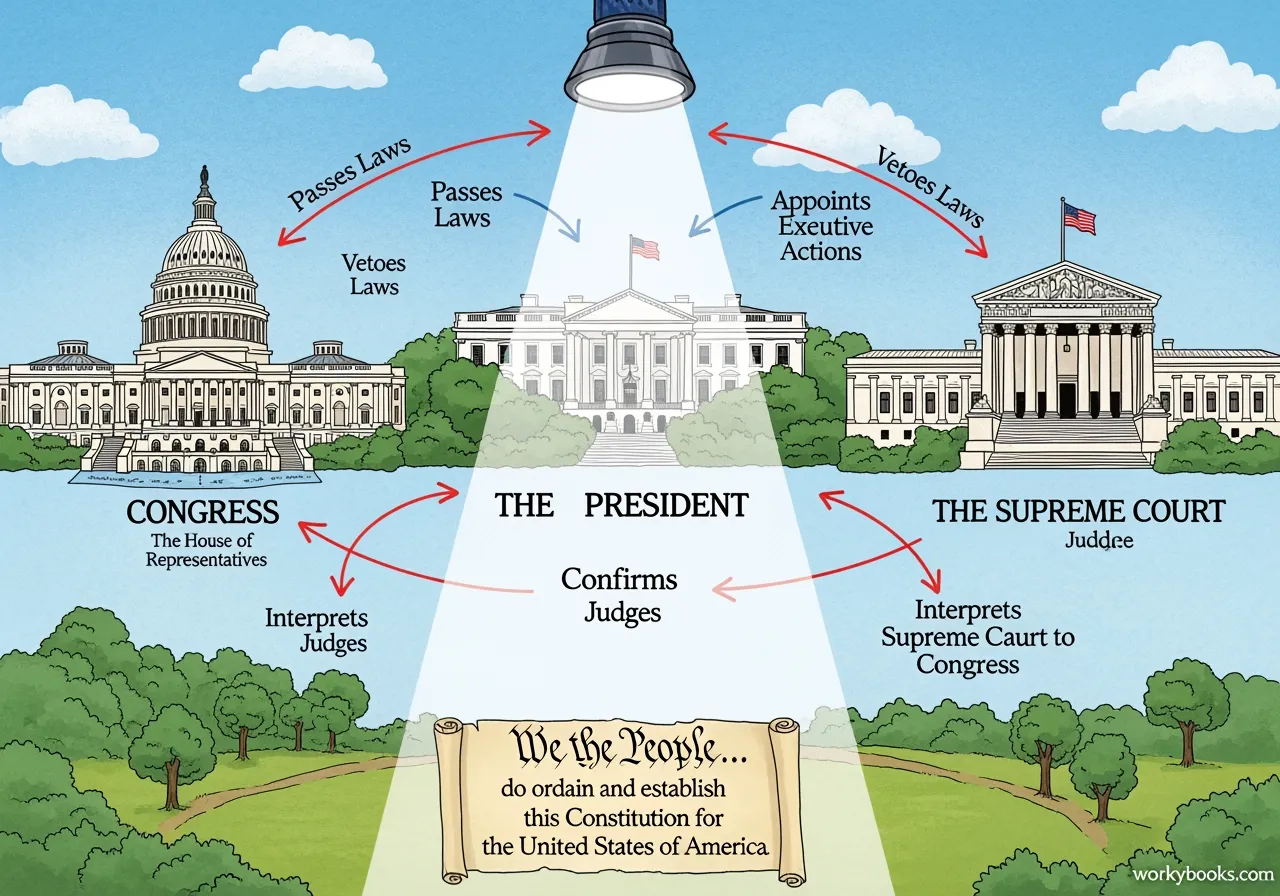
The Constitution created three branches of US government: checks and balances.
The United States government has three branches: the legislative, the executive, and the judicial branches. Each branch has special powers. The founders of the United States wanted to make sure no single person or group could have too much power. This idea is called separation of powers. It means the government’s jobs are split into different parts.
The first branch is the legislative branch. It is called Congress. Congress makes laws for the country. It has two parts: the House of Representatives and the Senate. Members of Congress are elected by the people. They talk about problems and vote to make new laws.
The second branch is the executive branch. The President leads this branch. The President’s job is to carry out the laws made by Congress. The President also leads the military and works with other countries. The President can say no to a law by using something called a veto. But, if enough members of Congress agree, they can pass the law anyway.
The third branch is the judicial branch. This branch is made up of courts. The highest court is the Supreme Court. Judges in these courts decide what laws mean. They make sure laws follow the Constitution, which is the country’s most important set of rules.
This system is called checks and balances. Each branch can check, or stop, some of the actions of the others. For example, the President can veto a law, but Congress can override the veto. The Supreme Court can tell Congress or the President if something they do is not allowed by the Constitution. This way, no branch becomes too powerful.
The founders created this plan because they wanted a strong but fair government. They had seen kings and leaders in other countries abuse their power. By dividing the government, they protected the people’s freedom. Today, these three branches still work together to keep the United States a democracy.
Interesting Fact: The idea of three branches of government comes from a French thinker named Montesquieu, who wrote about it in 1748.
Which branch makes laws?
LegislativeExecutiveJudicialMilitary
Who leads the executive branch?
The PresidentThe SenateThe Supreme CourtThe House
What is the highest court?
Supreme CourtFederal CourtCity CourtCongress
What does 'checks and balances' mean?
Each branch can stop othersOnly Congress has powerPresident is in chargeCourts make laws
Why did the founders split the government?
To stop too much powerTo make laws fasterFor more electionsTo help other countries
What can the President do to a law?
Veto itMake itVote in SenateChange the Constitution
The Supreme Court is part of the legislative branch. True or false?
TrueFalse
What does 'democracy' mean?
People choose leadersJudges ruleOnly Congress votesNo government
Perfect For:
👩🏫 Teachers
• Reading comprehension practice
• Auto-graded assessments
• Literacy skill development
👨👩👧👦 Parents
• Reading practice at home
• Comprehension improvement
• Educational reading time
🏠 Homeschoolers
• Reading curriculum support
• Independent reading practice
• Progress monitoring
Reading Features:
📖
Reading Passage
Engaging fiction or nonfiction text
❓
Comprehension Quiz
Auto-graded questions
📊
Instant Feedback
Immediate results and scoring
📄
Printable Version
Download for offline reading
🔊
Read Aloud
Voice-over with word highlighting
Reviews & Ratings
No reviews yet. Be the first to share your experience!
Related Content
California Government Branches
This engaging history reading passage introduces students to the three branches of California government: the Legislativ...
D2.CIV.1.3-5D2.CIV.2.3-5RI.4.3RI.4.4
The Governor’s Job: Leading the State
This reading passage introduces students to the important job of the governor in California. Students will learn how the...
D2.CIV.1.3-5D2.CIV.2.3-5RI.4.3RI.4.4
California Local Government
This engaging U.S. History reading passage introduces students to the roles of city and county governments in California...
D2.CIV.1.3-5D2.CIV.2.3-5RI.4.3RI.4.4
Local Leaders and How They Help Us
This engaging U.S. history passage explores the important roles that local leaders play in communities, with a focus on ...
D2.CIV.1.3-5D2.CIV.2.3-5RI.4.3RI.4.4
Informational Text —Healthy Teeth and Gums
RI.4.10RI.4.3RF.4.4RF.4.4.A
Informational Text —Migratory Birds
Engage young minds with this worksheet that delves into the wonders of migratory birds. Learn about their extraordinary ...
RI.4.10RI.4.3RF.4.4RF.4.4.A
Informational Text —All About Dentists
Students read an informational text explaining what dentists do and how they are trained. Aligned to RI.4.3-2
RI.4.10RI.4.3RF.4.4RF.4.4.A
The Role of Pollinators in Nature
Learn about the fascinating world of pollinators and discover their crucial role in the reproductive process of flowerin...
RI.4.2RI.4.3RI.4.4RI.5.1
Pollination: A Crucial Ecosystem Service
Explore the vital role of pollination beyond plant reproduction, as it sustains ecosystems by ensuring food security, pr...
RI.4.2RI.4.3RI.4.4RI.5.1
Seed Dispersal: How Plants Travel
Plants may seem stationary, but their seeds have amazing ways to travel! Explore the fascinating world of seed dispersal...
RI.4.2RI.4.3RI.4.4RI.5.1
The States of Matter: Solid
Discover the differences between solids, liquids and gases by exploring how their particles are arranged and move. This ...
RI.4.2RI.4.3RI.4.4RI.5.1
What is a Simple Machine
Discover the power of simple machines! This informational text explores how basic tools like levers, pulleys and incline...
RI.4.2RI.4.3RI.4.4RI.5.1
Bats in the Night
This informative first-grade reading passage delves into the intriguing world of bats, highlighting their nocturnal natu...
RI.3.1RI.4.4RI.4.3
What is Milky Way
This engaging passage introduces Grade 4-5 students to the Milky Way, our home galaxy. Students will learn that the Milk...
5-ESS1-15-ESS1-2RI.3.1RI.3.4
Andromeda Galaxy
This engaging science passage introduces Grade 4-5 students to the Andromeda Galaxy, our closest large galactic neighbor...
5-ESS1-15-ESS1-2RI.3.1RI.3.4
Malala Yousafzai
This Grade 4-5 science reading passage introduces students to Malala Yousafzai, a courageous young woman from Pakistan w...
NGSSRI.3.1RI.3.2RI.4.3
Understanding Biological Evolution and Diversity
This passage addresses the NGSS standard 3-LS4-2 focusing on biological evolution and the unity and diversity of life. T...
RI.3.3RI.4.3RI.5.33-LS4-2
Early Life Forms and Their Adaptations
This educational passage focuses on early life forms and their basic adaptations, supporting NGSS standard 3-LS4-2 for e...
RI.3.3RI.4.3RI.5.33-LS4-2
What Is a Physical Map?
This Grade 4-5 science passage introduces students to physical maps, explaining how these maps display natural features ...