This learning resource is available in interactive and printable formats. The interactive worksheet can be played online and assigned to students. The Printable PDF version can be downloaded and printed for completion by hand.
This comprehensive passage explores the life and legacy of Augustus, Rome's first emperor, who transformed the Roman Republic into a powerful empire. Students will learn about Augustus's rise to power, his political reforms, the significance of the Pax Romana, and his lasting influence on world history. The passage includes primary source references, analysis of cause-and-effect relationships, and discussion of social hierarchy and daily life in Ancient Rome. Activities support historical thinking, ELA, and social studies standards, such as CA HSS 6.7 and CCSS RH.6-8.2. Spanish translations and read aloud audio are provided for accessibility. The lesson is designed for deep analysis and includes a glossary, comprehension quiz, writing prompts, graphic organizers, and a timeline for a complete, rigorous learning experience.
CONTENT PREVIEW
Expand content preview
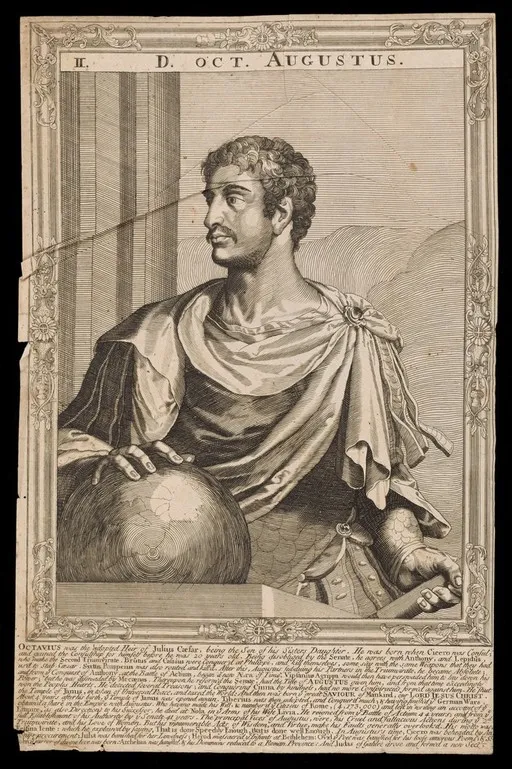
"Augustus, Emperor of Rome" / Europeana, licensed under CC BY.
Augustus, originally known as Gaius Octavius, became Rome's first emperor in 27 BCE and fundamentally changed the history of the ancient world. Born in 63 BCE, Augustus was the adopted son and heir of Julius Caesar. After Caesar's assassination in 44 BCE, Augustus used both political skill and military power to defeat his rivals, including Mark Antony and Cleopatra, and gained control over Rome. This victory ended a period of violent civil war and uncertainty in the Roman Republic.
Augustus understood that Rome needed stability. He reorganized the government, creating a new system called the Principate, which kept the outward appearance of the old Republic but gave real authority to the emperor. By holding titles such as "Princeps," meaning "first citizen," Augustus avoided calling himself king, which Romans distrusted. According to ancient historian Suetonius, Augustus claimed to have "found Rome a city of brick and left it a city of marble." Archaeological evidence, such as the restoration of temples and construction of monuments like the Ara Pacis, supports these claims. The Senate, once the main governing body, still existed but now had much less power. Augustus also reformed the Roman army, creating a permanent, professional force loyal directly to him.
One of Augustus's greatest achievements was bringing about the Pax Romana, or "Roman Peace." This was a long period—over 200 years—of relative peace, prosperity, and expansion for the Roman Empire. Trade routes flourished, cities grew, and Roman law brought order to many provinces. Augustus initiated building projects, improved roads, and established a fire brigade and police force for the city of Rome. He promoted traditional Roman values and passed laws to strengthen families and encourage moral behavior. Coins, inscriptions, and public records from this era show the ways Augustus shaped Roman society and identity.
However, Augustus's rule also marked the end of the Roman Republic and the beginning of imperial rule. Power became concentrated in one man, and future emperors would inherit this authority. Social hierarchy remained strict, with patricians and plebeians still divided by wealth and privilege. Yet, Augustus's reign allowed for greater stability and a sense of unity throughout the vast Roman world.
Augustus's leadership transformed Rome from a divided republic into a powerful empire that influenced later civilizations in Europe, North Africa, and the Middle East. The legacy of his reforms and the peace he established can still be seen in art, architecture, and government systems today.
Augustus's story connects to broader themes in world history, such as the rise and fall of empires, the role of leadership, and the impact of government change on societies.
Interesting Fact: Augustus was so respected that the month of August is named after him.
Who was Augustus's famous adoptive father?
Julius CaesarMark AntonyCleopatraSuetonius
What year did Augustus become emperor?
27 BCE44 BCE31 BCE63 BCE
Which period did Augustus help create?
Pax RomanaMiddle AgesGreek Golden AgeIron Age
Why did Augustus avoid calling himself king?
Romans distrusted kingsHe disliked the wordIt was illegalHis army objected
What effect did Augustus's reforms have?
Brought stability and peaceStarted new warsWeakened the empireEnded Roman law
What did Augustus's building projects show?
Rome's wealth and powerFear of invasionGreek influenceDecline of art
Augustus created a permanent, professional army. True or false?
TrueFalse
What does 'plebeians' mean?
Common peopleArmy officersWealthy landownersForeigners
Perfect For:
👩🏫 Teachers
• Reading comprehension practice
• Auto-graded assessments
• Literacy skill development
👨👩👧👦 Parents
• Reading practice at home
• Comprehension improvement
• Educational reading time
🏠 Homeschoolers
• Reading curriculum support
• Independent reading practice
• Progress monitoring
Reading Features:
📖
Reading Passage
Engaging fiction or nonfiction text
❓
Comprehension Quiz
Auto-graded questions
📊
Instant Feedback
Immediate results and scoring
📄
Printable Version
Download for offline reading
🔊
Read Aloud
Voice-over with word highlighting
Reviews & Ratings
No reviews yet. Be the first to share your experience!
Related Content
Ancient Law Codes: Hammurabi to Rome
This passage explores how ancient civilizations like Babylon and Rome used law codes to govern people, maintain social o...
Geography and Early Rome
This passage, aligned to HSS 6.7 and CCSS RH.6-8.2, explores the rise of Ancient Rome with a focus on its geographical s...
Rome's Lasting Legacy
This passage explores the profound legacy of Ancient Rome and how its beliefs, innovations, and systems continue to shap...
Evidence in Ancient History
This engaging history reading passage investigates how archaeologists and historians discover clues about how ancient pe...
Livy: Historian of Early Rome
This passage introduces students to Livy, one of Ancient Rome's most significant historians, whose writings help us unde...
Germanic Invasions of Rome
This engaging history reading passage explores the causes and effects of the Germanic tribes’ invasions of the Western R...
Slavery in Ancient Rome and in the Americas
This educational passage examines the history of slavery in two distinct regions and eras: Ancient Rome and Colonial Ame...
Ancient Theocracy
This engaging history reading passage explores the concept of theocracy in ancient civilizations, where priests and reli...
Slavery in Ancient World
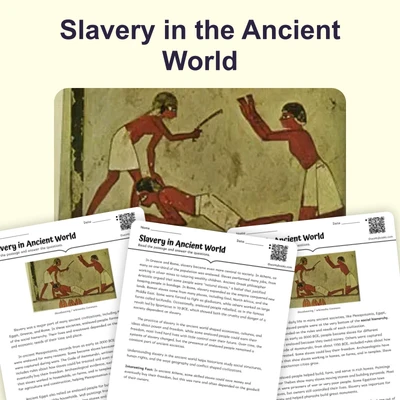
This passage explores the complex history of slavery in the ancient world, examining its presence in societies such as M...
Life in the Roman Empire
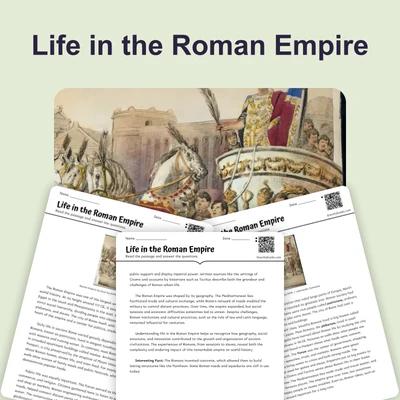
This rigorous history reading passage explores Life in the Roman Empire, guiding students through the social hierarchy, ...
Ancient Canaan
This educational passage explores the land of Canaan, the historical homeland of the ancient Israelites. Students will l...
Ancient Literature
This passage explores the importance of ancient stories and poems from civilizations such as Greece, India, and Israel. ...
Geography of Ancient Israel
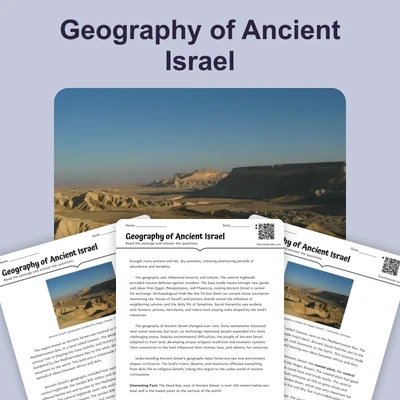
This passage explores the rich geography of Ancient Israel, focusing on how landforms, climate, and natural resources sh...
The Etruscans
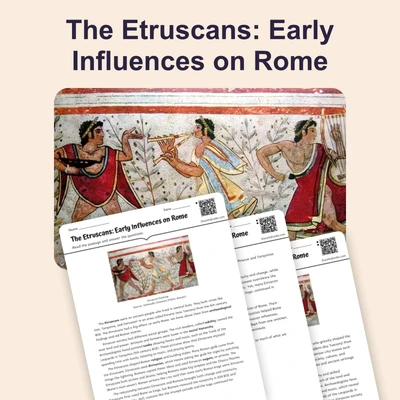
This engaging history reading passage explores the vital role of the Etruscans in shaping Ancient Rome. Students will di...
Ancient Writing Systems
This engaging history reading passage explores the origins and evolution of ancient writing systems, including cuneiform...
Ancient Agriculture Farming
This passage explores the transformative impact of farming on ancient societies, examining how the Neolithic Revolution ...
Cincinnatus
This rigorous history reading passage explores the story of Cincinnatus, a Roman farmer who became a dictator in a time ...
Ancient Mathematics
This passage explores the essential role of mathematics in ancient civilizations, including Mesopotamia, Egypt, Greece, ...
Trade Across Ancient India
This history reading passage explores Ancient India's trade networks and their impact on global connections. Students wi...
The Roman Republic
This passage explores the structure and significance of government and law in the Roman Republic, focusing on how Roman ...