Barnacle Biology and Adaptations
Interactive passage with audio narration, comprehension questions, and printable PDF.
By completing this purchase you agree to our Terms of Use and Privacy Policy. Your subscription renews automatically until you cancel. You can cancel anytime from your account settings. All sales are final and non-refundable. Digital content is available for download in your account immediately upon purchase.
What's included
Barnacle Biology and Adaptations preview and details
About this printable Barnacle Biology and Adaptations science reading passage, NGSS-aligned (Grade 6)
Sample passage and quiz from Barnacle Biology and Adaptations
Reading passage and comprehension quiz preview
Barnacle Biology and Adaptations
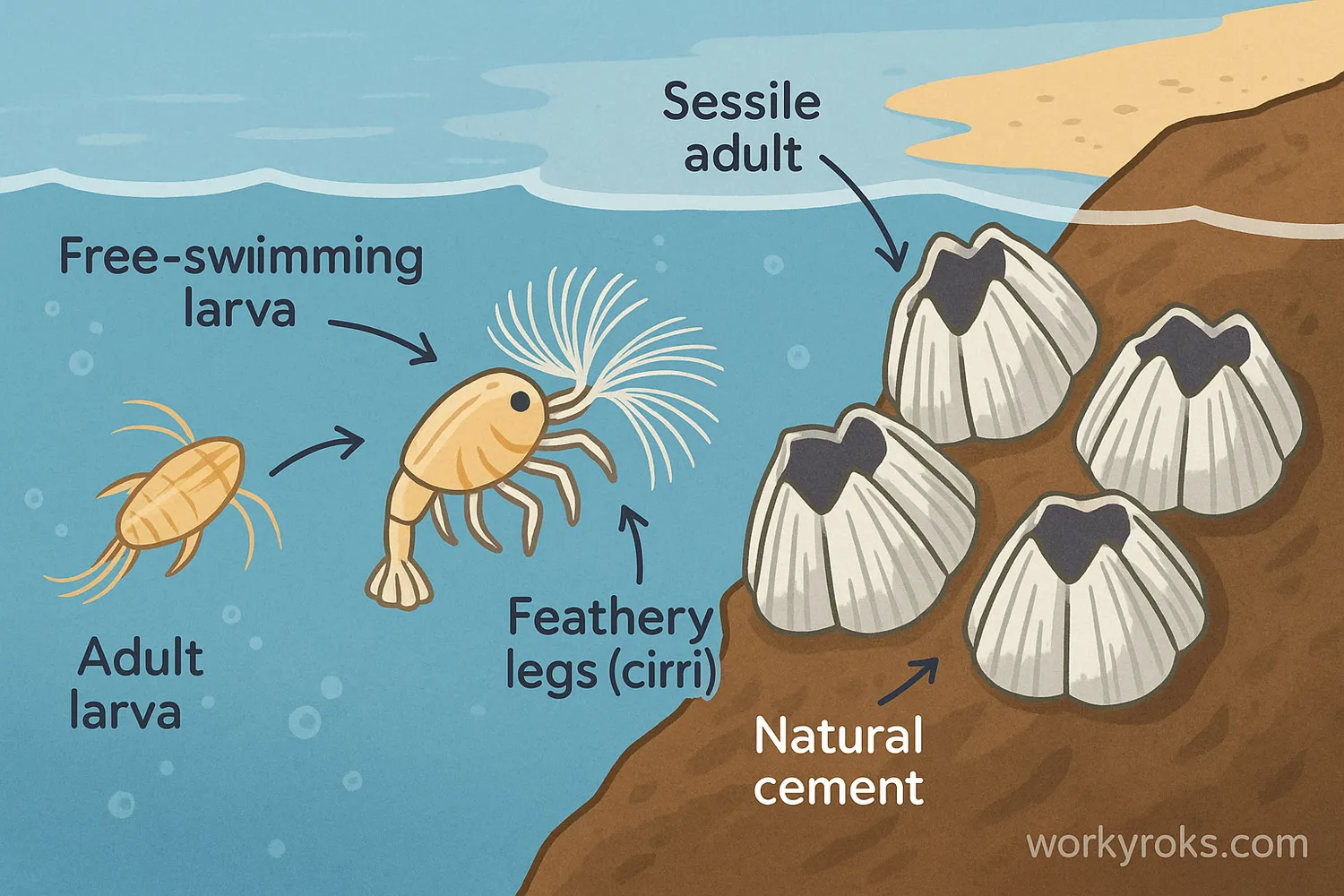
Imagine living your entire adult life stuck to one spot, unable to move. This is the reality for barnacles, incredible marine animals often mistaken for shells. These fascinating creatures are actually crustaceans, related to crabs and lobsters, and they have developed amazing adaptations to survive in their unique habitats, especially the intertidal zone.
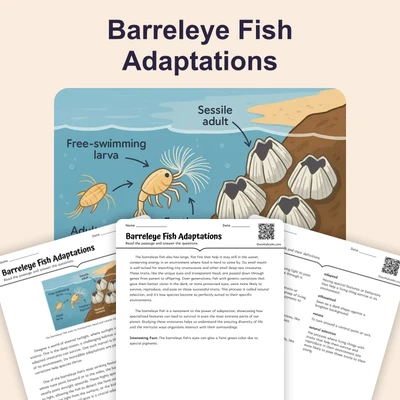
Barnacles begin their lives very differently from their adult form. They start as tiny, free-swimming larvae. These larvae drift in the ocean currents, searching for a suitable place to settle. This wandering stage is crucial because adult barnacles are sessile, meaning they cannot move from their chosen spot. Once a larva finds a good home – perhaps a rock, a boat hull, or even a whale – it undergoes a remarkable transformation, attaching itself head-first to the surface.
To stay put, barnacles produce an incredibly strong, natural cement. This bioadhesive is so powerful that scientists are still studying it to understand how it works! Once attached, the barnacle develops its characteristic hard, protective plates, forming a conical shell. These plates are vital for protection against predators, strong waves, and drying out during low tide in the intertidal zone. When the tide is high, the barnacle opens its plates slightly and extends feathery legs, called cirri, into the water to filter out tiny food particles like plankton.
Living a sessile life means barnacles face challenges, such as competition for space and finding mates. Their ability to produce abundant free-swimming larvae increases their chances of finding new, suitable habitats. The tough shell is a key trait that helps individuals survive and reproduce in harsh environments. Without their powerful glue and protective shell, barnacles wouldn't stand a chance against the ocean's forces. These biological features are perfect examples of how specific traits increase an organism's probability of surviving and reproducing.
Interesting Fact: Barnacles are hermaphrodites, meaning each individual barnacle has both male and female reproductive organs, which helps them reproduce even when stuck in one spot.
Comprehension quiz (10 questions)
1. What are barnacles related to?
2. What kind of glue do barnacles use?
3. What does 'sessile' mean?
4. Why are larvae important for barnacle survival?
5. What is the intertidal zone?
6. How do barnacles get food?
7. What is a key adaptation for barnacles?
8. Why is a tough shell beneficial for barnacles?
9. Adult barnacles are able to move freely.
10. Which word means to fight for resources?
Perfect for the way you teach
- Build comprehension skills
- Auto-graded quiz
- Differentiated reading
- Read together at home
- Improve fluency
- Quiet reading time
- Reading curriculum support
- Independent practice
- Track Lexile growth