Town Meetings: How Colonists Made Decisions — Reading Comprehension
Rate this
Premium Resource
Present
Present in classroom. No work saved
Assign
Classroom with student accounts, Track progress
Quick Play
No student accounts, assign with a link
Grades
3
4
5
Standards
D2.HIS.6.3-5
D2.CIV.2.3-5
RI.4.3
RI.4.4
W.4.2
PRINT+DIGITAL RESOURCE
This learning resource is available in interactive and printable formats. The interactive worksheet can be played online and assigned to students. The Printable PDF version can be downloaded and printed for completion by hand.
This passage explores the role of town meetings in the New England Colonies and how colonists worked together to make important decisions. Students will learn how early American settlers gathered, debated, and voted on issues facing their communities, laying the foundation for democratic government. The passage uses clear language and a chronological structure to help students make connections between past and present. Activities include a multiple-choice quiz, writing prompts, a glossary, and a graphic organizer. The passage is aligned to C3 Framework and Common Core standards, making it ideal for teaching history and literacy skills together. Audio support and a Spanish translation are included to support all learners. Students will gain an understanding of civic participation, unity, and leadership in colonial America, and see how these early practices continue to influence American democracy today.
CONTENT PREVIEW
Expand content preview
In the New England Colonies, colonists showed their belief in fair and equal say.
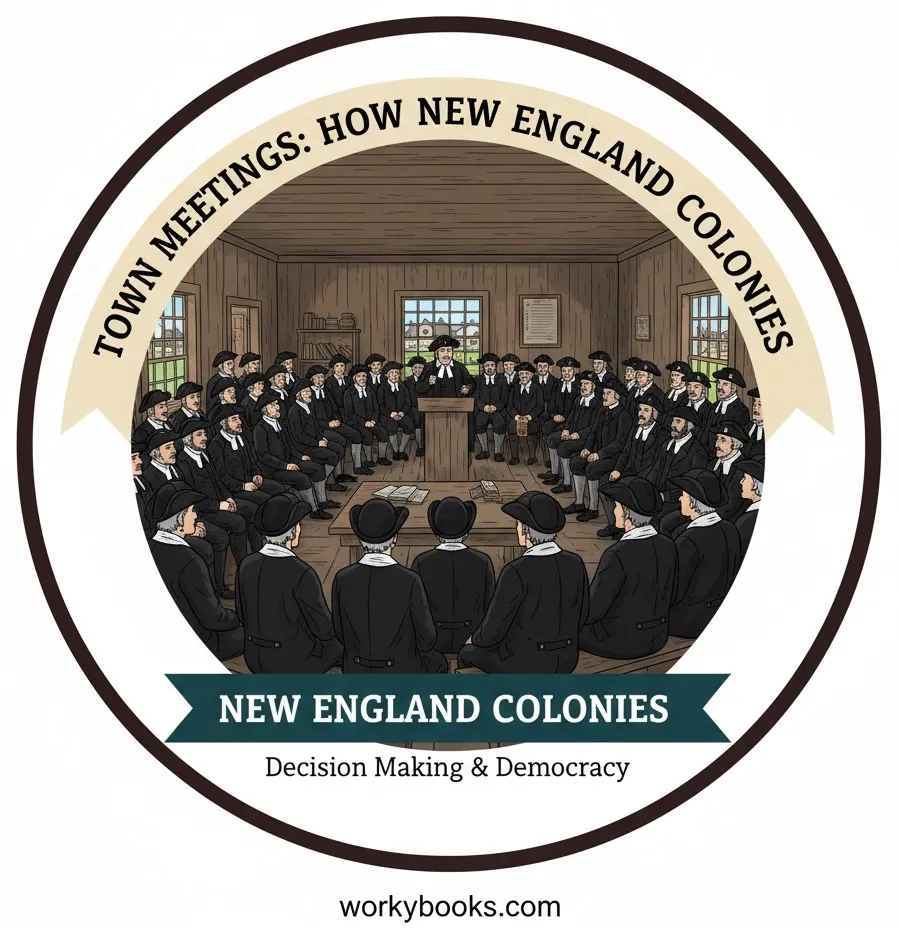
New England town meetings were a special way people in colonial America made decisions. In the 1600s and 1700s, many English settlers moved to places like Massachusetts, Connecticut, and Rhode Island. They wanted to build strong communities and have a say in how they were governed.
Each year, men who owned land gathered in a building called a meetinghouse. These meetings happened in the center of town. Only male property owners could vote, but everyone could listen and share ideas. The main goal was to make important choices for the whole community.
During a town meeting, leaders called selectmen helped run the event. The people talked about new rules, taxes, and how to care for roads, schools, and safety. Anyone could stand up and speak. Then, everyone voted, usually by raising a hand or voice. This process is called direct democracy, because people voted themselves instead of picking someone else to decide.
These meetings taught colonists about self-government. They learned to work together, solve problems, and respect each person's ideas. They saw that every vote mattered. Sometimes, there was debate and disagreement, but the final decision was one that most people agreed on. Town meetings helped create a sense of community and fairness.
Over time, New England town meetings became a model for future governments in America. Colonists wanted freedom from British rule, and these meetings showed they could govern themselves. Later, ideas from town meetings influenced the creation of state and national governments. Town meetings are still held in some New England towns today.
New England town meetings were more than just gatherings. They were a key step in building American democracy. People learned to vote, listen, and make laws together. Their work shaped the future of the United States.
Interesting Fact: Some New England towns have held town meetings every year for over 300 years, making it one of the oldest forms of self-government in America!
Who could vote in town meetings?
Male property ownersAll womenChildrenVisitors
Where did town meetings happen?
MeetinghousesChurch towersFieldsShips
What state was NOT mentioned?
New YorkMassachusettsRhode IslandConnecticut
Why did colonists hold town meetings?
To make community decisionsTo sell goodsTo play gamesTo fight battles
What is direct democracy?
People vote directlyOnly leaders voteNo votingOnly children vote
What did selectmen do?
Helped run meetingsFought warsBuilt housesTraded goods
Town meetings still happen in some towns. True or false?
TrueFalse
What does self-government mean?
People govern themselvesOnly one king rulesNo one makes rulesAnimals lead
Perfect For:
👩🏫 Teachers
• Reading comprehension practice
• Auto-graded assessments
• Literacy skill development
👨👩👧👦 Parents
• Reading practice at home
• Comprehension improvement
• Educational reading time
🏠 Homeschoolers
• Reading curriculum support
• Independent reading practice
• Progress monitoring
Reading Features:
📖
Reading Passage
Engaging fiction or nonfiction text
❓
Comprehension Quiz
Auto-graded questions
📊
Instant Feedback
Immediate results and scoring
📄
Printable Version
Download for offline reading
🔊
Read Aloud
Voice-over with word highlighting
Reviews & Ratings
No reviews yet. Be the first to share your experience!
Related Content
The Constitution and Bill of Rights
This passage explores the creation of the United States Constitution and the Bill of Rights. Students will learn about t...
D2.CIV.2.3-5D2.CIV.12.3-5RI.4.1RI.4.3
California Government Branches
This engaging history reading passage introduces students to the three branches of California government: the Legislativ...
D2.CIV.1.3-5D2.CIV.2.3-5RI.4.3RI.4.4
The Governor’s Job: Leading the State
This reading passage introduces students to the important job of the governor in California. Students will learn how the...
D2.CIV.1.3-5D2.CIV.2.3-5RI.4.3RI.4.4
California Local Government
This engaging U.S. History reading passage introduces students to the roles of city and county governments in California...
D2.CIV.1.3-5D2.CIV.2.3-5RI.4.3RI.4.4
Local Leaders and How They Help Us
This engaging U.S. history passage explores the important roles that local leaders play in communities, with a focus on ...
D2.CIV.1.3-5D2.CIV.2.3-5RI.4.3RI.4.4
California Citizen Participation
This engaging U.S. history reading passage explores the important role citizens play in shaping modern America, focusing...
D2.HIS.5.3-5D2.CIV.2.3-5RI.4.3RI.4.4
The Mexican-American War Comes to California
This passage explores the key events of the Mexican-American War as it reached California, focusing on the period leadin...
D2.HIS.2.3-5D2.HIS.6.3-5RI.4.3RI.4.4
First California Constitution
This U.S. History reading passage explores how California became a state and created its first constitution after the Me...
D2.HIS.2.3-5D2.HIS.6.3-5RI.4.3RI.4.4
Hollywood: The World of Entertainment
This engaging U.S. history reading passage introduces students to Hollywood and its transformation into the world’s ente...
D2.HIS.6.3-5D2.HIS.16.3-5RI.5.3RI.5.4
Rocky Coast and Thick Forests in New England Colony
This reading passage introduces students to the New England Colonies, focusing on the rocky coasts and thick forests tha...
D2.HIS.2.3-5D2.HIS.6.3-5RI.4.3RI.4.4
William Penn and the Quakers
This history reading passage introduces students to the story of William Penn and the Quakers, focusing on their role in...
D2.HIS.3.3-5D2.HIS.6.3-5RI.4.3RI.4.4
The Mills and Ironworks of the Middle Colonies
This engaging U.S. History reading passage explores the vital role that mills and ironworks played in the growth of the ...
D2.HIS.2.3-5D2.HIS.6.3-5RI.4.3RI.4.4
Reading Columbus's Letters from 1493
This engaging U.S. history reading passage explores Christopher Columbus's 1493 letters, one of the earliest primary sou...
D2.HIS.3.3-5D2.HIS.6.3-5RI.4.3RI.4.4
Informational Text —Healthy Teeth and Gums
RI.4.10RI.4.3RF.4.4RF.4.4.A
Informational Text —Migratory Birds
Engage young minds with this worksheet that delves into the wonders of migratory birds. Learn about their extraordinary ...
RI.4.10RI.4.3RF.4.4RF.4.4.A
Informational Text —All About Dentists
Students read an informational text explaining what dentists do and how they are trained. Aligned to RI.4.3-2
RI.4.10RI.4.3RF.4.4RF.4.4.A
Pollination: A Crucial Ecosystem Service
Explore the vital role of pollination beyond plant reproduction, as it sustains ecosystems by ensuring food security, pr...
RI.4.2RI.4.3RI.4.4RI.5.1
The States of Matter: Solid
Discover the differences between solids, liquids and gases by exploring how their particles are arranged and move. This ...
RI.4.2RI.4.3RI.4.4RI.5.1
What is a Simple Machine
Discover the power of simple machines! This informational text explores how basic tools like levers, pulleys and incline...