Climate Change: A Global Challenge
Interactive passage with audio narration, comprehension questions, and printable PDF.
By completing this purchase you agree to our Terms of Use and Privacy Policy. Your subscription renews automatically until you cancel. You can cancel anytime from your account settings. All sales are final and non-refundable. Digital content is available for download in your account immediately upon purchase.
What's included
Climate Change: A Global Challenge preview and details
About this printable Climate Change: A Global Challenge reading passage (Grades 5-8)
Sample passage and quiz from Climate Change: A Global Challenge
Reading passage and comprehension quiz preview
Climate Change: A Global Challenge
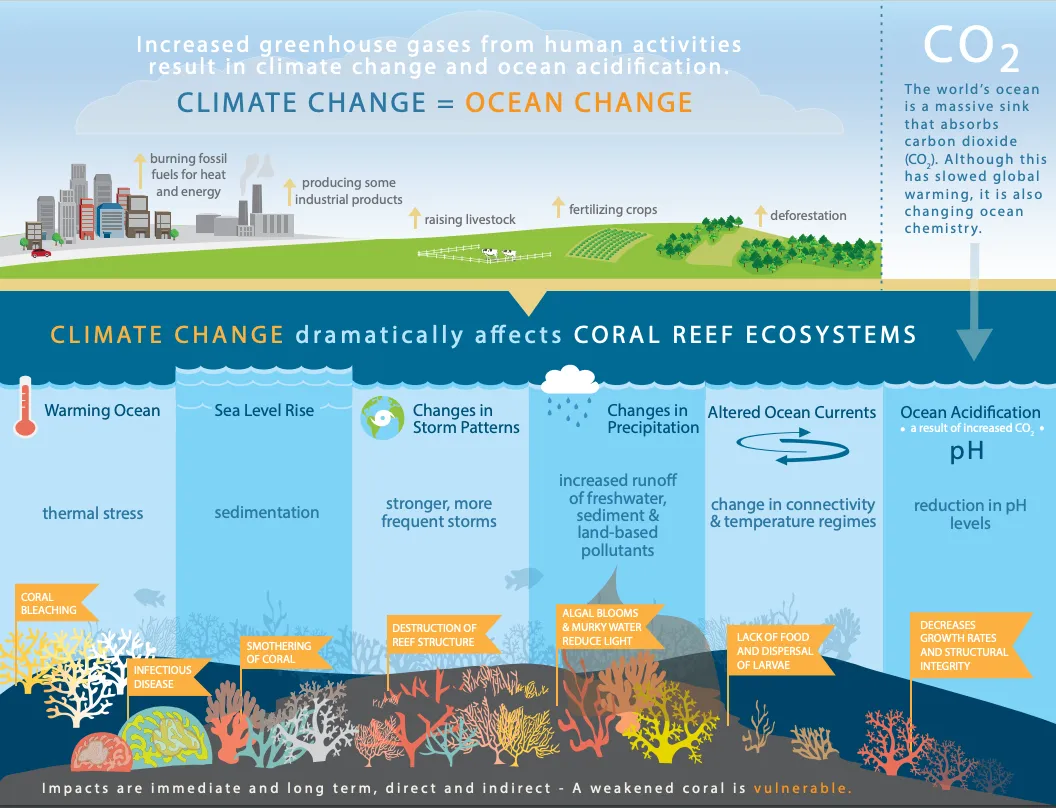
"Climate change threats to coral reefs" by NOAA: National Ocean Service /
Source: Wikimedia Commons (Public domain).
Climate change is one of the most pressing issues facing the world in the 21st century. Scientists define climate change as significant, long-term changes in global or regional weather patterns. The most recent changes are closely linked to global warming, a rise in Earth’s average surface temperature, mostly due to human activities since the late 1800s.
The main cause of global warming is the increased release of greenhouse gases like carbon dioxide and methane into the atmosphere. These gases trap heat from the sun, creating a ‘greenhouse effect’ that warms the planet. Since the Industrial Revolution began in the mid-18th century, people have burned more fossil fuels such as coal and oil for energy. This has raised carbon dioxide levels from about 280 parts per million to over 410 by 2020. For example, ice core samples from Antarctica, a type of primary source, show how these gas levels have changed over thousands of years. Deforestation, which removes trees that absorb carbon dioxide, also contributes to the problem.
The effects of climate change are wide-ranging. Many regions have experienced more frequent and severe droughts, floods, and wildfires. Glaciers and polar ice are melting at a rapid rate, causing sea levels to rise. In Bangladesh, millions of people are at risk of losing their homes due to flooding. In Africa, farmers face unpredictable rainfall, which threatens food supplies. These changes impact people differently, sometimes increasing social inequality because poorer communities have fewer resources to adapt. Evidence from satellite observations and weather stations worldwide helps scientists track these changes over time.
International cooperation has become essential in addressing climate change. In 1997, the Kyoto Protocol was the first major international treaty aimed at reducing greenhouse gas emissions. Later, the Paris Agreement of 2015 brought together nearly every country to set voluntary targets for limiting warming to less than 2 degrees Celsius above pre-industrial levels. These agreements show how nations can work together, though challenges remain. Some countries struggle to balance economic growth with environmental protection, and not all targets are legally binding.
Climate change remains a global challenge that demands both scientific understanding and international action. By learning about its causes and effects, people around the world can make informed decisions and advocate for solutions that protect both our planet and its people.
This topic connects to broader themes of human-environment interaction and the role of collective action in shaping world history.
Interesting Fact: The year 2016 was the hottest ever recorded globally, according to NASA and NOAA, highlighting the urgent need for climate action.
Comprehension quiz (8 questions)
1. What is the main cause of global warming?
2. When was the Kyoto Protocol signed?
3. What do ice cores from Antarctica show?
4. What is one effect of climate change?
5. Why are poorer communities more affected?
6. What was the goal of the Paris Agreement?
7. True or False: Deforestation helps reduce greenhouse gases.
8. What is a primary source?
Perfect for the way you teach
- Build comprehension skills
- Auto-graded quiz
- Differentiated reading
- Read together at home
- Improve fluency
- Quiet reading time
- Reading curriculum support
- Independent practice
- Track Lexile growth