Latin American Independence — Reading Comprehension
Rate this
Premium Resource
Present
Present in classroom. No work saved
Assign
Classroom with student accounts, Track progress
Quick Play
No student accounts, assign with a link
Grades
5
6
7
8
PRINT+DIGITAL RESOURCE
This learning resource is available in interactive and printable formats. The interactive worksheet can be played online and assigned to students. The Printable PDF version can be downloaded and printed for completion by hand.
This reading passage presents a detailed exploration of the Latin American Independence Movements during the 19th century, focusing on the revolutionary leaders Simón Bolívar and José de San Martín. Students will learn how these leaders, inspired by Enlightenment ideas and other global revolutions, led the charge to end Spanish and Portuguese colonial rule across South America. The text examines the causes and effects of the independence movements, highlights the importance of geography and social hierarchy, and references primary sources for context. Activities include multiple-choice questions, writing prompts, and graphic organizers to develop critical thinking. This resource aligns with HSS 6.7, RH.6-8.1, and RH.6-8.2, and features read aloud audio and a complete Spanish translation.
CONTENT PREVIEW
Expand content preview
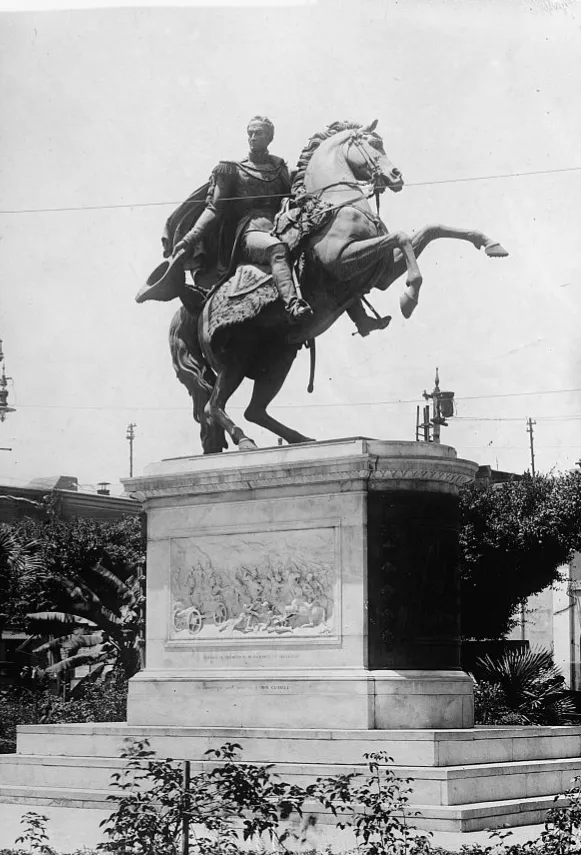
Statue of Bolivia [i.e., Simon Bolivar] / Library of Congress
The Latin American Independence Movements of the 19th century were a series of revolutions that ended centuries of colonial rule by Spain and Portugal in Central and South America. These movements changed the political map of the Americas and gave birth to new nations. Key leaders like Simón Bolívar and José de San Martín became symbols of the struggle for sovereignty and freedom.
One major cause of the independence movements was the influence of Enlightenment ideas, which emphasized liberty and equality. The American Revolution (1776) and the French Revolution (1789) inspired people in Latin America to demand their own rights. Social structure also played a role: Latin American society was divided into classes, with creoles (people of European descent born in the Americas) often excluded from top positions by Spanish-born peninsulares. This inequality created widespread resentment. Additionally, Napoleon’s invasion of Spain in 1808 weakened Spanish authority, creating an opportunity for revolutionaries.
Simón Bolívar, known as “El Libertador,” led campaigns in present-day Venezuela, Colombia, Ecuador, Peru, and Bolivia between 1810 and 1825. In a famous letter from Jamaica (1815), Bolívar wrote about the desire for freedom and unity among Latin Americans. José de San Martín led armies across the Andes Mountains from Argentina into Chile and Peru, using geography to surprise and defeat Spanish forces. The crossing of the Andes in 1817 is considered one of the greatest military feats in history. Primary sources, such as Bolívar’s speeches, show the determination and vision of these leaders.
The process of independence was not easy. Many battles were fought, and there were divisions among revolutionary groups. Indigenous peoples, enslaved Africans, and people of mixed heritage (like mestizos and mulattoes) also played important roles, though their voices are less often heard in historical records. Over time, most colonies gained independence: Mexico in 1821, Gran Colombia (now several modern countries) in 1821, and Brazil in 1822. However, many new nations continued to face challenges with governance and social inequality.
The Latin American Independence Movements were significant because they ended colonial rule and created new countries. They also inspired future struggles for equality and justice. These events connect to broader world history themes, such as the spread of revolutionary ideas and the impact of geography on human societies.
Interesting Fact: Simón Bolívar is one of the few people in history to have a country named after him—Bolivia!
Who was known as El Libertador?
Simón BolívarJosé de San MartínNapoleonMiguel Hidalgo
Which country was named after Bolívar?
BoliviaBrazilMexicoColombia
When did Mexico gain independence?
1821181018151822
Why did creoles resent peninsulares?
They wanted top jobs.They disliked the climate.They spoke different languages.They supported Napoleon.
How did geography influence San Martín’s campaign?
He crossed the Andes.He used rivers for trade.He used the jungle for cover.He avoided mountains.
Who inspired Latin Americans to seek freedom?
American and French RevolutionsIndustrial RevolutionGreek philosophersThe Roman Empire
Simón Bolívar led campaigns in Asia. True or false?
FalseTrue
What does 'sovereignty' mean?
Self-ruleColonial ruleMilitary trainingSocial class
Perfect For:
👩🏫 Teachers
• Reading comprehension practice
• Auto-graded assessments
• Literacy skill development
👨👩👧👦 Parents
• Reading practice at home
• Comprehension improvement
• Educational reading time
🏠 Homeschoolers
• Reading curriculum support
• Independent reading practice
• Progress monitoring
Reading Features:
📖
Reading Passage
Engaging fiction or nonfiction text
❓
Comprehension Quiz
Auto-graded questions
📊
Instant Feedback
Immediate results and scoring
📄
Printable Version
Download for offline reading
🔊
Read Aloud
Voice-over with word highlighting
Reviews & Ratings
No reviews yet. Be the first to share your experience!
Related Content
New Technologies Connect the World
This engaging world history reading passage explores how 19th-century inventions, such as the telegraph and steam locomo...
Abolition Movement
This rigorous world history reading passage examines the Abolition Movement of the 19th century, focusing on the fight t...
The 19th Amendment Passes
This U.S. history reading passage explores the inspiring story of the passage of the 19th Amendment, which granted women...
D2.HIS.1-4.3-5RI.4.3RI.4.4
Black History Month Word Search
RF.4.3RF.5.3L.4.4L.5.4
Manifest Destiny: American Expansion
This engaging U.S. history reading passage explores the concept of Manifest Destiny and its impact on American expansion...
D2.HIS.2.3-5D2.HIS.3.3-5RI.4.3RI.4.4
Easy Black History Month Word Search
RF.4.3RF.5.3L.4.4L.5.4
19th Amendment 1920: Women Win Voting Rights
This comprehensive reading passage examines the history and impact of the 19th Amendment, which granted American women t...
D2.HIS.2.3-5D2.HIS.3.3-5RI.4.3RI.4.4
COVID-19 Pandemic: A Global Health Crisis
This comprehensive passage explores the COVID-19 pandemic as a major event in 21st-century world history. Students will ...
Revolutions of 1848
This engaging history reading passage explores the Revolutions of 1848, a wave of political and social uprisings that sp...
Civil Rights Movements: Fighting for Equality
This engaging world history reading passage examines 20th-century civil rights movements, focusing on the United States,...
Climate Change: A Global Challenge
This rigorous world history reading passage explores climate change as a global challenge of the 21st century. Students ...
Causes of World War I
This comprehensive history reading passage explores the complex causes of World War I, focusing on alliances, nationalis...
American History Word Search
Word search on American History Word Search! Vocabulary practice aligned to Common Core standards!
L.K.5.AL.1.5.AL.2.5.AL.3.5.A
Word Families: —ight Words
This word families worksheet focuses on -ight words and is designed to help 4th-grade students practice their reading an...
RF.4.4
Horace Mann and Free Public Education
This passage explores the influential work of Horace Mann and the movement for free public education in the United State...
July 20, 1969: The First Moon Landing
This comprehensive history reading passage explores the historic first Moon landing on July 20, 1969, led by Neil Armstr...
Worky World! Capitalize Locations
This capitalization sheet will help students to practice capitalizing geographic locations. Illustrated on the sheet is ...
L.2.2.AL.2.2
Trench Warfare in World War I
This comprehensive history reading passage explores the realities of life in the trenches during World War I, aligned to...
Thanksgiving History Word Search
Word search on Thanksgiving History Word Search! Vocabulary practice aligned to Common Core standards!