Colonies Unite! The Big Meeting Before the American Revolution — Reading Comprehension
Rate this|
4
Premium Resource
Present
Present in classroom. No work saved
Assign
Classroom with student accounts, Track progress
Quick Play
No student accounts, assign with a link
Grades
3
4
5
Standards
D2.HIS.1.3-5
D2.HIS.2.3-5
RI.4.1
RI.4.3
RI.4.4
W.4.2
PRINT+DIGITAL RESOURCE
This learning resource is available in interactive and printable formats. The interactive worksheet can be played online and assigned to students. The Printable PDF version can be downloaded and printed for completion by hand.
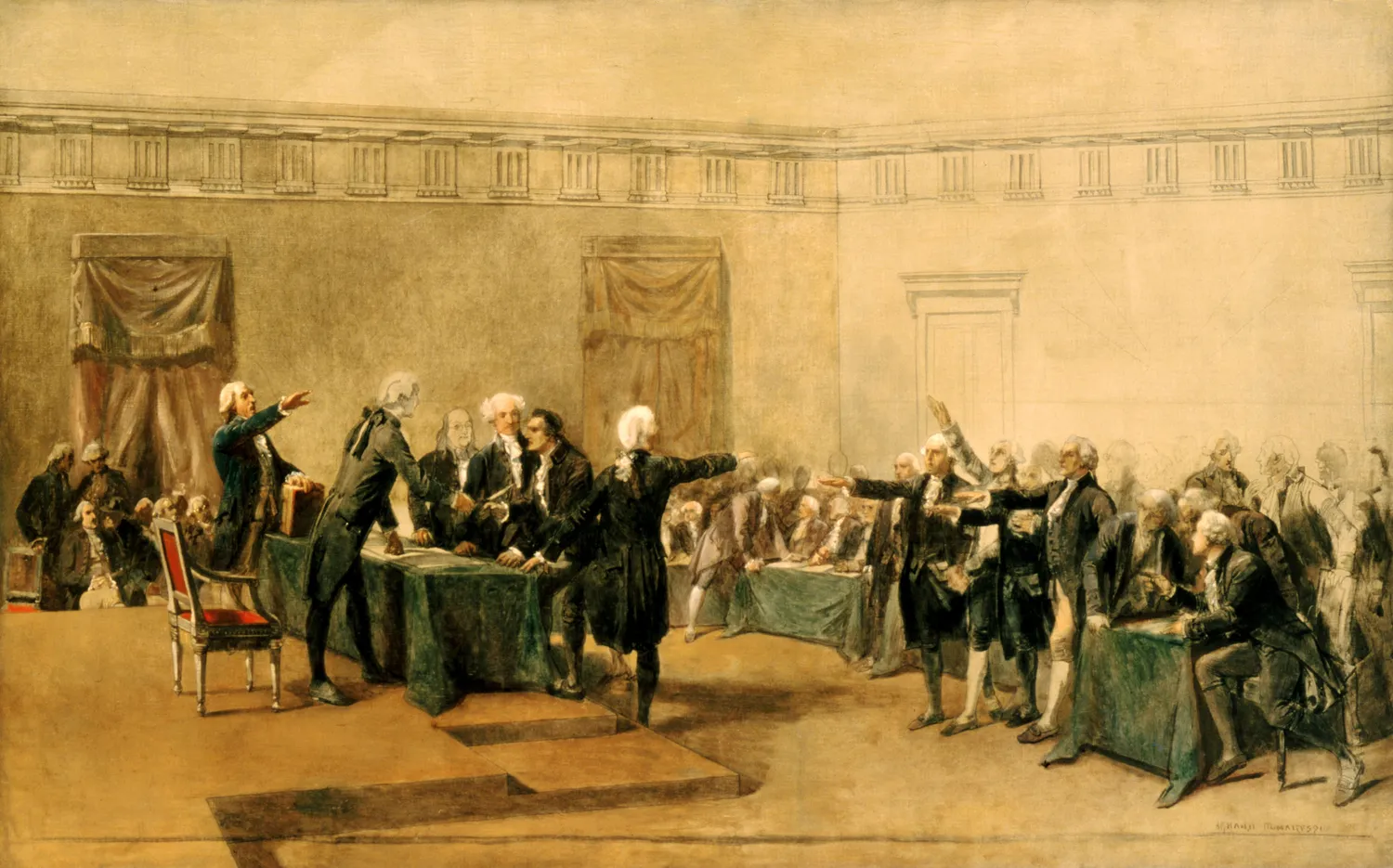
This engaging U.S. History reading passage explores the events leading up to the American Revolution, focusing on the First Continental Congress. Students will learn how colonial leaders united to address British laws and work together for their rights. The passage uses clear, student-friendly language and emphasizes themes of bravery, unity, and problem-solving. Included are a glossary of key terms, a Spanish translation, a reading comprehension quiz, writing activities, a timeline, and relevant graphic organizers. A public domain image and a coloring page prompt further enhance the learning experience. This passage and its activities are aligned with C3 Framework and literacy standards, and it features both read aloud audio and Spanish translation to support diverse learners.
CONTENT PREVIEW
Expand content preview
"Signing of Declaration of Independence by Armand-Dumaresq, c1873 - restored" by Charles Édouard Armand-Dumaresq / Source: Wikimedia Commons (Public domain).
The thirteen American colonies were separate places ruled by Britain. Each colony had its own leaders and laws. But as problems with Britain grew, the colonies began to understand they were stronger together.
In the 1750s and 1760s, Britain passed new taxes and laws that upset many colonists. Colonists had no say in these decisions. They felt these rules were unfair. Some colonies tried to protest alone, but this did not work. The British government was too powerful for just one colony to fight.
Benjamin Franklin, a leader from Pennsylvania, knew that unity was important. In 1754, he drew a cartoon of a snake cut into pieces. Each piece stood for a different colony. Under the snake were the words Join or Die. This cartoon meant that if the colonies did not work together, they could lose their freedom one by one.
By the 1770s, more colonists agreed that they needed to cooperate. They started to share news, ideas, and plans. They formed groups like the Committees of Correspondence. These groups helped the colonies talk to each other and make common decisions.
When Britain passed the Intolerable Acts in 1774, the colonies decided to unite. Leaders from twelve colonies met in Philadelphia. They called this meeting the First Continental Congress. They sent a message to Britain, asking for fair treatment. They also planned to stop buying British goods until the unfair laws were changed.
The colonists’ unity made them stronger. They learned that when they stood together, Britain had to listen. Soon, all thirteen colonies joined in the fight for freedom. Their shared cause and teamwork helped lead to the American Revolution and, finally, independence.
Interesting Fact: The phrase "Join or Die" became a symbol of colonial unity and was used again during the American Revolution to inspire people to work together.
Who drew the 'Join or Die' cartoon?
Benjamin FranklinGeorge WashingtonThomas JeffersonJohn Adams
What did the Intolerable Acts do?
Passed strict laws on coloniesGave colonies more rightsEnded all British taxesFreed all slaves
Where did the First Continental Congress meet?
PhiladelphiaBostonNew YorkLondon
Why did the colonies need to unite?
To be stronger togetherTo grow foodTo build shipsTo join Britain
What was the effect of colonial unity?
Colonists gained more powerColonies became weakerTaxes increasedColonists moved to England
What did 'Join or Die' mean?
Work together or lose freedomFight each otherMove to BritainGrow crops
The colonies worked alone to win freedom. True or false?
TrueFalse
What is a colony?
A place ruled by another countryA large cityA new lawA kind of animal
Perfect For:
👩🏫 Teachers
• Reading comprehension practice
• Auto-graded assessments
• Literacy skill development
👨👩👧👦 Parents
• Reading practice at home
• Comprehension improvement
• Educational reading time
🏠 Homeschoolers
• Reading curriculum support
• Independent reading practice
• Progress monitoring
Reading Features:
📖
Reading Passage
Engaging fiction or nonfiction text
❓
Comprehension Quiz
Auto-graded questions
📊
Instant Feedback
Immediate results and scoring
📄
Printable Version
Download for offline reading
🔊
Read Aloud
Voice-over with word highlighting
Reviews & Ratings
No reviews yet. Be the first to share your experience!
Related Content
Native American Tribes Across America
This engaging history reading passage introduces students to Native American tribes across America, focusing on their da...
D2.HIS.1.3-5D2.HIS.2.3-5RI.4.1RI.4.2
The Sioux: Warriors and Tribal Leaders
This history reading passage explores the Sioux Nation, focusing on their roles as warriors and tribal leaders. Students...
D2.HIS.1.3-5D2.HIS.2.3-5RI.4.1RI.4.3
Jamestown: The First Permanent English Colony
This engaging history passage explores the founding of Jamestown, the first permanent English colony in America. Aligned...
D2.HIS.1.3-5D2.HIS.2.3-5RI.4.3RI.4.4
Pocahontas and the Powhatan People
This engaging reading passage explores the life of Pocahontas and the Powhatan people and their important role in early ...
D2.HIS.1.3-5D2.HIS.2.3-5RI.4.1RI.4.3
Colonial Games and Entertainment
This engaging history reading passage explores the types of games and entertainment enjoyed by children and families in ...
D2.HIS.1.3-5RI.4.3RI.4.4
Colonial Towns and Village Life
This engaging history reading passage explores the daily life, work, and unity found in colonial towns and villages. Ali...
D2.HIS.1.3-5D2.HIS.2.3-5RI.4.3RI.4.4
George Washington Leads the Army
This engaging history reading passage explores how George Washington bravely led the Continental Army during the America...
D2.HIS.1.3-5D2.HIS.2.3-5RI.4.3RI.4.4
The Battle of Yorktown Ends War
This engaging U.S. history reading passage explores the Battle of Yorktown, a key event that ended the American Revoluti...
D2.HIS.1.3-5D2.HIS.2.3-5RI.4.1RI.4.3
Life as a Continental Soldier
This passage explores the daily life of a Continental Soldier during the American Revolutionary War, highlighting challe...
D2.HIS.1.3-5RI.4.1RI.4.3
Loyalists vs. Patriots: Divided Families
This engaging U.S. history reading passage explores the division between Loyalists and Patriots during the American Revo...
D2.HIS.1.3-5D2.HIS.2.3-5RI.4.3RI.4.4
Manifest Destiny: Coast to Coast
This engaging U.S. history reading passage explores Manifest Destiny and the westward expansion of the United States. St...
D2.HIS.1.3-5D2.HIS.2.3-5RI.4.3RI.4.4
Abraham Lincoln Becomes President
This engaging U.S. history reading passage introduces students to the story of Abraham Lincoln’s rise to the presidency....
D2.HIS.1.3-5D2.HIS.2.3-5RI.4.3RI.4.4
The Southern States Leave the Union
This engaging reading passage explores the key events leading up to the Southern states leaving the Union before the Civ...
D2.HIS.1.3-5D2.HIS.2.3-5RI.4.3RI.4.4
Lincoln Assassinated at Ford's Theatre
This history reading passage explores the events of President Abraham Lincoln's assassination at Ford's Theatre in 1865....
D2.HIS.1.3-5D2.HIS.2.3-5RI.4.3RI.4.4
Juan Cabrillo Explores California
This engaging U.S. history reading passage introduces students to Juan Cabrillo, the first European explorer to reach Ca...
D2.HIS.1.3-5D2.HIS.2.3-5D2.HIS.3.3-5RI.4.3
California's Early Spanish Settlements
This engaging U.S. history reading passage explores life during the early Spanish settlements in America, highlighting t...
D2.HIS.1.3-5D2.HIS.2.3-5D2.HIS.3.3-5RI.4.1
Discovery of Gold in 1848 by James Marshall
This engaging U.S. History passage introduces students to the discovery of gold in 1848 by James Marshall and the beginn...
D2.HIS.1.3-5D2.HIS.2.3-5D2.HIS.3.3-5RI.4.1
The Gold Rush Changes California Forever
This engaging U.S. History reading passage explores how the Gold Rush changed California forever. Students will learn ab...
D2.HIS.1.3-5D2.HIS.2.3-5D2.HIS.16.3-5RI.4.3
The Golden Spike: Connecting California to the Nation
This engaging U.S. history reading passage teaches students about the Golden Spike and how the first transcontinental ra...
D2.HIS.1.3-5D2.HIS.2.3-5D2.HIS.14.3-5RI.4.3
Farms, Factories, and Growing Cities
This engaging U.S. history reading passage explores the dramatic changes in America during the Progressive Era, focusing...