Division of the Roman Empire
Interactive passage with audio narration, comprehension questions, and printable PDF.
By completing this purchase you agree to our Terms of Use and Privacy Policy. Your subscription renews automatically until you cancel. You can cancel anytime from your account settings. All sales are final and non-refundable. Digital content is available for download in your account immediately upon purchase.
What's included
Division of the Roman Empire preview and details
About this printable Division of the Roman Empire reading passage (Grades 5-8)
Sample passage and quiz from Division of the Roman Empire
Reading passage and comprehension quiz preview
Division of the Roman Empire
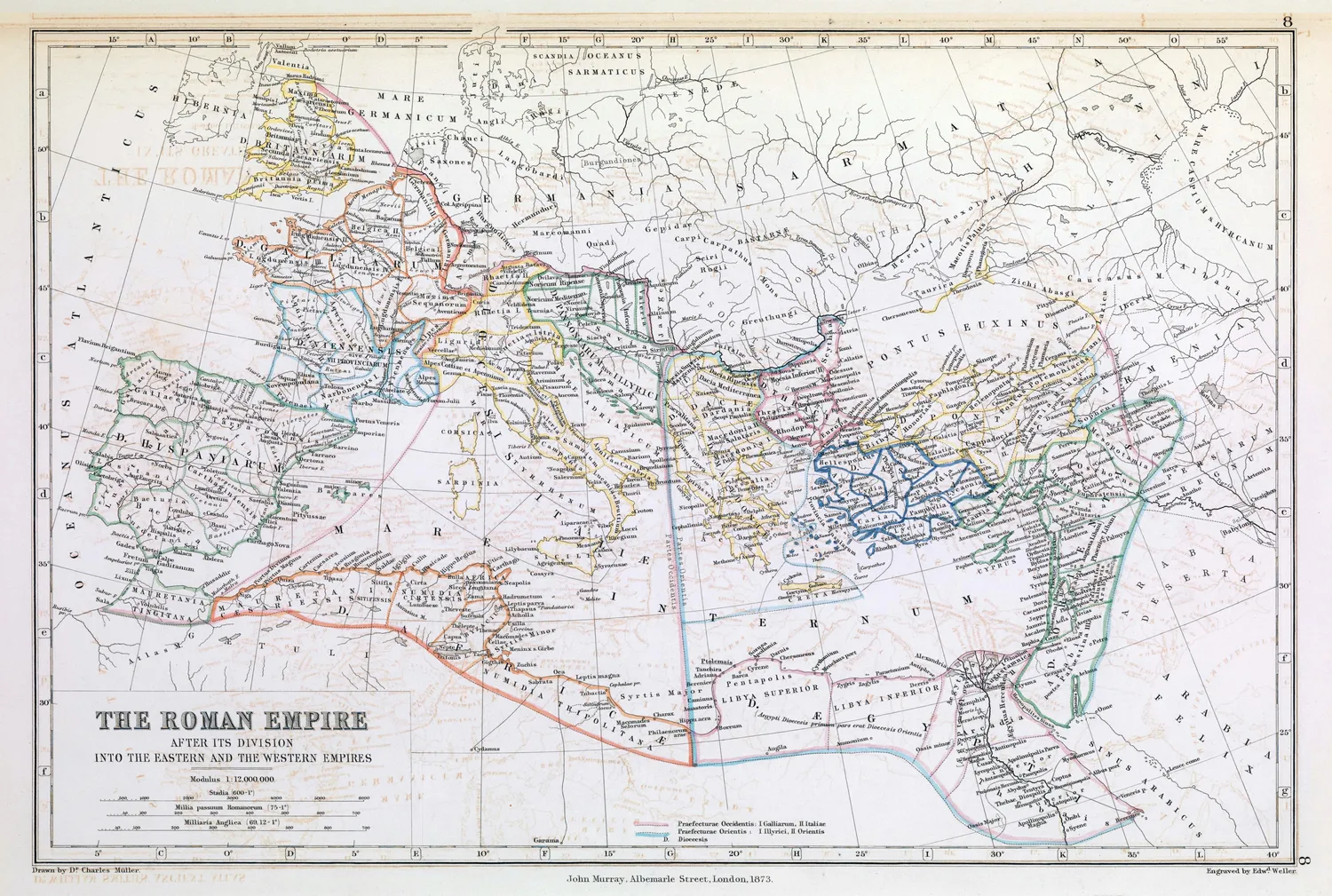
"The Roman Empire after its division into the Eastern and the Western Empires" by William Smith / George Grove / Wikimedia Commons
The Roman Empire was one of the largest and most powerful civilizations in ancient history. By the third century CE, it controlled vast lands across Europe, North Africa, and the Middle East. However, the empire faced serious challenges, including economic troubles, military invasions, and internal conflict. To address these problems, the empire was eventually divided into two parts: the Eastern and Western Roman Empires.
One major reason for the division was the sheer size of the empire. Managing such a vast territory became difficult, especially when communication and transportation were slow. In 285 CE, Emperor Diocletian decided to split the empire in half. He hoped this would make governing easier and help defend against outside threats. Diocletian ruled the eastern part from the city of Nicomedia, while his co-emperor, Maximian, ruled the west from Milan. This system was called the Tetrarchy, meaning "rule by four," because each half later had a junior emperor as well. Archaeological evidence, such as coins issued in both halves, shows how authority was shared and communicated across the empire.
After Diocletian retired, the empire was briefly reunited, but new problems soon arose. In 330 CE, Emperor Constantine established a new capital at Constantinople (modern-day Istanbul). Its strategic location on the Bosporus Strait allowed for control of trade routes between Europe and Asia. The city’s formidable walls, described by the historian Procopius, helped protect it from invaders. The Western Empire, meanwhile, faced frequent attacks by groups like the Visigoths and Vandals. In 410 CE, the Visigoths famously sacked Rome, shocking the ancient world. By 476 CE, the last Western Roman emperor, Romulus Augustulus, was deposed, marking the traditional end of the Western Roman Empire.
Despite the fall of the West, the Eastern Roman Empire—later called the Byzantine Empire—continued for nearly a thousand years. It preserved Roman laws, culture, and Christianity, and developed its own rich traditions. The social hierarchy in Byzantium included emperors, nobles, and commoners, with daily life centered around the capital, Constantinople. The empire’s administrative records and religious mosaics still survive today, providing primary sources for historians. Over time, the division between East and West shaped the religious and political map of Europe and the Mediterranean.
The division of the Roman Empire was a turning point in history. It allowed the East to survive and thrive, while the West declined and eventually fell. This separation influenced the rise of new kingdoms in Western Europe and the spread of Christianity in both regions. Understanding the reasons for and effects of the division helps explain the foundations of modern Europe and the development of different Christian traditions.
This moment connects to broader themes in history, such as how geography, leadership, and cultural change affect civilizations over time.
Interesting Fact: The city of Constantinople’s famous Hagia Sophia was originally built as a cathedral under Emperor Justinian in the 6th century and still stands today.
Comprehension quiz (8 questions)
1. Who divided the Roman Empire?
2. Where was the new Eastern capital?
3. What year did the Western Empire end?
4. What problem made ruling the empire hard?
5. Why was Constantinople well protected?
6. How did the division affect Christianity?
7. The Tetrarchy was rule by four leaders.
8. What does 'social hierarchy' mean?
Perfect for the way you teach
- Build comprehension skills
- Auto-graded quiz
- Differentiated reading
- Read together at home
- Improve fluency
- Quiet reading time
- Reading curriculum support
- Independent practice
- Track Lexile growth