This learning resource is available in interactive and printable formats. The interactive worksheet can be played online and assigned to students. The Printable PDF version can be downloaded and printed for completion by hand.
This engaging reading passage explores the significance of the Neolithic Revolution, focusing on the domestication of animals for farming. Students will learn how early humans shifted from hunting and gathering to settled agricultural societies, examining archaeological evidence and primary sources from sites like Çatalhöyük and Jericho. Key vocabulary such as 'domestication,' 'subsistence,' and 'pastoralist' is woven throughout the text to support academic learning. The passage is designed to fulfill history standards 6.2.2 and RH.6-8.2, and includes assessments to encourage historical analysis and critical thinking. Graphic organizers and a timeline help students track the sequence and effects of domestication. A Spanish translation and read aloud audio are provided for accessibility. This resource is ideal for deepening understanding of ancient history, human adaptation, and the transformative impact of farming on society.
CONTENT PREVIEW
Expand content preview
Scheme of commons task in cattle-raising during Neolithic Age in relation with its tools.José-Manuel Benitoderivative work: Phirosiberia (talk)/ Wikimedia Commons
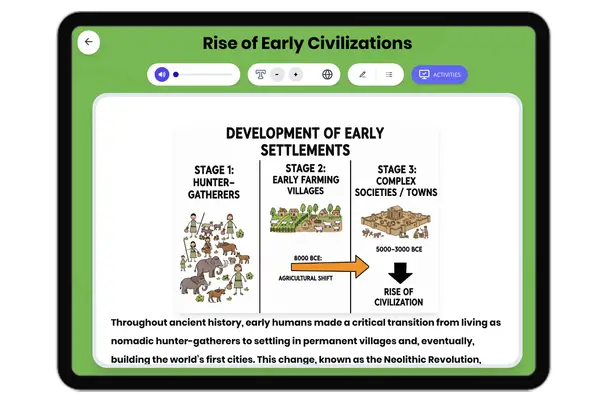
The Neolithic Revolution marked a major shift in human history as early communities began to rely on farming and the domestication of animals. This transformation started around 10,000 BCE in the Fertile Crescent, a region in the Middle East known for its rich soils and reliable water sources. Before this period, most people survived as hunter-gatherers, moving frequently to find food. The change to settled farming communities allowed humans to produce surplus food and support larger populations.
One of the most significant innovations during the Neolithic Revolution was the domestication of wild animals. Archaeological evidence from sites like Çatalhöyük in modern-day Turkey shows that people began to tame and breed animals such as sheep, goats, and cattle as early as 8,000 BCE. These animals provided a steady supply of meat, milk, wool, and labor. For example, sheep bones found at Çatalhöyük display evidence of selective breeding, which suggests people were intentionally choosing animals with desirable traits. In addition, at Jericho, archaeologists have found remains of domesticated goats, which became crucial for both food and clothing.
Domesticating animals was a complex process. Early farmers had to choose animals that were not only useful but also adaptable to human-controlled environments. Over time, humans selected animals for traits like docility, size, and productivity. This process differed from taming, as domestication involved breeding over generations to create animals dependent on humans. As a result, humans became pastoralists, raising herds for specific purposes. The domestication of animals also led to new forms of social organization, as some families or clans became responsible for managing herds, creating early forms of social hierarchy.
Geography played a critical role in which animals were domesticated. In the Fertile Crescent, the presence of wild sheep, goats, and cattle made domestication possible. In other regions, such as East Asia and the Andes, people domesticated animals like pigs, chickens, and llamas. This spread of domesticated animals and farming techniques eventually led to permanent settlements, the growth of villages, and the rise of early cities. The ability to raise animals for food and labor allowed for specialization of labor, as not everyone was needed in food production. This enabled the development of crafts, trade, and more complex societies.
The domestication of animals during the Neolithic Revolution changed the course of human history. It provided reliable sources of food, clothing, and work animals, which supported population growth and technological innovation. These changes laid the foundation for the development of civilizations across the world. The transition from hunting and gathering to farming and animal husbandry is a key example of how humans adapt to and shape their environment.
This transformation connects to broader themes in ancient history, such as the rise of agriculture, the development of social structures, and the importance of geography in shaping human societies.
Interesting Fact: Archaeologists have discovered ancient dog skeletons buried alongside humans, suggesting that dogs may have been the first domesticated animals and also held a special place in early societies.
Where did the Neolithic Revolution start?
Fertile CrescentEgyptGreeceEast Asia
What animals were first domesticated at Çatalhöyük?