Effects of the Gold Rush
Interactive passage with audio narration, comprehension questions, and printable PDF.
By completing this purchase you agree to our Terms of Use and Privacy Policy. Your subscription renews automatically until you cancel. You can cancel anytime from your account settings. All sales are final and non-refundable. Digital content is available for download in your account immediately upon purchase.
What's included
Part of this bundle

Effects of the Gold Rush preview and details
About this printable Effects of the Gold Rush reading passage (Grades 3-5)
Sample passage and quiz from Effects of the Gold Rush
Reading passage and comprehension quiz preview
Effects of the Gold Rush
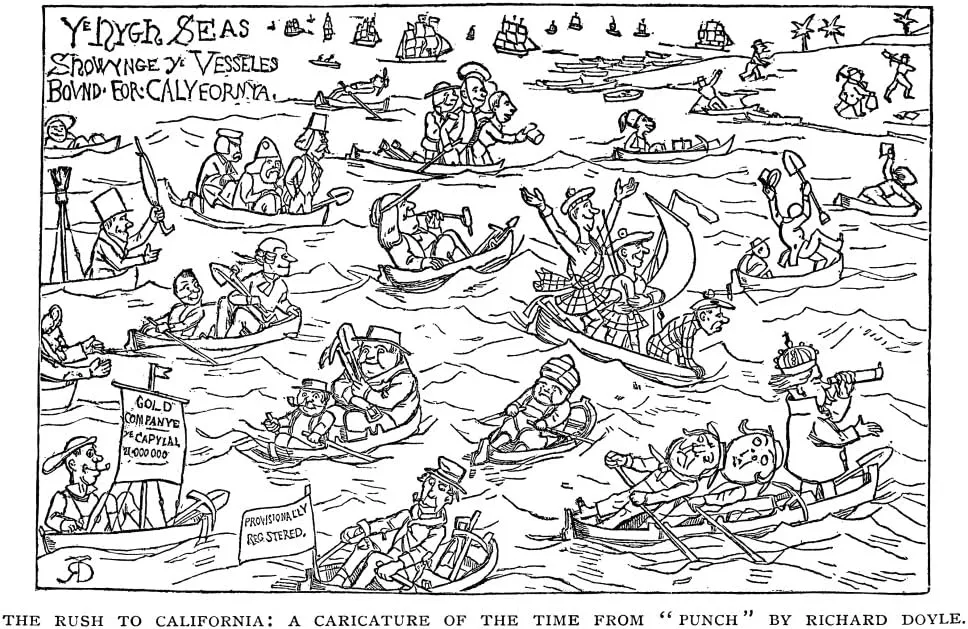
"California Gold Rush Caricature" by Richard Doyle / Wikimedia Commons
The Gold Rush began in California in 1848 when gold was found at Sutter’s Mill. News spread quickly. Soon, thousands of people traveled to California. They came from other parts of the United States and even from countries like China and Mexico. These people were called migrants because they moved to a new place for a better life.
The Gold Rush caused a huge demographic change. In just a few years, California’s population exploded. In 1848, about 14,000 people lived in California. By 1852, there were over 200,000. Towns and cities grew quickly. San Francisco became a busy port and city almost overnight.
Many people hoped to find gold and become rich. Some did, but most did not. Instead, people found other ways to earn money. Some opened stores, hotels, or restaurants. California’s economy grew because so many people needed food, tools, and supplies. This economic boom helped California become an important part of the United States.
The rapid growth also led to California becoming a state in 1850. This was important for the country. It helped the United States grow westward. People from many backgrounds had to work together to build new towns and farms.
However, not everyone benefited. The Gold Rush caused a lot of displacement for Native Americans. Many lost their land and homes as newcomers took over. Some Native Americans died from disease or conflict. This was a tragedy that changed their way of life forever.
The Gold Rush also brought hard challenges. Water was sometimes scarce. Law and order were hard to keep. But people showed bravery and found solutions to problems. They built roads, schools, and new ways to travel. The Gold Rush changed California and the nation in lasting ways.
Today, we remember the Gold Rush as a time of great change. It created new opportunities but also brought sorrow to some. The story of the Gold Rush shows how people’s hopes and hard work can shape history, for better and for worse.
Interesting Fact: In 1849, people who moved to California for gold were called “Forty-Niners.”
Comprehension quiz (8 questions)
1. When did the Gold Rush begin?
2. What was Sutter’s Mill known for?
3. What city grew quickly during the Gold Rush?
4. Why did people move to California?
5. How did the Gold Rush help the economy?
6. What happened to many Native Americans?
7. The Gold Rush led to California becoming a state.
8. What is the meaning of 'migrants'?
Perfect for the way you teach
- Build comprehension skills
- Auto-graded quiz
- Differentiated reading
- Read together at home
- Improve fluency
- Quiet reading time
- Reading curriculum support
- Independent practice
- Track Lexile growth