California Forty-Niners
Interactive passage with audio narration, comprehension questions, and printable PDF.
By completing this purchase you agree to our Terms of Use and Privacy Policy. Your subscription renews automatically until you cancel. You can cancel anytime from your account settings. All sales are final and non-refundable. Digital content is available for download in your account immediately upon purchase.
What's included
Part of this bundle

California Forty-Niners preview and details
About this printable California Forty-Niners reading passage (Grades 3-5)
Sample passage and quiz from California Forty-Niners
Reading passage and comprehension quiz preview
California Forty-Niners
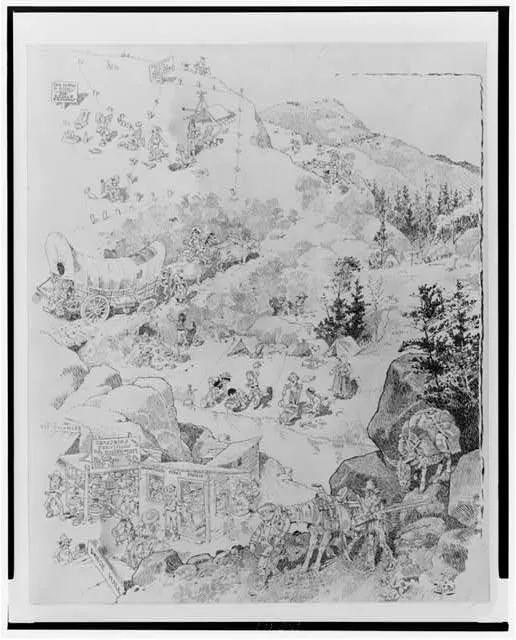
Source: Library of Congress - Crawford, Will, 1869-1944
The California Forty-Niners were people who rushed to California in 1849 to search for gold. In January 1848, gold was found at Sutter’s Mill in northern California. News spread quickly across the United States and around the world. By the next year, thousands of people left their homes and traveled to California, hoping to become rich.
The journey to California was long and dangerous. Some people traveled across the country in covered wagons. Others took ships around South America or crossed the jungles of Panama. They faced harsh weather, sickness, and rough roads. Many people did not reach California, but those who did were full of hope and excitement.
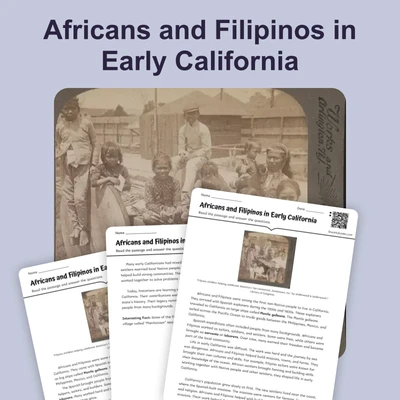
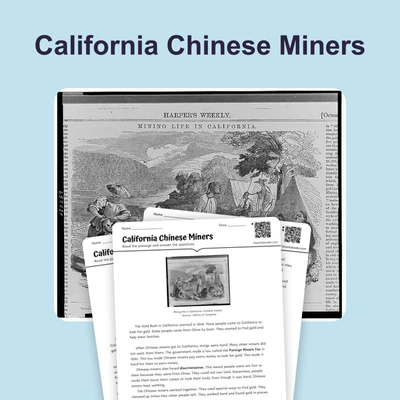
The people who went to California in 1849 were called “Forty-Niners.” They came from all over the world. People came from the United States, Mexico, South America, Europe, Asia, and even Australia. This made California a place with many different cultures and languages. The Forty-Niners worked hard, using picks, shovels, and gold pans to search for gold in rivers and streams.
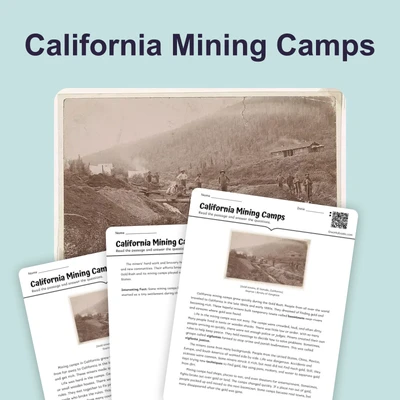
Mining for gold was hard work. Most Forty-Niners did not find much gold, but some became very rich. Many set up camps and small towns near rivers. These towns grew quickly as more people arrived. Stores, hotels, and banks opened to help the new settlers. Some people made more money selling supplies than searching for gold.
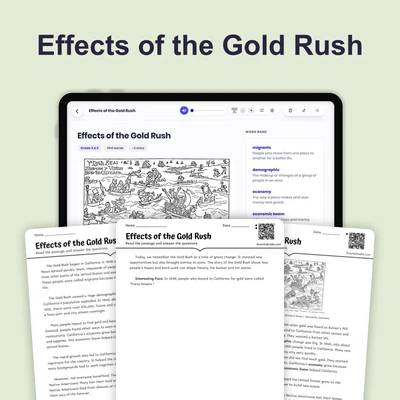
The California Gold Rush changed the state forever. The population grew rapidly, and new cities like San Francisco became busy centers for trade and business. The Gold Rush also brought people from many backgrounds together. Even though life was hard, people helped each other and built new communities. The dream of finding gold brought hope, but it was the hard work and bravery of the Forty-Niners that helped shape California’s future.
Interesting Fact: Levi Strauss, who invented blue jeans, first sold his pants to Forty-Niners who needed strong clothes for mining.
Comprehension quiz (8 questions)
1. When did the Gold Rush start?
2. Where was gold first found?
3. Who were called Forty-Niners?
4. Why did people move to California?
5. What was one challenge the Forty-Niners faced?
6. How did the Gold Rush change California?
7. True or False: Most miners became rich.
8. What does "diverse" mean in the passage?
Perfect for the way you teach
- Build comprehension skills
- Auto-graded quiz
- Differentiated reading
- Read together at home
- Improve fluency
- Quiet reading time
- Reading curriculum support
- Independent practice
- Track Lexile growth