Africans and Filipinos in Early California — Reading Comprehension
Rate this
Premium Resource
Present
Present in classroom. No work saved
Assign
Classroom with student accounts, Track progress
Quick Play
No student accounts, assign with a link
Grades
3
4
5
Standards
D2.HIS.1.4-5
D2.HIS.2.4-5
RI.4.3
RI.4.4
W.4.2
PRINT+DIGITAL RESOURCE
This learning resource is available in interactive and printable formats. The interactive worksheet can be played online and assigned to students. The Printable PDF version can be downloaded and printed for completion by hand.
This engaging reading passage explores the important roles Africans and Filipinos played in the early expeditions to California during the era of European exploration and colonization. Students will learn how people from Africa and the Philippines joined Spanish explorers on their journeys, helped build missions, and contributed to California's early settlements. The passage highlights key historical events, figures, and cause-and-effect relationships in a clear, chronological narrative. Aligned to C3 Framework and Common Core standards, this resource helps students build historical understanding, reading comprehension, and vocabulary. Activities include a multiple-choice quiz, writing prompts, timeline, glossary, and graphic organizer. Also included are a Spanish translation and read aloud audio, making this an accessible and comprehensive resource for U.S. History instruction.
CONTENT PREVIEW
Expand content preview
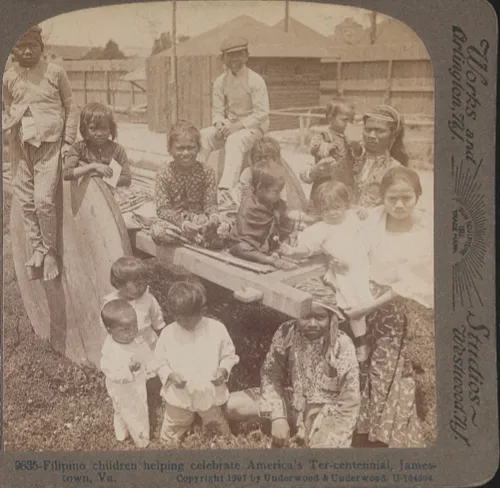
"Filipino children helping celebrate America's Ter-centennial, Jamestown, Va." by Underwood & Underwood / Library of Congress.
Africans and Filipinos were among the first non-Native people to live in California. They arrived with Spanish explorers during the 1500s and 1600s. These explorers traveled to California on large ships called Manila galleons. The Manila galleons sailed across the Pacific Ocean to trade goods between the Philippines, Mexico, and California.
Spanish expeditions often included people from many backgrounds. Africans and Filipinos worked as sailors, soldiers, and settlers. Some were free, while others were brought as servants or laborers. Over time, many earned their freedom and became part of the local community.
Life in early California was difficult. The work was hard and the journey by sea was dangerous. Africans and Filipinos helped build missions, towns, and farms. They brought their own cultures and skills. For example, Filipino sailors were known for their knowledge of the ocean. African settlers brought farming and building skills. Working together with Native people and other settlers, they shaped life in early California.
California’s population grew slowly at first. The new settlers lived near the coast, where the Spanish built missions. The missions were centers for farming, learning, and religion. Africans and Filipinos helped with building, farming, and protecting the missions. Their work helped California grow into a diverse and multicultural place.
Many early Californians had mixed backgrounds. Some African and Filipino settlers married local Native people. Their families created new traditions and helped build strong communities. These early settlers showed courage and skill. They worked together to solve problems and build a new life in a new land.
Today, historians are learning more about the stories of Africans and Filipinos in California. Their contributions were often forgotten. But they played a key role in the state’s history. Their legacy reminds us that California has always been home to people from many backgrounds.
Interesting Fact: Some of the first Filipino settlers in California founded a small village called “Manilatown” near the coast in the late 1700s.
Who arrived in California with Spanish explorers?
Africans and FilipinosEnglish and DutchChinese and RussiansFrench and Germans
What were Manila galleons?
Large Spanish shipsGold minesNative villagesFarming tools
Where did most early settlers live?
Near the coastIn the mountainsIn the desertFar from water
Why did Africans and Filipinos work together?
To build missions and townsTo find goldTo fish for whalesTo hunt buffalo
What did Filipino sailors bring?
Ocean knowledgeGold coinsWild horsesSugarcane
Why was life hard for early settlers?
Work was hard and trips dangerousNo one spoke SpanishToo much rainToo many animals
Africans and Filipinos helped build California. (True/False)
TrueFalse
What does 'multicultural' mean?
Many cultures togetherJust one cultureOnly Spanish cultureNo culture at all
Perfect For:
👩🏫 Teachers
• Reading comprehension practice
• Auto-graded assessments
• Literacy skill development
👨👩👧👦 Parents
• Reading practice at home
• Comprehension improvement
• Educational reading time
🏠 Homeschoolers
• Reading curriculum support
• Independent reading practice
• Progress monitoring
Reading Features:
📖
Reading Passage
Engaging fiction or nonfiction text
❓
Comprehension Quiz
Auto-graded questions
📊
Instant Feedback
Immediate results and scoring
📄
Printable Version
Download for offline reading
🔊
Read Aloud
Voice-over with word highlighting
Reviews & Ratings
No reviews yet. Be the first to share your experience!
Related Content
The Bear Flag Revolt
This engaging U.S. History reading passage explores the Bear Flag Revolt, an important event during the time of Westward...
D2.HIS.1.4-5D2.HIS.2.4-5D2.HIS.3.4-5RI.4.3
The Siege of Boston: Surrounding the British
This passage explores the Siege of Boston, a key event at the start of the American Revolution. Students will learn how ...
D2.HIS.1.4-5D2.HIS.2.4-5D2.HIS.14.4-5RI.4.3
Informational Text —Healthy Teeth and Gums
RI.4.10RI.4.3RF.4.4RF.4.4.A
Informational Text —Migratory Birds
Engage young minds with this worksheet that delves into the wonders of migratory birds. Learn about their extraordinary ...
RI.4.10RI.4.3RF.4.4RF.4.4.A
Informational Text —All About Dentists
Students read an informational text explaining what dentists do and how they are trained. Aligned to RI.4.3-2
RI.4.10RI.4.3RF.4.4RF.4.4.A
Pollination: A Crucial Ecosystem Service
Explore the vital role of pollination beyond plant reproduction, as it sustains ecosystems by ensuring food security, pr...
RI.4.2RI.4.3RI.4.4RI.5.1
The States of Matter: Solid
Discover the differences between solids, liquids and gases by exploring how their particles are arranged and move. This ...
RI.4.2RI.4.3RI.4.4RI.5.1
What is a Simple Machine
Discover the power of simple machines! This informational text explores how basic tools like levers, pulleys and incline...
RI.4.2RI.4.3RI.4.4RI.5.1
The Role of Pollinators in Nature
Learn about the fascinating world of pollinators and discover their crucial role in the reproductive process of flowerin...
RI.4.2RI.4.3RI.4.4RI.5.1
Seed Dispersal: How Plants Travel
Plants may seem stationary, but their seeds have amazing ways to travel! Explore the fascinating world of seed dispersal...
RI.4.2RI.4.3RI.4.4RI.5.1
What is Milky Way
This engaging passage introduces Grade 4-5 students to the Milky Way, our home galaxy. Students will learn that the Milk...
5-ESS1-15-ESS1-2RI.3.1RI.3.4
Andromeda Galaxy
This engaging science passage introduces Grade 4-5 students to the Andromeda Galaxy, our closest large galactic neighbor...
5-ESS1-15-ESS1-2RI.3.1RI.3.4
Bats in the Night
This informative first-grade reading passage delves into the intriguing world of bats, highlighting their nocturnal natu...
RI.3.1RI.4.4RI.4.3
Malala Yousafzai
This Grade 4-5 science reading passage introduces students to Malala Yousafzai, a courageous young woman from Pakistan w...
NGSSRI.3.1RI.3.2RI.4.3
Understanding Biological Evolution and Diversity
This passage addresses the NGSS standard 3-LS4-2 focusing on biological evolution and the unity and diversity of life. T...
RI.3.3RI.4.3RI.5.33-LS4-2
Early Life Forms and Their Adaptations
This educational passage focuses on early life forms and their basic adaptations, supporting NGSS standard 3-LS4-2 for e...
RI.3.3RI.4.3RI.5.33-LS4-2
Simple Machines: How They Work
Students read an informative paragraph on simple machines and fill in key technical vocabulary terms to demonstrate unde...
RI.4.2RI.4.3RI.4.4RI.5.1
Longhouses of the Eastern Woodlands
This engaging U.S. history reading passage explores the longhouses of the Eastern Woodlands, focusing on the Iroquois an...
D2.HIS.1-6.3-5RI.4.1RI.4.3
Traditional Native American Clothing
This engaging history passage explores traditional Native American clothing and how it reflected the environment, values...