This learning resource is available in interactive and printable formats. The interactive worksheet can be played online and assigned to students. The Printable PDF version can be downloaded and printed for completion by hand.
This engaging history reading passage explores the experiences of Chinese miners during the California Gold Rush and Westward Expansion. Students will learn how Chinese immigrants traveled to California in search of fortune but encountered harsh discrimination, special taxes like the Foreign Miners Tax, and violence. Despite these challenges, Chinese miners played a vital role in gold mining and railroad construction, showing perseverance and teamwork. This passage aligns with HSS 4.4.3; RH.6-8.1 and is perfect for classroom instruction, featuring a glossary, timeline, graphic organizers, quizzes, and writing activities. Spanish translation and read aloud audio are included, supporting all learners. Key vocabulary includes discrimination, immigration, perseverance, and more, making this resource valuable for both history and language development.
CONTENT PREVIEW
Expand content preview
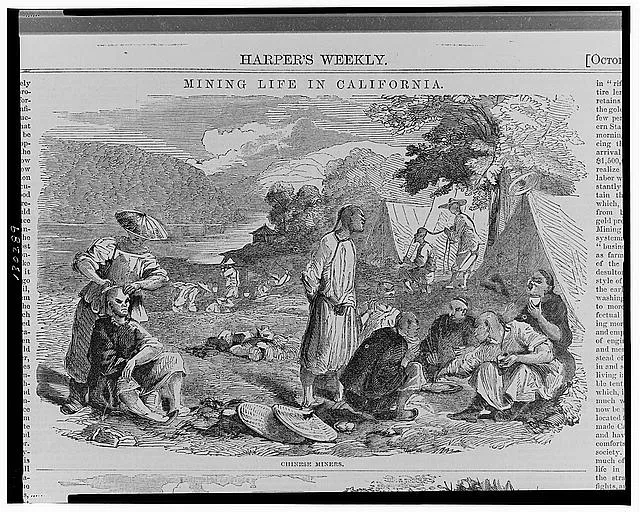
Mining life in California--Chinese miners. Source: Library of Congress
The California Gold Rush began in 1848. People from all over the world came to California to find gold. Many people from China arrived by ship. They hoped to find gold and earn a better life for their families.
When the Chinese miners arrived, they faced many problems. Other miners did not want them there. Some people treated them unfairly and tried to stop them from working. The California government passed the Foreign Miners Tax in 1850. This law forced non-American miners, including Chinese miners, to pay extra money just to mine for gold. The tax made it hard for Chinese miners to make a profit.
Besides the tax, Chinese miners often faced discrimination. Discrimination means treating people unfairly because of their race or where they come from. Chinese miners were not allowed to own land. They were sometimes forced out of mining camps. Sometimes, they were attacked or their tools were stolen. Even with these challenges, the Chinese miners did not give up.
Chinese miners showed perseverance. They worked together in groups and helped each other. They used special mining techniques they learned in China. Many Chinese miners cleaned up old mining claims that others left behind. They worked hard and found gold where others had given up.
By the 1860s, many Chinese miners moved on to find other work. Some helped build the Transcontinental Railroad. Their work was dangerous and difficult, but they were important in finishing the railroad. The railroad helped connect the United States from coast to coast.
The story of Chinese miners in California is one of courage and hope. They faced unfair laws and violence, but they kept working to build a better future. Their hard work helped shape California and the nation.
Interesting Fact: In some towns, Chinese miners made up more than half the population during the Gold Rush.
When did the California Gold Rush begin?
1848185018601871
Why did many Chinese people come to California?
To find goldTo buy landTo visit familyTo start farms
What was the Foreign Miners Tax?
A tax for non-American minersA tax for railroad workersA gold selling lawA tax for land owners
What is discrimination?
Unfair treatment based on raceA type of goldA way to mineA law about taxes
Why did Chinese miners work together in groups?
To help each other succeedTo pay more taxesTo build homesTo sell land
What did some Chinese miners do after mining?
Helped build the railroadMoved to ChinaBecame teachersStarted banks
Chinese miners never faced unfair laws. True or false?
TrueFalse
What does perseverance mean?
Not giving upPaying taxesMining for goldTraveling by ship
Perfect For:
👩🏫 Teachers
• Reading comprehension practice
• Auto-graded assessments
• Literacy skill development
👨👩👧👦 Parents
• Reading practice at home
• Comprehension improvement
• Educational reading time
🏠 Homeschoolers
• Reading curriculum support
• Independent reading practice
• Progress monitoring
Reading Features:
📖
Reading Passage
Engaging fiction or nonfiction text
❓
Comprehension Quiz
Auto-graded questions
📊
Instant Feedback
Immediate results and scoring
📄
Printable Version
Download for offline reading
🔊
Read Aloud
Voice-over with word highlighting
Reviews & Ratings
No reviews yet. Be the first to share your experience!
Related Content
Women and Children of the Gold Rush
This engaging history reading passage explores the vital roles that women and children played during the U.S. Gold Rush ...
HSS 4.4.3RH.6-8.4
San Francisco Growth
This comprehensive U.S. history passage explores the rapid growth of San Francisco during the California Gold Rush. Stud...
HSS 4.4.3RH.6-8.2
California Gold Rush Merchants
This passage explores the role of merchants during the California Gold Rush, highlighting how many business people becam...
HSS 4.4.3RH.6-8.4
Africans and Filipinos in Early California
This history reading passage explores the important role of Africans and Filipinos in early California. Long before the ...
HSS 4.2.1RH.6-8.1
Bear Flag Revolt
This engaging history reading passage covers the Bear Flag Revolt, a pivotal moment during Westward Expansion when Ameri...
HSS 4.3.5RH.6-8.1
First California Constitution
This engaging history reading passage explores the creation of the First California Constitution in 1849, a pivotal even...
HSS 4.3.5RH.6-8.1
California Forty-Niners
This history reading passage explores the story of the California Forty-Niners, who rushed to California in 1849 in sear...
HSS 4.4.2RH.6-8.1
Effects of the Gold Rush
This engaging U.S. History reading passage explores the effects of the Gold Rush on California and the United States. Al...
HSS 4.4.4RH.6-8.1
Golden Spike 1869
This history reading passage explores the 1869 Golden Spike event that marked the completion of America's Transcontinent...
HSS 4.4.1RH.6-8.1
Meroë: Capital of Kush
This passage explores the rise and significance of Meroë, once the capital of the Kingdom of Kush in ancient Africa. Loc...
CA HSS 6.2.6RH.6-8.1RH.6-8.2WHST.6-8.2
Egypt Kush Trade
This engaging history reading passage explores the complex trade networks that connected Ancient Egypt, Kush, and region...
6.2.3RH.6-8.1RH.6-8.4RH.6-8.7
First Humans
This engaging history reading passage explores the evolution of early humans, tracing the journey from the earliest homi...
CA HSS 6.1RH.6-8.1RH.6-8.2W.6.2
Ancient Egyptian Afterlife
This engaging history reading passage explores ancient Egyptian beliefs about the afterlife and the construction of the ...
CA HSS 6.2RH.6-8.1RH.6-8.4
Han Dynasty: Seismograph
Discover the groundbreaking invention of the seismograph during the Han dynasty in ancient China in this engaging histor...
HSS 6.6.7RH.6-8.1RH.6-8.2WHST.6-8.2
Paleolithic Migration by Land and Sea
This passage explores the migration of Paleolithic humans from Africa to the rest of the world, focusing on the routes t...
6.1RH.6-8.1RH.6-8.2RH.6-8.4
Origins of Social Classes
This engaging history reading passage explores how the rise of farming and the spread of pastoral nomads across the Eura...