Evidence for Evolution: Comparative Anatomy
Interactive passage with audio narration, comprehension questions, and printable PDF.
By completing this purchase you agree to our Terms of Use and Privacy Policy. Your subscription renews automatically until you cancel. You can cancel anytime from your account settings. All sales are final and non-refundable. Digital content is available for download in your account immediately upon purchase.
What's included
Evidence for Evolution: Comparative Anatomy preview and details
About this printable Evidence for Evolution: Comparative Anatomy science reading passage, NGSS-aligned (Grades 5-8)
Sample passage and quiz from Evidence for Evolution: Comparative Anatomy
Reading passage and comprehension quiz preview
Evidence for Evolution: Comparative Anatomy
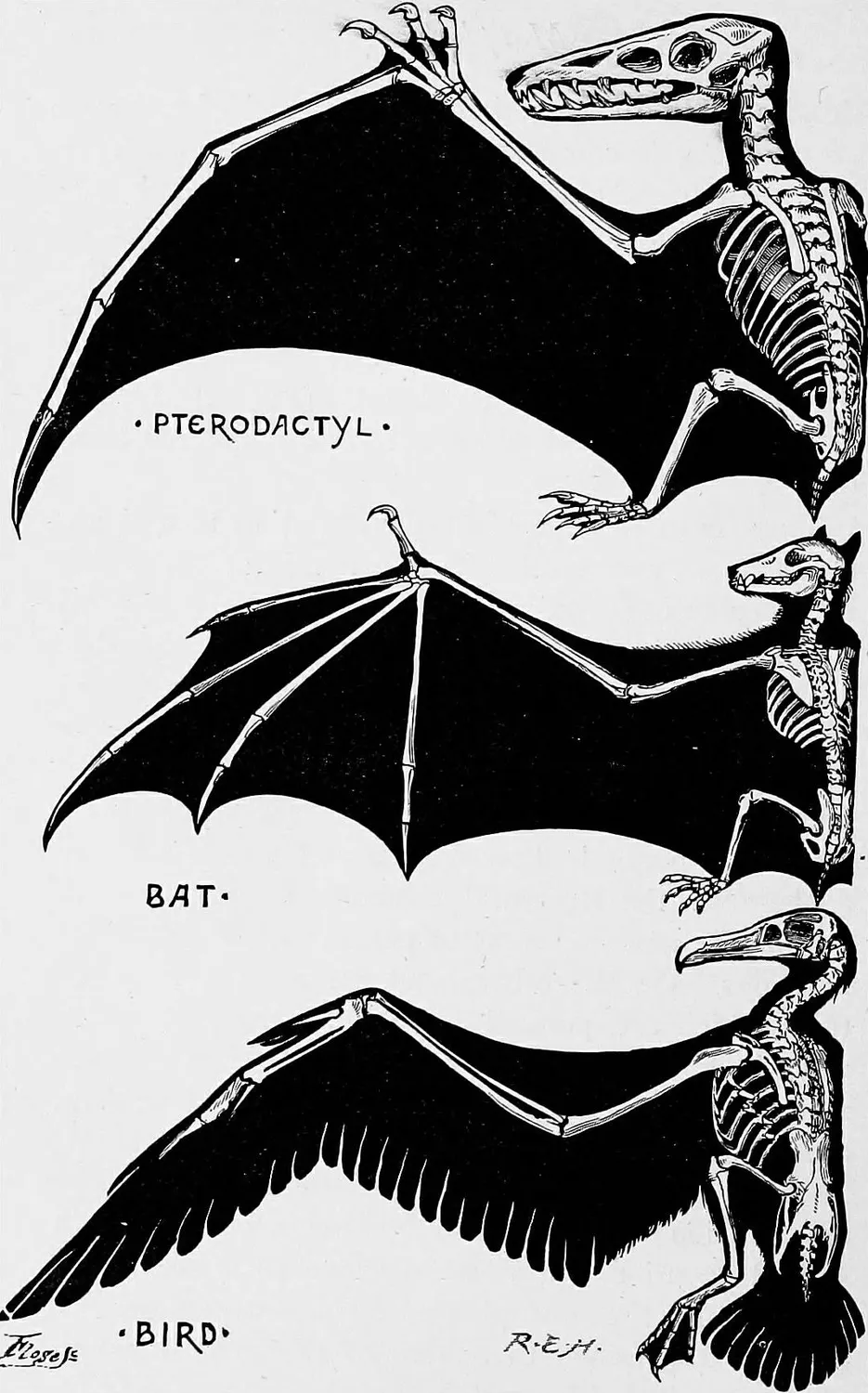
"Homology" by John Romanes (1848-1894) / Wikimedia Commons (Public domain).
Comparative anatomy is a branch of science that examines the similarities and differences in the body structures of different organisms. Scientists have discovered that certain patterns in animal anatomy can only be explained by evolutionary processes. For example, the bones in a human arm, a whale flipper, and a bat wing appear very different on the outside, but their internal structures are strikingly similar. This evidence helps scientists answer the fundamental question: How do we know that different species are related through evolution?
Homologous Structures: Evidence of Shared Ancestry
A homologous structure is a body part that has a similar structure but may serve a different function in different species. For instance, the arm bones in humans, the wings of bats, and the flippers of whales all share a similar arrangement of bones—such as the humerus, radius, and ulna. These similarities exist because these animals inherited these structures from a common ancestor. Even though these limbs are used for grasping, flying, or swimming, their underlying bone patterns reveal their shared origin. According to research, over 90% of vertebrate animals have limb bones arranged in this way. This pattern supports the idea that species change over time, adapting their limbs to new environments and ways of life.
Analogous and Vestigial Structures: Variations and Remnants
Not all similar-looking body parts are inherited from a common ancestor. Analogous structures are features that serve similar functions but have different internal structures and evolutionary origins. For example, the wings of birds and insects both help them fly, but their wing structures are built differently. Bird wings have bones, while insect wings are made of a thin membrane. These features evolved independently, showing how different species can develop similar solutions to environmental challenges—a process called convergent evolution.
Another important clue comes from vestigial structures. These are body parts that have lost most or all of their original function. For example, humans have an appendix, which is a small, unused pouch in the digestive system, and whales have tiny hip bones, even though they have no back legs. Ostriches, which cannot fly, still have small wings. These structures are leftovers from ancestors that used them more fully, and their presence is best explained by evolution.
The Big Picture: Why Comparative Anatomy Matters
Comparative anatomy connects to many scientific principles, including natural selection and adaptation. By analyzing anatomical patterns, scientists can build family trees (phylogenies) that show how species are related. This helps researchers understand how living things respond to environmental pressures and change over millions of years. Comparative anatomy also has real-world applications, such as improving medical research. For example, understanding the similarities between human and animal anatomy helps doctors develop new treatments and drugs by testing them in animals first.
Comparative anatomy reveals the deep connections among living things. By studying homologous, analogous, and vestigial structures, scientists can trace the history of life on Earth and explain the diversity of species we see today.
Interesting Fact:
Whale hip bones, once thought to be useless, actually help support reproductive organs, showing how vestigial structures can sometimes develop new functions!
Comprehension quiz (10 questions)
1. What is the main purpose of comparative anatomy in science?
2. Which of the following is an example of a homologous structure?
3. What does the presence of vestigial structures in animals suggest?
4. What does 'convergent evolution' mean as used in the passage?
5. In the passage, what does the word 'phylogeny' refer to?
6. Why do bird wings and insect wings look similar but have different internal structures?
7. How does comparative anatomy help in medical research, as mentioned in the passage?
8. True or False: All similar-looking body parts in animals come from a common ancestor.
9. True or False: Vestigial structures are completely useless in modern animals.
10. What percentage of vertebrate animals have their limb bones arranged in a similar way, as stated in the passage?
Perfect for the way you teach
- Build comprehension skills
- Auto-graded quiz
- Differentiated reading
- Read together at home
- Improve fluency
- Quiet reading time
- Reading curriculum support
- Independent practice
- Track Lexile growth