Vertebrates: Mammals
Interactive passage with audio narration, comprehension questions, and printable PDF.
By completing this purchase you agree to our Terms of Use and Privacy Policy. Your subscription renews automatically until you cancel. You can cancel anytime from your account settings. All sales are final and non-refundable. Digital content is available for download in your account immediately upon purchase.
What's included
Vertebrates: Mammals preview and details
About this printable Vertebrates: Mammals science reading passage, NGSS-aligned (Grades 5-8)
Sample passage and quiz from Vertebrates: Mammals
Reading passage and comprehension quiz preview
Vertebrates: Mammals
Mammals are a class of vertebrates that display a remarkable range of forms and behaviors across the planet. From the icy waters inhabited by whales to the hot Australian outback where kangaroos hop, mammals have adapted to nearly every environment. Scientists classify mammals by a set of unique characteristics that distinguish them from other animals, making them a crucial focus for understanding how biological systems evolve and interact.
Key Characteristics of Mammals
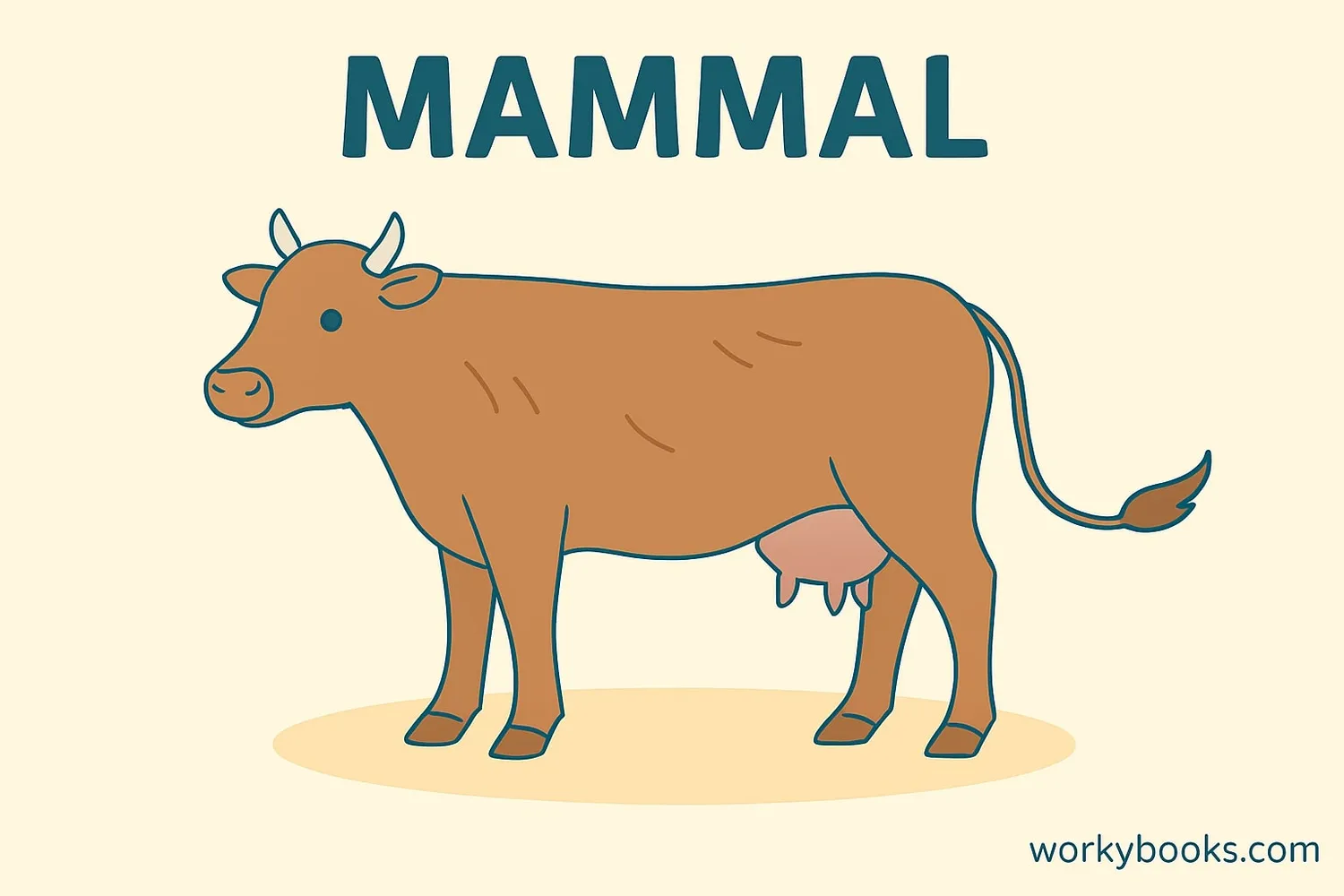
All mammals share several defining features. They possess a backbone, making them vertebrates. Mammals are endothermic, meaning they maintain a stable internal body temperature regardless of the environment. They are covered with hair or fur, which helps with insulation. One of the most significant features is the presence of mammary glands—specialized organs that produce milk to nourish their young. Most mammals give live birth, unlike other vertebrates such as birds or reptiles. They also have a four-chambered heart that efficiently separates oxygen-rich and oxygen-poor blood, and their teeth are specialized for different diets. Additionally, mammals have relatively large brains compared to their body size, supporting complex behaviors and learning.
Groups of Mammals and Adaptations
Mammals are divided into three major groups based on how they reproduce and care for their young. Monotremes are the only egg-laying mammals, with the platypus and echidna as examples. Marsupials, like kangaroos and koalas, give birth to tiny, undeveloped young that continue to grow inside a pouch. The largest group is the Placental mammals, which include humans, whales, bats, and most other mammals. Placental mammals develop their young inside the mother’s body for a longer period, receiving nutrients through a placenta. These differences in reproduction have allowed mammals to adapt to diverse environments. For example, whales are fully aquatic, bats are the only mammals capable of true flight, and moles have adapted for burrowing underground. Scientists study these adaptations using fossil evidence and genetic data to understand evolutionary relationships.
Ecological Roles and Human Connection
Mammals occupy a wide range of ecological roles. Some, like deer and elephants, are herbivores that shape plant communities. Others, such as lions and wolves, are carnivores that regulate populations of other animals. Many mammals are omnivores, eating both plants and animals, which allows them to exploit various food sources. Certain mammals, such as bats, act as pollinators or help disperse seeds, supporting plant reproduction and ecosystem health. Humans are classified as mammals in the order Primates. Our ability to alter environments and use technology is linked to our advanced brains, a trait shared among mammals. Understanding mammal diversity helps scientists protect species and ecosystems, especially as many mammals face threats from habitat loss and climate change.
By examining the systems and interactions that define mammals, scientists gain insight into broader biological principles—such as adaptation, evolution, and interdependence—central to life on Earth.
Interesting Fact: The blue whale, a mammal, is the largest animal ever known to have lived, reaching lengths of up to 30 meters (almost 100 feet).
Comprehension quiz (10 questions)
1. Which feature is shared by all mammals?
2. What is the primary function of mammary glands in mammals?
3. Monotremes, marsupials, and placental mammals are distinguished mainly by their:
4. What role do bats play in some ecosystems, according to the passage?
5. In the passage, what does the term 'endothermic' mean?
6. Which of the following is NOT a mammal group described in the passage?
7. How does a four-chambered heart help mammals?
8. Why is studying mammal adaptations important for scientists?
9. True or False: All mammals lay eggs.
10. True or False: Humans are classified as mammals in the order Primates.
Perfect for the way you teach
- Build comprehension skills
- Auto-graded quiz
- Differentiated reading
- Read together at home
- Improve fluency
- Quiet reading time
- Reading curriculum support
- Independent practice
- Track Lexile growth