This learning resource is available in interactive and printable formats. The interactive worksheet can be played online and assigned to students. The Printable PDF version can be downloaded and printed for completion by hand.
This middle school science passage explains the theory of evolution and the concept of common ancestry, aligning with NGSS standards MS-LS4-1 and MS-LS4-2. Students will learn how biological evolution describes changes in species over generations, the evidence for a shared ancestry among all living things, and Charles Darwin’s contributions through his observations on the HMS Beagle. The passage clarifies the scientific meaning of 'theory,' discusses mechanisms like natural selection, and provides real-world examples, including Galápagos finches and antibiotic resistance. Designed for grades 6-8, the resource includes a glossary, Spanish translation, simplified version, comprehension quiz, writing prompts, and interactive graphic organizers. Audio integration supports accessibility, making it ideal for diverse classroom needs. Keywords: evolution, common ancestry, Darwin, adaptation, natural selection, NGSS.
CONTENT PREVIEW
Expand content preview
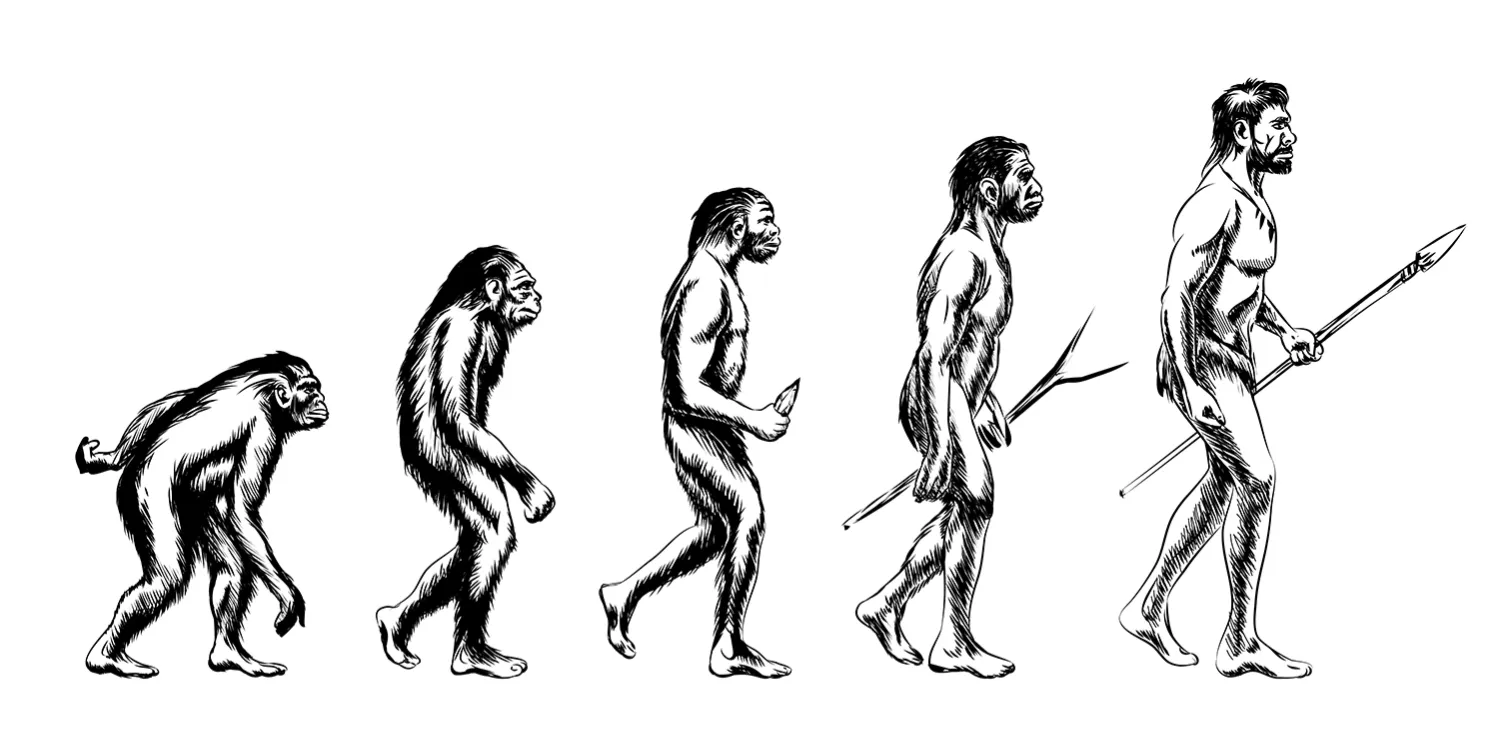
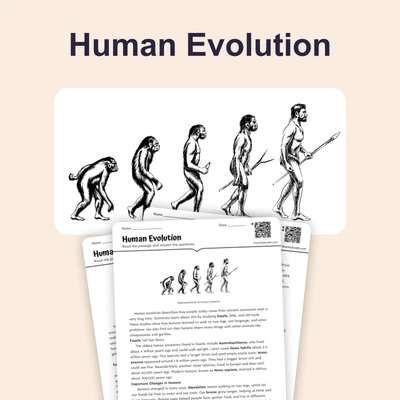
Representation of human evolution
Biological evolution is the scientific explanation for how living things change across generations. Scientists observe that species are not fixed—over long periods, populations shift in characteristics, sometimes leading to entirely new species. This ongoing process helps explain the enormous diversity of life on Earth. Understanding evolution is essential to modern biology and helps us answer big questions, such as why different organisms share similar features or how new species arise.
How Evolution Works: Variation, Inheritance, and Natural Selection
Evolution relies on three main mechanisms: variation, inheritance, and natural selection. Variation means individuals within a species are not all identical. For example, some finches on the Galápagos Islands have large beaks, while others have small beaks. Inheritance allows traits to pass from parents to offspring through genes. Natural selection is the process where individuals with traits suited to their environment tend to survive and reproduce more successfully. Over many generations, advantageous traits become more common, causing the species to adapt.
Evidence for Common Ancestry: The Tree of Life
Scientists have collected evidence—such as fossils, DNA similarities, and shared body structures—to show that all life forms are related. This idea is called common ancestry. The “tree of life” is a model that shows how species branch out from shared roots, with each split representing a common ancestor. For example, humans and chimpanzees share about 98% of their DNA. The presence of vestigial structures, such as tiny leg bones in whales, also supports this idea.
Darwin’s Discovery and the Scientific Meaning of Theory
Charles Darwin’s voyage on the HMS Beagle was critical for the development of evolutionary theory. Observing finches and tortoises on the Galápagos Islands, Darwin noticed that their differences were related to the environments they inhabited. He proposed that species change over time through natural selection. In science, a theory is not just a guess, but a well-tested explanation supported by evidence. Evolution is both a fact—because we observe change—and a theory—because it explains the mechanisms causing change. Importantly, evolution does not mean progress toward perfection; it describes adaptation to current environments.
Evolutionary principles have real-world applications, such as understanding antibiotic resistance in bacteria or breeding crops for specific traits. These concepts connect to broader scientific principles, showing how all life is interconnected and constantly changing.
Interesting Fact: Some bacteria can evolve resistance to antibiotics in as few as 11 days, demonstrating how quickly evolution can occur under strong selection pressure.
What does biological evolution explain?
How living things change over generationsHow rocks are formedWhy the weather changesHow stars are created
Which of the following is NOT a mechanism of evolution mentioned in the passage?
What evidence supports the idea of common ancestry?
Fossils, DNA similarities, and shared body structuresMoon phasesSound wavesGravity
According to the passage, what did Darwin observe on the Galápagos Islands?
Finches and tortoises with traits related to their environmentsVolcanoes eruptingFish migration patternsRainforest weather
What does the term 'theory' mean in science, according to the passage?
A well-tested explanation supported by evidenceA wild guessA story from the pastA set of laws
In the context of evolution, what is natural selection?
The process where individuals with helpful traits survive and reproduce more successfullyThe study of plantsA random eventThe movement of tectonic plates
Why is evolution important in understanding antibiotic resistance?
Because bacteria evolve quickly and can become resistant to medicinesBecause it explains plant growthBecause it predicts earthquakesBecause it creates new planets
According to the passage, evolution means species become perfect over time. (True/False)
TrueFalse
According to the passage, evolution only happens in animals. (True/False)
TrueFalse
Which percentage of DNA do humans and chimpanzees share, as stated in the passage?
About 98%25%45%100%
Perfect For:
👩🏫 Teachers
• Reading comprehension practice
• Auto-graded assessments
• Literacy skill development
👨👩👧👦 Parents
• Reading practice at home
• Comprehension improvement
• Educational reading time
🏠 Homeschoolers
• Reading curriculum support
• Independent reading practice
• Progress monitoring
Reading Features:
📖
Reading Passage
Engaging fiction or nonfiction text
❓
Comprehension Quiz
Auto-graded questions
📊
Instant Feedback
Immediate results and scoring
📄
Printable Version
Download for offline reading
🔊
Read Aloud
Voice-over with word highlighting
Reviews & Ratings
No reviews yet. Be the first to share your experience!
Related Content
Extinction: Past and Present
This comprehensive reading passage for grades 6-8 explores the concept of extinction, its causes, and its impact on life...
MS-LS4-1MS-LS2-5
Endangered Species and the Sixth Extinction
This engaging science reading passage for grades 6-8 explores the current biodiversity crisis, known as the 'Sixth Extin...
MS-LS4-1MS-LS2-5
Vertebrates: Fishes
This middle school science reading passage offers an in-depth look at fishes, a major group of vertebrates. It covers fi...
MS-LS4-2MS-LS4-4
Vertebrates: Amphibians
This comprehensive middle school science passage dives into the fascinating world of amphibians, a group of vertebrates ...
MS-LS4-2MS-LS4-4
Vertebrates: Reptiles
This comprehensive science passage for grades 6-8 introduces students to reptiles, a fascinating class of vertebrates. A...
MS-LS4-2MS-LS4-4
Vertebrates: Birds
This middle school science passage explores birds as vertebrates, focusing on their unique adaptations such as feathers,...
MS-LS4-2MS-LS4-4
Vertebrates: Mammals
This comprehensive passage introduces middle school students to the class Mammalia and their defining characteristics, i...
MS-LS4-2MS-LS4-4
Invertebrates: Sponges and Cnidarians
This passage explores two of the simplest animal phyla: Porifera (sponges) and Cnidaria (jellyfish, corals, and sea anem...
MS-LS4-2
Invertebrates: Worms
This comprehensive passage introduces middle school students to the fascinating world of invertebrate worms, focusing on...
MS-LS4-2
Invertebrates: Arthropods
This comprehensive science passage introduces middle school students to the phylum Arthropoda, the largest and most dive...
MS-LS4-2MS-LS4-4
Invertebrates: Mollusks
This middle school science passage introduces students to the phylum Mollusca, focusing on their body structure, main cl...
MS-LS4-2
Invertebrates: Echinoderms
This comprehensive reading passage, aligned to NGSS standard MS-LS4-2, introduces middle school students to the fascinat...
MS-LS4-2
Human Evolution
This middle school science passage explains the scientific evidence for human evolution, aligning with NGSS standards MS...
MS-LS4-1MS-LS4-2
Evidence for Evolution: Comparative Anatomy
This middle school science reading passage explores the evidence for evolution through comparative anatomy, aligning wit...
MS-LS4-2MS-LS4-3
Extinction and Biodiversity
This comprehensive middle school science passage explores the concepts of extinction and biodiversity, aligned to NGSS s...
MS-LS4-1MS-LS4-4
Bacteria
This comprehensive middle school science passage dives into the fascinating world of bacteria, aligned to NGSS standards...
MS-LS4-2MS-LS1-1
Evidence for Evolution: The Fossil Record
This middle school science passage explains the importance of fossils as preserved evidence of ancient life and their ro...
MS-LS4-1
Fossils: Evidence of Past Life
This comprehensive informational passage introduces middle school students to the fascinating world of fossils, in align...
MS-ESS1-4MS-LS4-1
Types of Fossils and Preservation
This engaging informational passage for grades 6-8 explores the different types of fossils and the natural processes tha...