Invertebrates: Mollusks
Interactive passage with audio narration, comprehension questions, and printable PDF.
By completing this purchase you agree to our Terms of Use and Privacy Policy. Your subscription renews automatically until you cancel. You can cancel anytime from your account settings. All sales are final and non-refundable. Digital content is available for download in your account immediately upon purchase.
What's included
Invertebrates: Mollusks preview and details
About this printable Invertebrates: Mollusks science reading passage, NGSS-aligned (Grades 5-8)
Sample passage and quiz from Invertebrates: Mollusks
Reading passage and comprehension quiz preview
Invertebrates: Mollusks
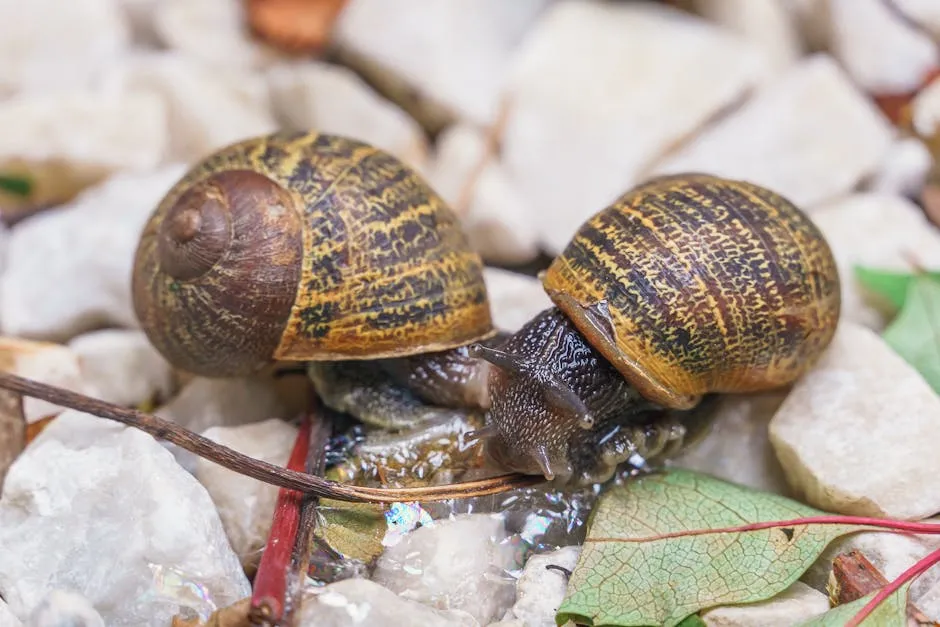
"Close-up of two garden snails on white pebbles surrounded by leaves, showcasing nature's detail." by Cristian Jacinto / Pexels.
Mollusks are one of the largest groups of invertebrates on Earth, including animals as different as snails, clams, and octopuses. Scientists recognize that mollusks share a set of fundamental body features that allow them to thrive in environments ranging from deep ocean trenches to freshwater streams and even dry land. The study of mollusks helps us understand how animal body plans and adaptations can lead to remarkable diversity within a single phylum.
Body Structure and Classes of Mollusks
All mollusks have a soft body with a muscular foot, a mantle, and in many cases, a shell. The muscular foot is used for movement, while the mantle is a tissue layer that often produces a hard, protective shell. Mollusks are divided into three main classes: gastropods, bivalves, and cephalopods. Gastropods, such as snails and slugs, usually have a single spiral shell or no shell at all, and they move by gliding along their foot. Bivalves, like clams, oysters, and mussels, have two-part hinged shells and are mostly filter feeders, pulling water in and trapping food particles as small as 0.01 millimeters. Cephalopods, which include octopuses, squids, and nautiluses, have the most complex nervous systems of all mollusks. Many cephalopods have either a reduced internal shell or none at all, and use tentacles for movement and capturing prey.
Ecological Roles and Human Uses
Mollusks play crucial roles in aquatic ecosystems. Bivalves act as natural water filters—one adult oyster can filter up to 190 liters of water per day, improving water clarity and quality. Gastropods often graze on algae, helping to maintain the balance of aquatic plants. Cephalopods are active predators, using their advanced eyes to locate prey and their tentacles to catch it. Mollusks are a significant food source for many animals, including humans. People eat clams, oysters, and squid, and also use pearls formed by oysters in jewelry. Overharvesting and pollution can threaten mollusk populations, disrupting entire food webs and ecosystem services.
Adaptation, Intelligence, and Scientific Understanding
The study of mollusks shows how structural adaptations support survival. For example, the hard shells of bivalves protect them from predators, while the camouflage abilities and advanced problem-solving skills of octopuses demonstrate the evolution of intelligence in invertebrates. Scientists use comparative anatomy and observation of behavior to understand these adaptations. Research has shown that some octopus species can open jars, solve puzzles, and even use tools, making them one of the most intelligent invertebrates known.
By examining mollusks, scientists learn how body structures, ecological roles, and behavior interact in animal systems. These insights help us protect biodiversity and understand the evolutionary history of life.
Interesting Fact:
Some squid species can swim at speeds over 40 kilometers per hour, making them among the fastest invertebrates in the ocean.
Comprehension quiz (10 questions)
1. What is the main body part that all mollusks have?
2. Which of the following is NOT a class of mollusks?
3. What does the mantle do in a mollusk?
4. Which mollusk class includes animals with tentacles and advanced eyes?
5. What does the term 'filter feeders' mean in the passage?
6. Why are bivalves important for aquatic ecosystems?
7. How do scientists learn about the intelligence of octopuses?
8. If many mollusks disappear from an ecosystem, what could happen?
9. True or False: All mollusks have a hard external shell.
10. True or False: A single oyster can filter over 100 liters of water each day.
Perfect for the way you teach
- Build comprehension skills
- Auto-graded quiz
- Differentiated reading
- Read together at home
- Improve fluency
- Quiet reading time
- Reading curriculum support
- Independent practice
- Track Lexile growth