Fall of the Western Roman Empire
Interactive passage with audio narration, comprehension questions, and printable PDF.
By completing this purchase you agree to our Terms of Use and Privacy Policy. Your subscription renews automatically until you cancel. You can cancel anytime from your account settings. All sales are final and non-refundable. Digital content is available for download in your account immediately upon purchase.
What's included
Fall of the Western Roman Empire preview and details
About this printable Fall of the Western Roman Empire reading passage (Grades 5-8)
Sample passage and quiz from Fall of the Western Roman Empire
Reading passage and comprehension quiz preview
Fall of the Western Roman Empire
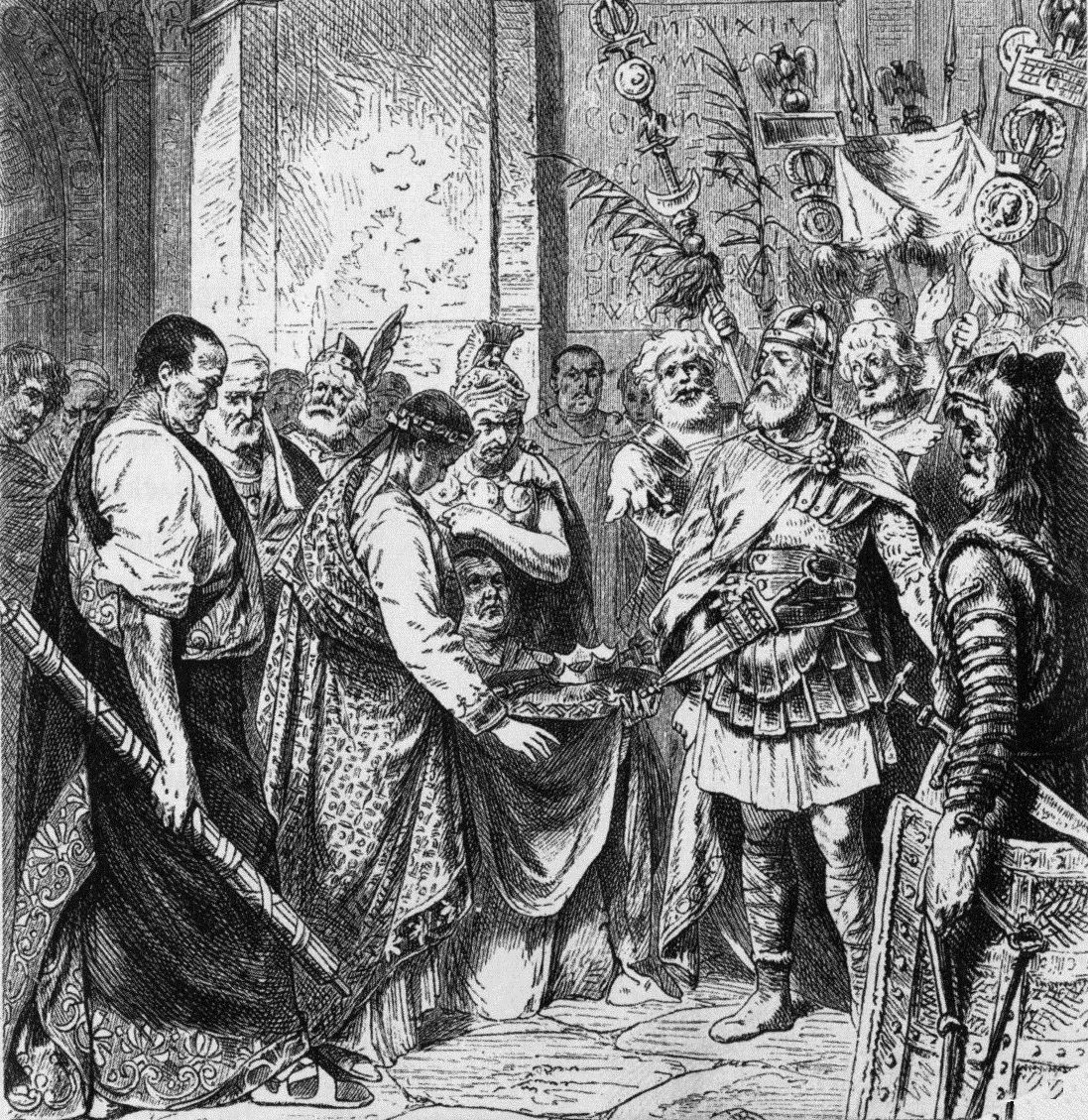
"Romulus Augustulus and Odoacer" by Bernhard Mörlins (B. Moerlins) / Wikimedia Commons
The year 476 CE is recognized by historians as the moment when the Western Roman Empire came to an end. This event marked the fall of one of the most powerful civilizations in ancient history and had lasting effects on Europe and the Mediterranean region.
For centuries, the Roman Empire had controlled vast territories across Europe, North Africa, and the Middle East. Its capital shifted from Rome to Ravenna in the fifth century, reflecting growing instability and threats from outside forces. By the 400s CE, the empire faced enormous challenges, including invasions by Germanic tribes, economic troubles, and weak leadership. In 410 CE, the Visigoths, led by Alaric, even sacked the city of Rome. Archaeological evidence, like destroyed buildings and abandoned villas, shows the damage these invasions caused.
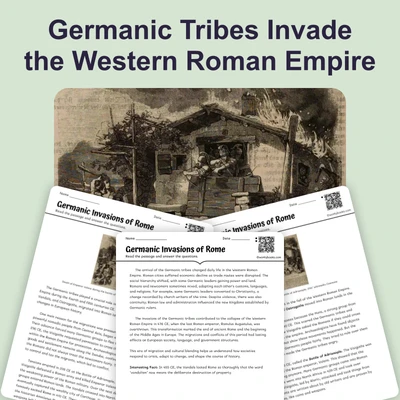
One important cause of the empire's decline was the constant pressure from so-called "barbarian" groups such as the Vandals, Visigoths, and Ostrogoths. These groups crossed the Roman frontiers, sometimes settling as federates (allied soldiers), but often fighting the Romans for land and resources. The Roman government struggled to maintain control over its huge provinces. Soldiers and officials were often more loyal to their own commanders than to the emperor. The empire's complex bureaucracy became difficult to manage, leading to corruption and inefficiency.
In 476 CE, a Germanic leader named Odoacer deposed Romulus Augustulus, the last emperor of the Western Roman Empire. According to the historian Jordanes, Odoacer sent the imperial regalia to the Eastern Roman Emperor in Constantinople, signaling the end of the Western Empire. Some citizens continued Roman traditions and laws, but power in the West now belonged to new rulers. The Eastern Roman Empire, also called the Byzantine Empire, survived for nearly a thousand more years.
The fall of the Western Roman Empire led to great changes in European society. Cities shrank, long-distance trade declined, and local leaders gained more power. However, Roman culture, language, and laws continued to influence Europe for centuries. The event in 476 CE is often seen as the beginning of the Middle Ages, a period marked by new kingdoms and shifting borders.
This turning point shows how geography, leadership, military strength, and economic systems shape the rise and fall of civilizations.
Interesting Fact: The title of "Roman Emperor" in the West was never officially restored after 476 CE, but later leaders like Charlemagne tried to revive the empire centuries later.
Comprehension quiz (8 questions)
1. Who was the last Western Roman Emperor?
2. What year did the Western Roman Empire fall?
3. Which city became the capital in the 400s CE?
4. Why did the Roman bureaucracy become a problem?
5. What was a result of the fall?
6. What did Odoacer do with the regalia?
7. The Western Roman Empire ended in 476 CE.
8. What is a bureaucracy?
Perfect for the way you teach
- Build comprehension skills
- Auto-graded quiz
- Differentiated reading
- Read together at home
- Improve fluency
- Quiet reading time
- Reading curriculum support
- Independent practice
- Track Lexile growth