Lend-Lease Act 1941: Supporting Britain
Interactive passage with audio narration, comprehension questions, and printable PDF.
By completing this purchase you agree to our Terms of Use and Privacy Policy. Your subscription renews automatically until you cancel. You can cancel anytime from your account settings. All sales are final and non-refundable. Digital content is available for download in your account immediately upon purchase.
What's included
Lend-Lease Act 1941: Supporting Britain preview and details
About this printable Lend-Lease Act 1941: Supporting Britain reading passage (Grades 6-8)
Sample passage and quiz from Lend-Lease Act 1941: Supporting Britain
Reading passage and comprehension quiz preview
Lend-Lease Act 1941
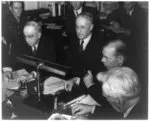
"Washington, D.C. Feb., 1943. Lend-Lease hearings before U.S. House of Representatives Foreign Affairs Committee" by Palmer, Alfred T. / Library of Congress.
The Lend-Lease Act of 1941 was a major turning point in U.S. history during World War II. At that time, the United States was still recovering from the Great Depression, and most Americans wanted to avoid getting involved in another overseas conflict. However, as Nazi Germany and its Axis allies threatened Europe, President Franklin D. Roosevelt and other leaders debated how the United States could help without directly joining the war.
The main problem was how to support the Allied nations, such as Great Britain and the Soviet Union, who were fighting for survival against the Axis powers. These countries desperately needed weapons, food, and other supplies to defend themselves, but they could not afford to buy everything they needed. The U.S. government faced a difficult decision: should it stay neutral, or find a way to help the Allies without violating neutrality laws?
The solution came with the Lend-Lease Act, which Congress passed in March 1941. This new law allowed the United States to lend or lease military equipment and other materials to countries deemed vital to U.S. security. Instead of selling these goods, the U.S. would provide them with the understanding that the items would be returned or paid for later. This creative approach allowed the U.S. to assist key allies without declaring war or sending soldiers overseas.
Through Lend-Lease, the United States shipped enormous amounts of tanks, planes, trucks, and food across the Atlantic. Factories and workers in America became known as the "arsenal of democracy" because they produced the essential resources that kept Allied armies fighting. The program created strong alliances between the U.S. and its partners, showing the power of cooperation in a time of global crisis.
Although the Lend-Lease Act was controversial at first, it quickly proved effective. By supplying vital resources, the U.S. helped prevent the defeat of Allied nations and laid the groundwork for its eventual entry into World War II after the attack on Pearl Harbor. The program also boosted the American economy by increasing industrial production and creating jobs, which helped the country escape the lingering effects of the Great Depression.
The Lend-Lease Act showed that international challenges often require creative solutions. It marked a shift from strict neutrality to active support for countries fighting aggression. By becoming the world's leading supplier of war materials, the United States took on a new global role and shaped the outcome of the war.
Interesting Fact: By the end of World War II, the United States had supplied over $50 billion worth of goods to more than 30 countries through Lend-Lease, making it one of the largest foreign aid programs in history.
Comprehension quiz (8 questions)
1. When was the Lend-Lease Act passed?
2. Who was U.S. president during Lend-Lease?
3. Which nations received Lend-Lease supplies?
4. Why did the U.S. create Lend-Lease?
5. How did Lend-Lease affect U.S. economy?
6. What was the 'arsenal of democracy'?
7. The U.S. stayed completely neutral in WWII.
8. What does 'alliance' mean?
Perfect for the way you teach
- Build comprehension skills
- Auto-graded quiz
- Differentiated reading
- Read together at home
- Improve fluency
- Quiet reading time
- Reading curriculum support
- Independent practice
- Track Lexile growth