This learning resource is available in interactive and printable formats. The interactive worksheet can be played online and assigned to students. The Printable PDF version can be downloaded and printed for completion by hand.
Explore the dramatic transformation of Ancient Rome as it shifted from a Republic to an Empire under the leadership of Julius Caesar and Augustus. This engaging reading passage delves into the causes and consequences of Rome’s transition, referencing key dates, events, and primary sources. Students will analyze how political power shifted, how geography affected Rome’s expansion, and how daily life changed for Roman citizens. The passage aligns with CA HSS 6.7 and CCSS RH.6-8.3 standards and includes a glossary, multiple-choice quiz, writing prompts, graphic organizers, and a timeline. Additional supports include a simplified differentiated version, full Spanish translation, and read aloud audio. This resource is designed to help students build historical thinking skills while understanding the human impact and significance of Rome’s transformation.
CONTENT PREVIEW
Expand content preview
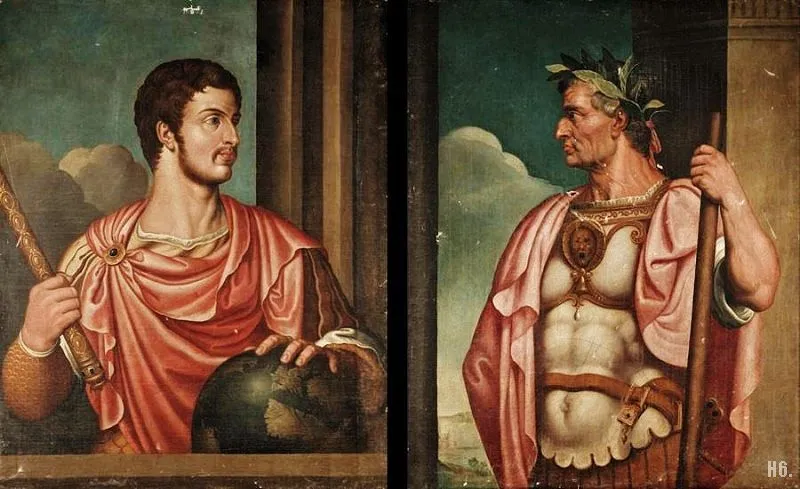
"Portraits of Augustus and Caesar" by After Titian / Source: Wikimedia Commons
The transformation of Rome from a Republic to an Empire was led by two remarkable figures: Julius Caesar and Augustus. This period, from 49 BCE to 14 CE, changed Roman government, society, and the ancient world forever.
The Roman Republic was a system where elected representatives, called senators, made decisions for the people. However, by the first century BCE, Rome faced problems such as civil wars, economic troubles, and conflicts between the wealthy elite and the poor. Julius Caesar, a military general and skilled politician, took advantage of this chaos. In 49 BCE, he famously crossed the Rubicon River with his army, defying the Senate’s authority. Ancient historian Suetonius wrote that Caesar declared, "The die is cast," as he marched towards Rome. By 46 BCE, Caesar became dictator for life, ending hundreds of years of republican rule. Archaeological evidence from his grand building projects, like the Forum of Caesar, shows the changes he brought to Rome’s landscape.
Caesar’s rule ended suddenly in 44 BCE when he was assassinated by a group of senators who feared he was becoming a king. The Republic tried to return, but Rome plunged again into civil war. After years of conflict, Caesar’s adopted son Octavian emerged victorious. In 27 BCE, Octavian took the title Augustus, meaning “the revered one,” and became Rome’s first emperor. Augustus cleverly kept the Senate but held ultimate power. He reformed the army, built roads, and expanded the empire. Coins from Augustus’s reign, found across the Mediterranean, show his image and titles, providing primary evidence of his authority. Under Augustus, Rome enjoyed the Pax Romana, or “Roman Peace,” a period of stability that lasted nearly 200 years.
This transition from Republic to Empire had enormous effects. The government became more centralized, with the emperor at the top of a strict hierarchy. Ordinary citizens saw changes in daily life—new public works, greater security, and expanded citizenship. However, not everyone benefited equally. The Senate lost much of its real power, and some Romans missed the old traditions of shared government. Rome’s geography, with its central location and network of roads, helped the emperors control a vast territory stretching from Britain to Egypt.
Rome’s transformation under Julius Caesar and Augustus marked the end of the ancient Republic and the birth of an empire that influenced Europe, North Africa, and the Middle East for centuries. Understanding this turning point helps us see how leadership, ambition, and conflict can shape societies and the course of history.
Interesting Fact: Julius Caesar’s name became the basis for the word “emperor” in many languages, such as “Kaiser” in German and “Czar” in Russian.
Who was Rome’s first emperor?
AugustusJulius CaesarMark AntonyBrutus
What did Caesar do in 49 BCE?
Crossed the Rubicon RiverBecame emperorBuilt the ColosseumFounded Rome
What is the Pax Romana?
A period of peaceA civil warA military leaderA Roman city
Why did some senators kill Caesar?
Feared he was becoming kingHe built roadsHe lost a battleHe left Rome
How did Augustus keep power?
Kept Senate but held controlEnded the armyDestroyed roadsGave up power
What effect did Rome’s geography have?
Helped control vast areasMade Rome isolatedLed to floodingStopped road building
Julius Caesar was assassinated in 44 BCE.
TrueFalse
What does hierarchy mean?
System of ranking peopleType of governmentMilitary battleRoman building
Perfect For:
👩🏫 Teachers
• Reading comprehension practice
• Auto-graded assessments
• Literacy skill development
👨👩👧👦 Parents
• Reading practice at home
• Comprehension improvement
• Educational reading time
🏠 Homeschoolers
• Reading curriculum support
• Independent reading practice
• Progress monitoring
Reading Features:
📖
Reading Passage
Engaging fiction or nonfiction text
❓
Comprehension Quiz
Auto-graded questions
📊
Instant Feedback
Immediate results and scoring
📄
Printable Version
Download for offline reading
🔊
Read Aloud
Voice-over with word highlighting
Reviews & Ratings
No reviews yet. Be the first to share your experience!
Related Content
Ancient Law Codes: Hammurabi to Rome
This passage explores how ancient civilizations like Babylon and Rome used law codes to govern people, maintain social o...
Geography and Early Rome
This passage, aligned to HSS 6.7 and CCSS RH.6-8.2, explores the rise of Ancient Rome with a focus on its geographical s...
Rome's Lasting Legacy
This passage explores the profound legacy of Ancient Rome and how its beliefs, innovations, and systems continue to shap...
Evidence in Ancient History
This engaging history reading passage investigates how archaeologists and historians discover clues about how ancient pe...
Livy: Historian of Early Rome
This passage introduces students to Livy, one of Ancient Rome's most significant historians, whose writings help us unde...
Germanic Invasions of Rome
This engaging history reading passage explores the causes and effects of the Germanic tribes’ invasions of the Western R...
Slavery in Ancient Rome and in the Americas
This educational passage examines the history of slavery in two distinct regions and eras: Ancient Rome and Colonial Ame...
Ancient Theocracy
This engaging history reading passage explores the concept of theocracy in ancient civilizations, where priests and reli...
Slavery in Ancient World
This passage explores the complex history of slavery in the ancient world, examining its presence in societies such as M...
Life in the Roman Empire
This rigorous history reading passage explores Life in the Roman Empire, guiding students through the social hierarchy, ...
Ancient Canaan
This educational passage explores the land of Canaan, the historical homeland of the ancient Israelites. Students will l...
Ancient Literature
This passage explores the importance of ancient stories and poems from civilizations such as Greece, India, and Israel. ...
Geography of Ancient Israel
This passage explores the rich geography of Ancient Israel, focusing on how landforms, climate, and natural resources sh...
The Etruscans
This engaging history reading passage explores the vital role of the Etruscans in shaping Ancient Rome. Students will di...
Ancient Writing Systems
This engaging history reading passage explores the origins and evolution of ancient writing systems, including cuneiform...
Ancient Agriculture Farming
This passage explores the transformative impact of farming on ancient societies, examining how the Neolithic Revolution ...
Cincinnatus
This rigorous history reading passage explores the story of Cincinnatus, a Roman farmer who became a dictator in a time ...
Ancient Mathematics
This passage explores the essential role of mathematics in ancient civilizations, including Mesopotamia, Egypt, Greece, ...
Trade Across Ancient India
This history reading passage explores Ancient India's trade networks and their impact on global connections. Students wi...
The Roman Republic
This passage explores the structure and significance of government and law in the Roman Republic, focusing on how Roman ...