This history reading passage explores the concept of cultural diffusion and its significance in shaping ancient civilizations. Students will learn how the spread of ideas and inventions, such as writing, paper, and religious beliefs, transformed societies from Mesopotamia to Egypt and China. The passage provides specific archaeological and historical examples, discusses the role of trade routes like the Silk Road, and examines how geography influenced the exchange of culture. Activities include a multiple-choice quiz, graphic organizers, writing assessments, a glossary of key terms, a timeline, and a Spanish translation. This resource is aligned with CA HSS 6.1, 6.2, TEKS 113.18(b)(1)(A), and CCSS.ELA-LITERACY.RI.6.3, and supports close reading and historical thinking skills. Read aloud audio and accessible content make it suitable for diverse learners.
Written by Workybooks TeamPublished by Workybooks
Preview
Sample passage and quiz content
CONTENT PREVIEW
Expand content preview
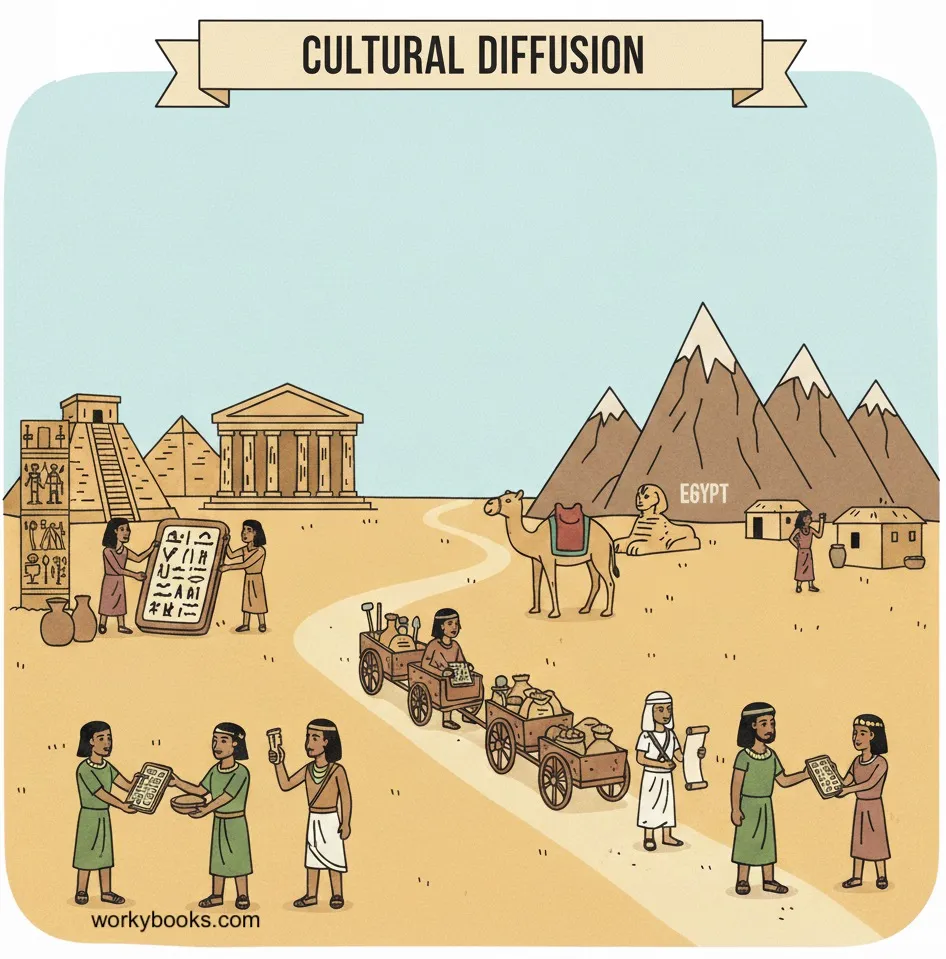
Cultural diffusion is the process by which ideas, beliefs, technologies, and inventions move from one society to another. Throughout ancient history, this exchange shaped the development of civilizations across continents. The spread of culture was often driven by trade, migration, and conquest, helping societies learn from each other and adapt to new challenges.
One of the earliest examples of cultural diffusion occurred in ancient Mesopotamia, around 3200 BCE, when people developed the system of cuneiform writing. As traders traveled between Mesopotamia and neighboring regions like Egypt and the Indus Valley, they shared not only goods but also knowledge. Archaeological evidence shows that the concept of writing, along with mathematical ideas, spread to Egypt, where hieroglyphs appeared shortly after cuneiform. This transfer enabled civilizations to record laws, keep economic records, and communicate over long distances.
Trade routes such as the Silk Road played a crucial role in cultural diffusion. Starting around the 2nd century BCE, merchants and travelers moved between China, Central Asia, and the Mediterranean. Along these paths, inventions like paper and silk traveled westward, while glassmaking and religious beliefs such as Buddhism moved eastward. For instance, a set of Buddhist statues found in China shows Greek-style artistic influence, demonstrating the blending of cultures through contact. The Silk Road also carried foods, languages, and even diseases, which changed daily life and social structures in many regions.
Geography often influenced how and where cultural diffusion happened. The Nile River valley connected Egypt to other African and Asian societies, making it a center for trade and the exchange of technologies like irrigation and metalworking. In contrast, some civilizations, such as those in the Americas, were separated by oceans and mountains, which limited direct contact and slowed the process of diffusion. However, even there, evidence shows that ideas like pyramid building and maize agriculture spread between distant peoples.
Over time, cultural diffusion led to both change and continuity. While new technologies and beliefs transformed societies, some traditions and social hierarchies continued. The impact of these exchanges can be seen in language, art, religion, and government systems that still influence our world today. Understanding cultural diffusion helps historians explain how ancient civilizations grew, adapted, and connected with each other across great distances.
This topic connects to the broader theme of how humans interact with their environment and develop complex societies by sharing knowledge, resources, and beliefs.
Interesting Fact: The word "paper" comes from "papyrus," an Egyptian plant used for writing, but true paper was invented in China and reached Europe only after centuries of cultural diffusion along trade routes.
What is cultural diffusion?
Sharing ideas and inventionsGrowing cropsBuilding pyramidsMaking pottery
Which writing system started in Mesopotamia?
CuneiformAlphabetHieroglyphsLatin
What was the Silk Road?
Trade routeRiverBuildingTool
Why did the Nile River help cultural diffusion?
It connected people to tradeIt was dangerousIt was dryIt was a mountain
What is one effect of the Silk Road?
Spread of BuddhismSlowed tradeNo inventionsIsolated people
How did geography affect diffusion in the Americas?
Oceans/mountains slowed contactIt made trade easyThere were no riversPeople didn’t move
Cultural diffusion only happened in Europe. True or false?
TrueFalse
What does 'hieroglyphs' mean?
Picture writing systemA trade routeA toolA food
Who it's for
Perfect for the way you teach
Teachers
Build comprehension skills
Auto-graded quiz
Differentiated reading
Parents
Read together at home
Improve fluency
Quiet reading time
Homeschoolers
Reading curriculum support
Independent practice
Track Lexile growth
Topics
cultural diffusionancient civilizationsSilk RoadtradeinventionsMesopotamiaEgypthistory passage
Reviews & Ratings
No reviews yet. Be the first to share your experience!
More reading you might love
19 more
Climate Change and Ancient Sites
This detailed history passage explores the impact of climate change on ancient archaeological sites around the world. St...
CA HSS 6.16.2RH.6-8.1RH.6-8.2
Primary and Secondary Sources
This passage explores how archaeologists and historians use ancient stones and writings to understand the civilizations ...
CA HSS 6.16.2TEKS 113.18(B)(1)CCSS.RI.6.1
Lost City of Pompeii
This engaging passage explores the ancient Roman city of Pompeii, which was buried by the eruption of Mount Vesuvius in ...
CA HSS 6.1RH.6-8.2RH.6-8.4RH.6-8.7
Minoan Civilization
This engaging history reading passage explores the Minoans, one of the earliest civilizations of the Bronze Age located ...
CA HSS 6.1RH.6-8.1RH.6-8.4
First Humans
This engaging history reading passage explores the evolution of early humans, tracing the journey from the earliest homi...
CA HSS 6.1RH.6-8.1RH.6-8.2W.6.2
Who Were the Neanderthals
This engaging history reading passage explores the fascinating world of the Neanderthals, our ancient relatives who live...
CA HSS 6.1TEKS 6.2RI.6.1RI.6.4
Early Human Cognition
This engaging reading passage explores the Cognitive Revolution, a major turning point in human history that occurred ar...
CA HSS 6.1CCSS.RI.6.1CCSS.RI.6.2CCSS.RI.6.4
Valmiki and the Ramayana
This ancient history reading passage explores the life and legacy of Valmiki, the celebrated poet credited with composin...
CA HSS 6.1CCSS.ELA-LITERACY.RH.6-8.1CCSS.ELA-LITERACY.RH.6-8.2
China's Terracotta Army
This passage explores the fascinating discovery of the Terra-Cotta Army near Xi’an, China, and its significance in ancie...
CA HSS 6.1CCSS RH.6-8.1CCSS RH.6-8.4CCSS RH.6-8.7
Dead Sea Scrolls Discovery
This passage explores the remarkable discovery of the Dead Sea Scrolls, one of history’s most significant archaeological...
CA HSS 6.1CCSS.RI.6.1CCSS.RI.6.3
Life as a Hunter-Gatherer
This engaging history reading passage explores the ways early humans survived and spread across continents by foraging, ...
CA HSS 6.1RI.6.1RI.6.4RI.7.1
Human Impact on Extinctions
This passage explores how Paleolithic people, or early humans, shaped their environment through the use of fire, hunting...
CA HSS 6.1CCSS RH.6-8.2CCSS RI.6.4
Stone Age Settlements
Explore how early humans in the Paleolithic Era built shelters such as caves and huts to survive harsh climates. This pa...
CA HSS 6.1CCSS.RI.6.3CCSS.RI.7.1CCSS.RI.8.2
How Early Humans Survived the Ice Age
This passage explores how Paleolithic people adapted to a variety of landscapes, including coastal regions, mountains, p...
CA HSS 6.1CCSS RH.6-8.1CCSS RH.6-8.2CCSS RH.6-8.4
Life in the Neolithic Age
This engaging passage explores what life was like during a typical day in the Neolithic Age, a pivotal era in ancient hi...
CA HSS 6.1CCSS RH.6-8.2CCSS RH.6-8.4
Ramayana Epic of India
This passage introduces students to the epic of the Ramayana and its role in teaching the concept of dharma within ancie...
CA HSS 6.1RI.6.1RI.6.4RI.7.1
How Artifacts Are Restored
This engaging passage explores how scientists, especially archaeologists and conservators, protect and restore artifacts...
CA HSS 6.1RI.6.1RH.6-8.2
Ancient World Literature
This passage explores the importance of ancient stories and poems from civilizations such as Greece, India, and Israel. ...
CA HSS 6.1CCSS.RI.6.1CCSS.RI.6.4
What Was the Neolithic Revolution
This comprehensive history reading passage explores the Neolithic Revolution, focusing on how early humans transitioned ...