Reading PassagePremium

China's Terracotta Army

Interactive passage with audio narration, comprehension questions, and printable PDF.

No ratings yet|
1
Grades 6–8ReadingElaSocial-studiesHistoryEnglish · SpanishInteractive · Printable
Aligned toCA HSS 6.1CCSS RH.6-8.1CCSS RH.6-8.4CCSS RH.6-8.7
Just this resource
$1.50
One-time purchase
Best value
Unlock everything
$49.99$24.99/yr
50% off until Sept 15 — 10,000+ resources
Renews at $49.99/year.

By completing this purchase you agree to our Terms of Use and Privacy Policy. Your subscription renews automatically until you cancel. You can cancel anytime from your account settings. All sales are final and non-refundable. Digital content is available for download in your account immediately upon purchase.

Unlock above to use these actions

What's included

Reading passage
Audio narration
Comprehension quiz
Writing activity
Glossary & flashcards
Differentiated version
Spanish translation

China's Terracotta Army preview and details

About this printable China's Terracotta Army reading passage (Grades 6-8)

This passage explores the fascinating discovery of the Terra-Cotta Army near Xi’an, China, and its significance in ancient history. Students will learn about Emperor Qin Shi Huang, the archaeological methods used to uncover the site, and the impact this discovery has had on our understanding of Chinese civilization. The passage includes specific archaeological evidence, cause-and-effect relationships, and discusses social hierarchy in ancient China. Activities include a glossary, multiple-choice quiz, writing prompts, graphic organizers, and timeline. A Spanish translation and a differentiated, simplified version are also provided. This resource is aligned with CA HSS 6.1 and CCSS RH.6-8.1, making it ideal for ancient history lessons. Read aloud audio is available for accessibility.
Written by Workybooks TeamPublished by Workybooks
Preview

Sample passage and quiz from China's Terracotta Army

Reading passage and comprehension quiz preview

China's Terracotta Army
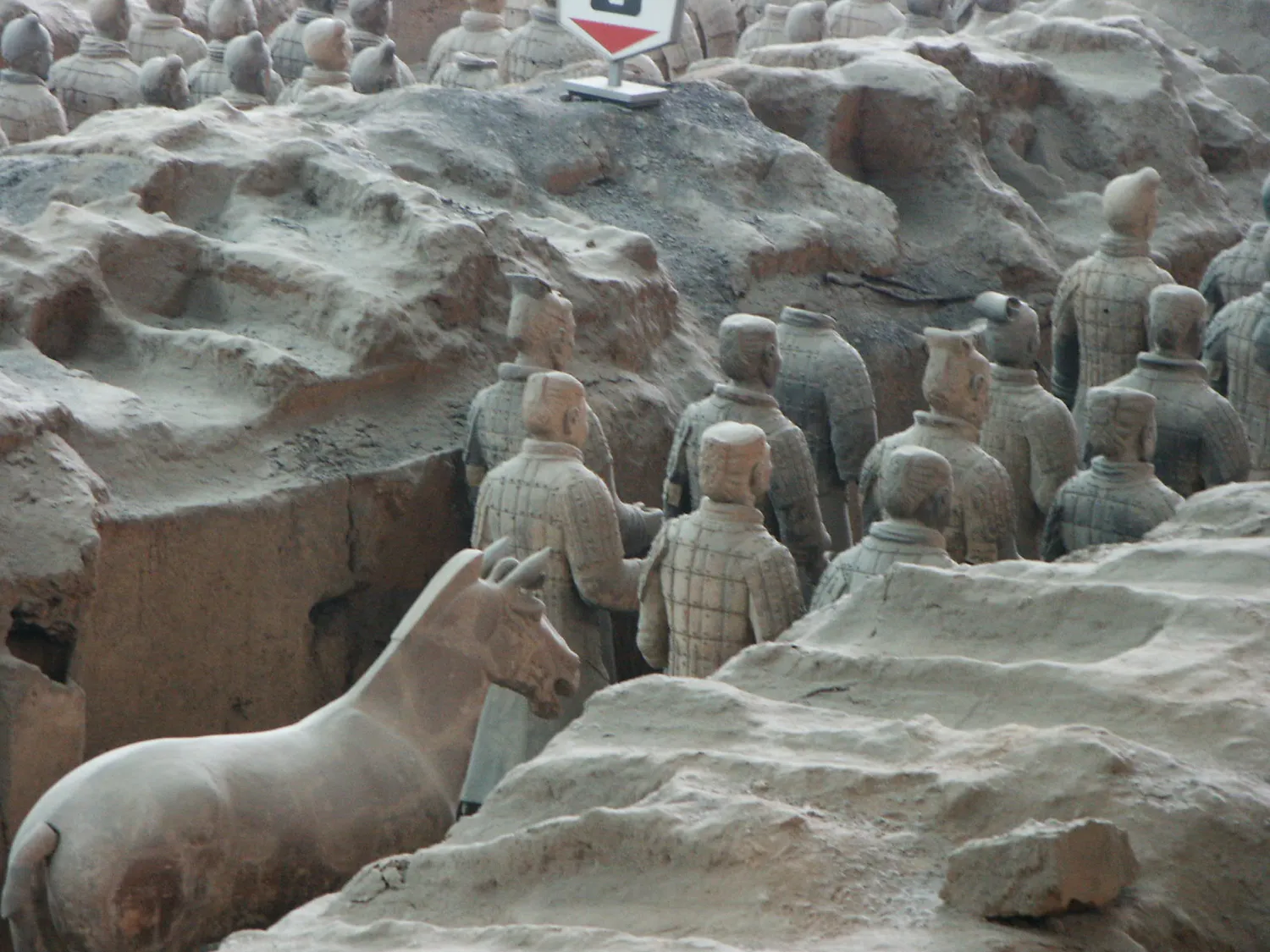
Qin Shihuang Terracotta Army, Pit 1
"Qin Shihuang Terracotta Army, Pit 1" by Gary Todd / 
Source: Wikimedia Commons (CC0).

The Terra-Cotta Army is one of the most remarkable archaeological discoveries of the twentieth century. In 1974, farmers digging a well near the city of Xi’an in central China uncovered clay fragments. These fragments turned out to be part of an entire army of life-sized clay soldiers buried underground. The army was created to guard the tomb of China’s first emperor, Qin Shi Huang, who ruled from 221 to 210 BCE. The site quickly became a focus for historians, archaeologists, and tourists from around the world.

Archaeologists have excavated more than 8,000 clay soldiers, along with horses and chariots. Each warrior has unique facial features, clothing, and weapons, showing careful craftsmanship. Historical records, such as the ancient Chinese historian Sima Qian’s writings, describe how Emperor Qin wanted protection in the afterlife. To achieve this, more than 700,000 workers labored for decades to construct his tomb complex and the Terra-Cotta Army. The army’s soldiers are arranged in battle formation, reflecting the military organization of the Qin Dynasty. Nearby, bronze weapons and armor were found, providing evidence of the technology and warfare of ancient China.

The tomb complex covers over 20 square miles and includes not just soldiers, but also statues of musicians, acrobats, and animals. This suggests the emperor’s belief in an afterlife where he would need not only protection but also entertainment and servants. The discovery has given historians valuable insight into the social hierarchy of the time. The Terra-Cotta Army includes officers, generals, infantry, and cavalry, each distinguished by their uniforms and weapons. This reflects the chain of command in Qin society and how power was organized.

The excavation of the Terra-Cotta Army has changed our understanding of ancient Chinese civilization. The site demonstrates the ambition and authority of Emperor Qin, who unified China and standardized its writing, currency, and laws. The project also shows the cost of such monumental undertakings, as historical records mention harsh labor conditions and even the deaths of many workers. Some mysteries remain, such as what lies within the unopened central tomb mound, which archaeologists have not yet explored due to concerns about preservation.

The Terra-Cotta Army connects to broader themes in world history, such as the use of monuments to express power, the role of belief systems in shaping societies, and the importance of archaeological evidence in reconstructing the past.

Interesting Fact: Over 2,000 bronze weapons, including swords and spears, were found with the Terra-Cotta Army, many still sharp after 2,000 years!

Comprehension quiz (8 questions)

1. Who was guarded by the Terra-Cotta Army?

Qin Shi Huang
Han Wudi
Confucius
Emperor Wu

2. When was the Terra-Cotta Army discovered?

1974
221 BCE
2000 CE
1453 CE

3. How many clay warriors have been found?

Over 8,000
About 200
Less than 100
Around 500

4. Why did Emperor Qin build the Terra-Cotta Army?

To protect him in afterlife
To decorate his palace
To honor soldiers
For farming purposes

5. What does the army’s formation reflect?

Military organization
Religious rituals
Trade routes
Festivals

6. What is a 'social hierarchy'?

Ranks in society
A type of monument
A farming tool
Ancient weapon

7. The tomb’s central mound has been excavated.

True
False

8. What does 'craftsmanship' mean?

Skill in making things
Belief in afterlife
A kind of weapon
A farming process
Who it's for

Perfect for the way you teach

Teachers
  • Build comprehension skills
  • Auto-graded quiz
  • Differentiated reading
Parents
  • Read together at home
  • Improve fluency
  • Quiet reading time
Homeschoolers
  • Reading curriculum support
  • Independent practice
  • Track Lexile growth
Topics

Reviews & Ratings

No reviews yet. Be the first to share your experience!

More reading you might love

19 more
Passage
Lost City of Pompeii - reading educational content
Grades 5–8

Lost City of Pompeii

ancient history · CA HSS 6.1+3

$1.50
Passage
Minoan Civilization - reading educational content
Grades 5–8

Minoan Civilization

ancient history · CA HSS 6.1+2

$1.50
Passage
How Ancient Ideas Spread - reading educational content
Grades 5–8

How Ancient Ideas Spread

ancient history · CA HSS 6.1+3

$1.50
Passage
First Humans - reading educational content
Grades 5–8

First Humans

ancient history · CA HSS 6.1+3

$1.50
Passage
Who Were the Neanderthals - reading educational content
Grades 5–8

Who Were the Neanderthals

ancient history · CA HSS 6.1+4

$1.50
Passage
Early Human Cognition - reading educational content
Grades 6–8

Early Human Cognition

ancient history · CA HSS 6.1+4

$1.50
Passage
Valmiki and the Ramayana - reading educational content
Grades 6–8

Valmiki and the Ramayana

ancient history · CA HSS 6.1+2

$1.50
Passage
Dead Sea Scrolls Discovery - reading educational content
Grades 6–8

Dead Sea Scrolls Discovery

ancient history · CA HSS 6.1+2

$1.50
Passage
Indigenous Snowshoes - reading educational content
Grades 5–8

Indigenous Snowshoes

us history · CA HSS 6.1+3

$1.50
Passage
Life as a Hunter-Gatherer - reading educational content
Grades 5–8

Life as a Hunter-Gatherer

ancient history · CA HSS 6.1+4

$1.50
Passage
Human Impact on Extinctions - reading educational content
Grades 6–8

Human Impact on Extinctions

ancient history · CA HSS 6.1+2

$1.50
Passage
Stone Age Settlements - reading educational content
Grades 6–8

Stone Age Settlements

ancient history · CA HSS 6.1+3

$1.50
Passage
How Early Humans Survived the Ice Age - reading educational content
Grades 6–8

How Early Humans Survived the Ice Age

ancient history · CA HSS 6.1+3

$1.50
Passage
Life in the Neolithic Age - reading educational content
Grades 6–8

Life in the Neolithic Age

ancient history · CA HSS 6.1+2

$1.50
Passage
Ramayana Epic of India - reading educational content
Grades 5–8

Ramayana Epic of India

ancient history · CA HSS 6.1+4

$1.50
Passage
How Artifacts Are Restored - reading educational content
Grades 5–8

How Artifacts Are Restored

ancient history · CA HSS 6.1+2

$1.50
Passage
Ancient World Literature - reading educational content
Grades 6–8

Ancient World Literature

ancient history · CA HSS 6.1+2

$1.50
Passage
Inuit Snow Goggles - reading educational content
Grades 5–8

Inuit Snow Goggles

us history · CA HSS 6.1+3

$1.50
Passage
Native American Basket Weaving - reading educational content
Grades 5–8

Native American Basket Weaving

us history · CA HSS 6.1+2

$1.50
Copyright © 2026 Workybooks. Made with ♥ in California.