Indigenous Snowshoes
Interactive passage with audio narration, comprehension questions, and printable PDF.
By completing this purchase you agree to our Terms of Use and Privacy Policy. Your subscription renews automatically until you cancel. You can cancel anytime from your account settings. All sales are final and non-refundable. Digital content is available for download in your account immediately upon purchase.
What's included
Indigenous Snowshoes preview and details
About this printable Indigenous Snowshoes reading passage (Grades 5-8)
Sample passage and quiz from Indigenous Snowshoes
Reading passage and comprehension quiz preview
Indigenous Snowshoes
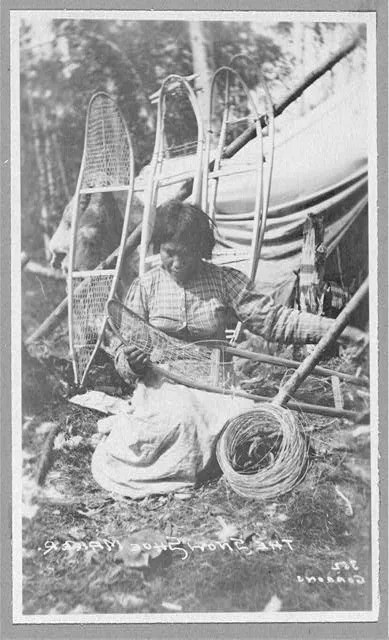
"Woman making snow shoes" / Library of Congress.
Indigenous peoples living in northern climates developed snowshoes to travel efficiently across deep winter snow. These tools, made from natural materials, became essential for hunting, trade, and survival in regions where snow could pile up several feet deep for months each year.
Different cultures adapted snowshoe designs to match their local environment. For example, the Ojibwe people of the Great Lakes region crafted snowshoes with long, narrow frames and rounded tips. This design performed well in forested areas with powdery snow, allowing hunters to move quietly and quickly. In contrast, the Cree of the Canadian plains made snowshoes with an elongated, almost pointed shape, ideal for open terrain. Archaeological evidence, such as a 5,800-year-old snowshoe found in the Italian Alps, shows that snowshoe technology developed independently in Eurasia as well. The ancient snowshoe, made of birch wood and leather, demonstrates how people in mountainous regions solved similar problems.
Snowshoes worked by distributing a person's weight over a larger surface area, preventing them from sinking into soft snow. This principle, called weight distribution, made winter travel possible for hunting and gathering. Historical accounts from European explorers in the 1600s describe how Indigenous guides, using snowshoes, could travel much farther and faster than those without them. These guides often taught newcomers how to make and use snowshoes, sharing valuable technological knowledge.
Making snowshoes was a skilled craft. Indigenous makers carefully selected wood such as ash or birch for the frames and used rawhide or other tough material for the webbing. The process often included ceremonies or the passing down of techniques within families. Snowshoes were not only tools for survival, but also symbols of cultural identity and social connection. Some designs were decorated with patterns or markings unique to a tribe or family, showing the importance of snowshoes in daily life.
Over time, snowshoes remained important even as other technologies, like sleds and later snowmobiles, became available. Their design continued to evolve, showing continuity as well as change in response to new materials and needs. Today, snowshoes are used for sport and recreation, but their origins highlight the ingenuity of Indigenous peoples adapting to their environment. Studying snowshoes helps us understand the relationship between geography, technology, and culture across time.
This topic connects to broader world history themes of technological innovation, human adaptation to environments, and cultural exchange.
Interesting Fact: The oldest known snowshoe, discovered in the Italian Alps in 2016, dates back nearly 6,000 years and shows that people in both North America and Eurasia invented similar tools independently.
Comprehension quiz (8 questions)
1. Which group used long, round-tipped snowshoes?
2. Where was the oldest snowshoe found?
3. What material was used for webbing?
4. Why were snowshoes important for travel?
5. How did snowshoe design change over time?
6. What is 'weight distribution'?
7. Snowshoes are used for recreation today. True or false?
8. What does 'archaeological evidence' mean?
Perfect for the way you teach
- Build comprehension skills
- Auto-graded quiz
- Differentiated reading
- Read together at home
- Improve fluency
- Quiet reading time
- Reading curriculum support
- Independent practice
- Track Lexile growth