Reading PassagePremium

Ramayana Epic of India

Interactive passage with audio narration, comprehension questions, and printable PDF.

No ratings yet
Grades 5–8ReadingElaSocial-studiesHistoryEnglish · SpanishInteractive · Printable
Aligned toCA HSS 6.1RI.6.1RI.6.4RI.7.1RI.7.4
Just this resource
$1.50
One-time purchase
Best value
Unlock everything
$49.99$24.99/yr
50% off until Sept 15 — 10,000+ resources
Renews at $49.99/year.

By completing this purchase you agree to our Terms of Use and Privacy Policy. Your subscription renews automatically until you cancel. You can cancel anytime from your account settings. All sales are final and non-refundable. Digital content is available for download in your account immediately upon purchase.

Unlock above to use these actions

What's included

Reading passage
Audio narration
Comprehension quiz
Writing activity
Glossary & flashcards
Differentiated version
Spanish translation

Part of this bundle

Ramayana Epic of India preview and details

About this printable Ramayana Epic of India reading passage (Grades 5-8)

This passage introduces students to the epic of the Ramayana and its role in teaching the concept of dharma within ancient Indian society. Students will learn about the story’s main characters, such as Rama, Sita, and Ravana, and analyze how the Ramayana influenced social norms, daily life, and moral behavior. The passage integrates archaeological and literary evidence to provide a deep understanding of the Ramayana’s historical context and cultural significance. Accompanied by a timeline, glossary, comprehension activities, graphic organizers, and a Spanish translation, this resource supports CA HSS 6.1 and CCSS RI.6-8. It also provides a read-aloud audio option for accessibility. This comprehensive lesson is ideal for exploring ancient civilizations and world religions, and for developing students’ skills in historical analysis, critical thinking, and academic vocabulary.
Written by Workybooks TeamPublished by Workybooks
Preview

Sample passage and quiz from Ramayana Epic of India

Reading passage and comprehension quiz preview

Ramayana Epic of India
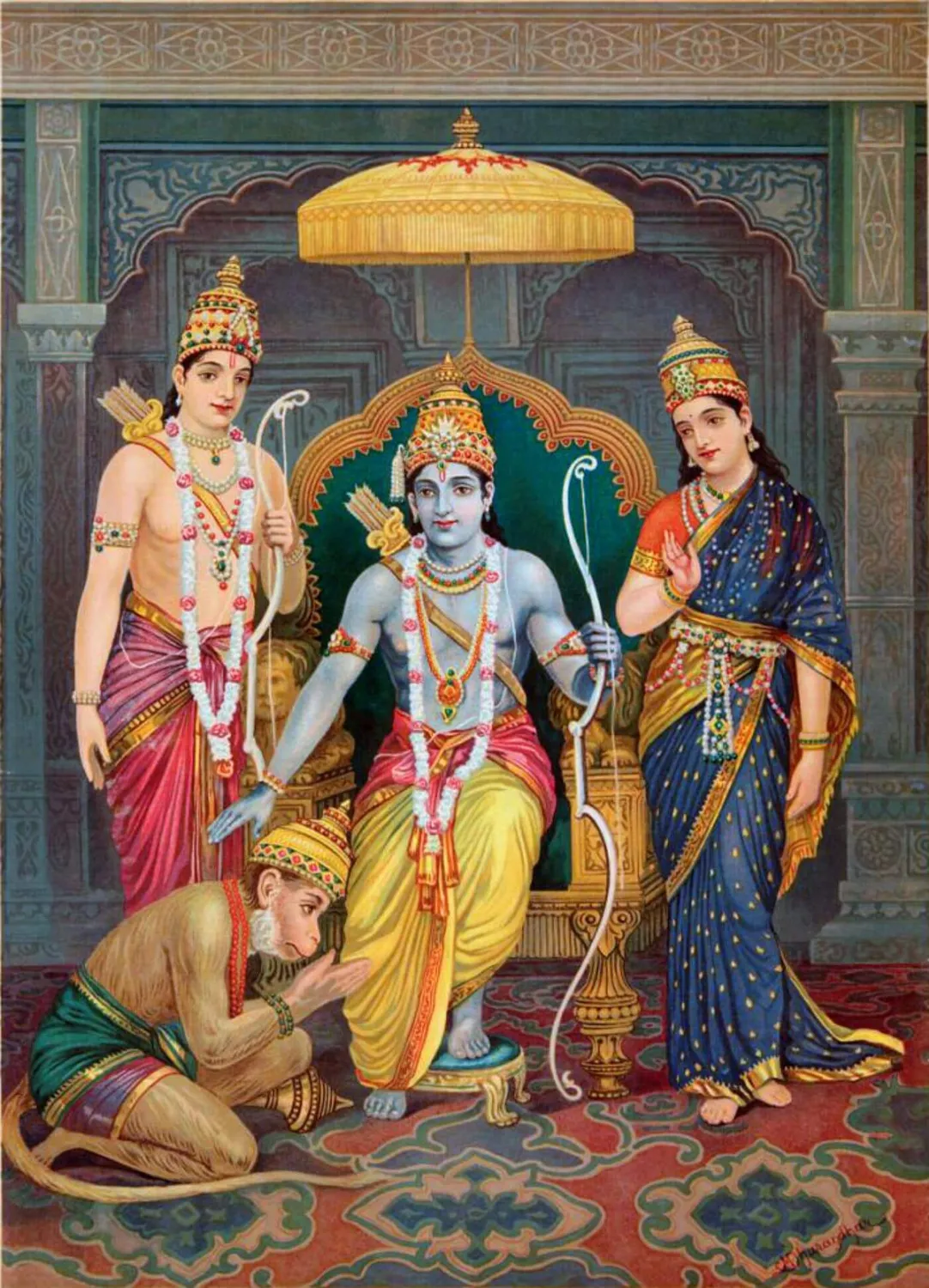
Sree Raghunandan - Ram Laxman Sita and Hanuman, M V Dhurandar

"Sree Raghunandan - Ram Laxman Sita and Hanuman, M. V. Dhurandhar (1867- 1944) / 
Source: Wikimedia Commons (Public domain).

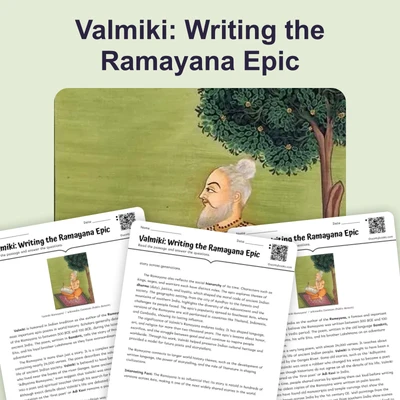
The Ramayana is one of the oldest and most important epics of ancient India. Composed in Sanskrit by the poet Valmiki around the 5th to 4th century BCE, the Ramayana tells the story of Prince Rama, his wife Sita, and his brother Lakshmana. The epic's setting spans the ancient kingdoms of Ayodhya and Lanka, offering a window into the beliefs and daily life of Indian society over two thousand years ago.

At the heart of the Ramayana is the concept of dharma. In Hindu tradition, dharma refers to the moral and social duties that guide how people should act. Throughout the Ramayana, characters face difficult choices that test their commitment to dharma. For example, Rama obeys his father’s command to go into exile for fourteen years, even though it means giving up his right to the throne. Sita, his wife, chooses to follow Rama into the forest, displaying loyalty and devotion. These actions illustrate how personal sacrifice and duty are valued in ancient Indian culture.

The Ramayana is filled with dramatic events. The demon king Ravana kidnaps Sita and takes her to his kingdom of Lanka. With the help of his loyal brother Lakshmana and the monkey general Hanuman, Rama embarks on a quest to rescue Sita. The epic features vivid descriptions of battles, alliances, and journeys, including Hanuman leaping across the ocean to find Sita. Archaeological evidence, such as ancient temples and stone carvings in India and Southeast Asia, shows how the story of the Ramayana spread and shaped art and culture across the region. The Ramayana was not just a story, but a guide for rulers and families on how to live according to the values of their society.

For centuries, the Ramayana has played a key role in shaping social hierarchy and daily customs. Its characters became moral examples for kings, warriors, and ordinary people. In village dramas and temple carvings, scenes from the Ramayana taught lessons about justice, respect, and the importance of keeping promises. The epic’s popularity also encouraged the spread of Sanskrit language and Hindu beliefs throughout Asia, showing how literature can influence both religion and government.

In conclusion, the Ramayana is more than an ancient poem—it is a powerful work that helped define the values and identity of ancient India. Its lessons about dharma, sacrifice, and righteousness continue to influence millions of people today. The Ramayana reminds us that stories can teach important lessons about how to live in a community and uphold moral values.

This theme of moral guidance through literature connects the Ramayana to other world epics and religious texts, highlighting how ancient civilizations used stories to shape their cultures and societies.

Interesting Fact: The Ramayana has been performed in dance, drama, and song for over two thousand years, and versions of the story exist in many Asian countries, including Thailand and Indonesia.

Comprehension quiz (8 questions)

1. Who wrote the Ramayana?

Valmiki
Hanuman
Ravana
Sita

2. What is dharma?

A type of food
A moral duty
A city
A weapon

3. Where was Sita taken by Ravana?

Ayodhya
Lanka
Delhi
Ganges

4. Why did Rama go into exile?

To find Sita
By his father's command
To fight Ravana
To become king

5. How did the Ramayana spread across Asia?

Through trade
Through art and literature
Through war
Through farming

6. What is one main lesson from the Ramayana?

How to build houses
The value of dharma
How to farm
The taste of spices

7. The Ramayana is more than a poem. (True/False)

True
False

8. Which word means a long heroic poem?

hierarchy
epic
Sanskrit
kingdom
Who it's for

Perfect for the way you teach

Teachers
  • Build comprehension skills
  • Auto-graded quiz
  • Differentiated reading
Parents
  • Read together at home
  • Improve fluency
  • Quiet reading time
Homeschoolers
  • Reading curriculum support
  • Independent practice
  • Track Lexile growth
Topics

Reviews & Ratings

No reviews yet. Be the first to share your experience!

More reading you might love

19 more
Passage
Lost City of Pompeii - reading educational content
Grades 5–8

Lost City of Pompeii

ancient history · CA HSS 6.1+3

$1.50
Passage
Minoan Civilization - reading educational content
Grades 5–8

Minoan Civilization

ancient history · CA HSS 6.1+2

$1.50
Passage
How Ancient Ideas Spread - reading educational content
Grades 5–8

How Ancient Ideas Spread

ancient history · CA HSS 6.1+3

$1.50
Passage
First Humans - reading educational content
Grades 5–8

First Humans

ancient history · CA HSS 6.1+3

$1.50
Passage
Who Were the Neanderthals - reading educational content
Grades 5–8

Who Were the Neanderthals

ancient history · CA HSS 6.1+4

$1.50
Passage
Early Human Cognition - reading educational content
Grades 6–8

Early Human Cognition

ancient history · CA HSS 6.1+4

$1.50
Passage
Valmiki and the Ramayana - reading educational content
Grades 6–8

Valmiki and the Ramayana

ancient history · CA HSS 6.1+2

$1.50
Passage
China's Terracotta Army - reading educational content
Grades 6–8

China's Terracotta Army

ancient history · CA HSS 6.1+3

$1.50
Passage
Dead Sea Scrolls Discovery - reading educational content
Grades 6–8

Dead Sea Scrolls Discovery

ancient history · CA HSS 6.1+2

$1.50
Passage
Indigenous Snowshoes - reading educational content
Grades 5–8

Indigenous Snowshoes

us history · CA HSS 6.1+3

$1.50
Passage
Life as a Hunter-Gatherer - reading educational content
Grades 5–8

Life as a Hunter-Gatherer

ancient history · CA HSS 6.1+4

$1.50
Passage
Human Impact on Extinctions - reading educational content
Grades 6–8

Human Impact on Extinctions

ancient history · CA HSS 6.1+2

$1.50
Passage
Stone Age Settlements - reading educational content
Grades 6–8

Stone Age Settlements

ancient history · CA HSS 6.1+3

$1.50
Passage
How Early Humans Survived the Ice Age - reading educational content
Grades 6–8

How Early Humans Survived the Ice Age

ancient history · CA HSS 6.1+3

$1.50
Passage
Life in the Neolithic Age - reading educational content
Grades 6–8

Life in the Neolithic Age

ancient history · CA HSS 6.1+2

$1.50
Passage
How Artifacts Are Restored - reading educational content
Grades 5–8

How Artifacts Are Restored

ancient history · CA HSS 6.1+2

$1.50
Passage
Ancient World Literature - reading educational content
Grades 6–8

Ancient World Literature

ancient history · CA HSS 6.1+2

$1.50
Passage
Inuit Snow Goggles - reading educational content
Grades 5–8

Inuit Snow Goggles

us history · CA HSS 6.1+3

$1.50
Passage
Native American Basket Weaving - reading educational content
Grades 5–8

Native American Basket Weaving

us history · CA HSS 6.1+2

$1.50
Copyright © 2026 Workybooks. Made with ♥ in California.