Valmiki and the Ramayana
Interactive passage with audio narration, comprehension questions, and printable PDF.
By completing this purchase you agree to our Terms of Use and Privacy Policy. Your subscription renews automatically until you cancel. You can cancel anytime from your account settings. All sales are final and non-refundable. Digital content is available for download in your account immediately upon purchase.
What's included
Part of this bundle

Valmiki and the Ramayana preview and details
About this printable Valmiki and the Ramayana reading passage (Grades 6-8)
Sample passage and quiz from Valmiki and the Ramayana
Reading passage and comprehension quiz preview
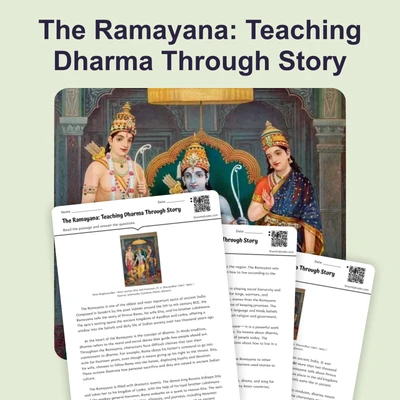
Valmiki and the Ramayana
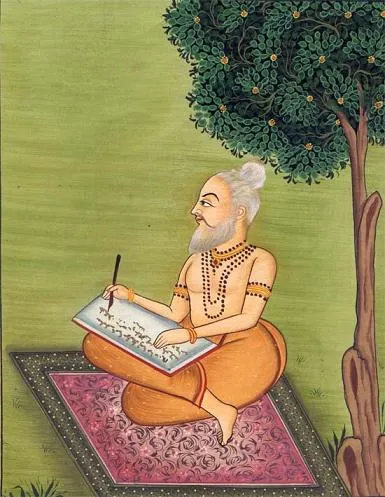
"Valmiki Ramayana" / Wikimedia Commons (Public domain).
Valmiki is honored in Indian tradition as the author of the Ramayana, one of the most important epic poems in world history. Scholars generally date the composition of the Ramayana to between 500 BCE and 100 BCE, during the later Vedic period in ancient India. The poem, written in Sanskrit, tells the story of Prince Rama, his wife Sita, and his loyal brother Lakshmana as they face extraordinary challenges and adventures.
The Ramayana is more than just a story. It is a complex work of literature containing nearly 24,000 verses. The poem describes the values, beliefs, and daily life of ancient Indian society. Valmiki is believed to have been a sage or wise man who lived near the banks of the river Ganges. Some ancient sources, such as the "Adhyatma Ramayana," even suggest that Valmiki was once a bandit who transformed into a poet and spiritual teacher through his search for knowledge and truth. Although exact details about Valmiki’s life are debated among historians, his reputation as the ‘first poet’ or Adi Kavi remains a powerful part of Indian cultural memory.
Composed during a time when oral tradition was dominant, the Ramayana was first recited aloud before being written down. The earliest manuscripts were inscribed on palm leaves. Archaeological evidence, such as ancient manuscripts and temple carvings, shows that the Ramayana was performed and depicted across India by the 1st century CE. For example, murals from the Gupta period (4th–6th century CE) and stone carvings from South India depict scenes from the epic. The poem’s structure, with its use of rhyme and meter, helped people remember and retell the story across generations.
The Ramayana also reflects the social hierarchy of its time. Characters such as kings, sages, and warriors each have distinct roles. The epic explores themes of dharma (duty), justice, and loyalty, which shaped the moral code of ancient Indian society. The geographic setting, from the city of Ayodhya to the forests and mountains of southern India, highlights the diversity of the subcontinent and the challenges its people faced. The epic’s popularity spread to Southeast Asia, where versions of the Ramayana are still performed in countries like Thailand, Indonesia, and Cambodia, showing its lasting influence.
The significance of Valmiki’s Ramayana endures today. It has shaped language, art, and religion for more than two thousand years. The epic’s lessons about honor, sacrifice, and the struggle between good and evil continue to inspire people worldwide. Through his work, Valmiki helped preserve Indian cultural heritage and provided a model for future poets and storytellers.
The Ramayana connects to larger world history themes, such as the development of written language, the power of storytelling, and the role of literature in shaping civilizations.
Interesting Fact: The Ramayana is so influential that its story is retold in hundreds of versions across Asia, making it one of the most widely shared stories in the world.
Comprehension quiz (8 questions)
1. Who wrote the Ramayana?
2. When was the Ramayana composed?
3. What language was the Ramayana written in?
4. Why is Valmiki called 'Adi Kavi'?
5. How did the Ramayana travel across generations?
6. What is the theme of 'dharma' in the Ramayana?
7. The Ramayana is only known in India. True or false?
8. What does 'hierarchy' mean in the passage?
Perfect for the way you teach
- Build comprehension skills
- Auto-graded quiz
- Differentiated reading
- Read together at home
- Improve fluency
- Quiet reading time
- Reading curriculum support
- Independent practice
- Track Lexile growth