This learning resource is available in interactive and printable formats. The interactive worksheet can be played online and assigned to students. The Printable PDF version can be downloaded and printed for completion by hand.
This 250-word reading passage teaches fourth-grade students about joints and their role in the human skeletal system. Aligned with NGSS 4-LS1-1 and Disciplinary Core Idea LS1.A, the passage explains that joints are the places where two bones meet and allow the body to bend and move. Students explore real-world examples including knee joints, elbow joints, and shoulder joints to understand how different joints enable different types of movement. The passage uses simple, age-appropriate language and concrete examples that fourth graders can relate to, such as bending knees and swinging arms. Audio integration supports diverse learners by providing text-to-speech functionality. Accompanying activities include multiple-choice comprehension questions, writing prompts that ask students to explain and apply their understanding, and graphic organizers that help students organize information about joint structure and function. The simplified differentiated version provides the same core science content with shorter sentences and scaffolded support for students reading below grade level. Spanish translations of both versions ensure accessibility for English language learners. This comprehensive resource builds foundational understanding of how the skeletal system supports body movement.
CONTENT PREVIEW
Expand content preview
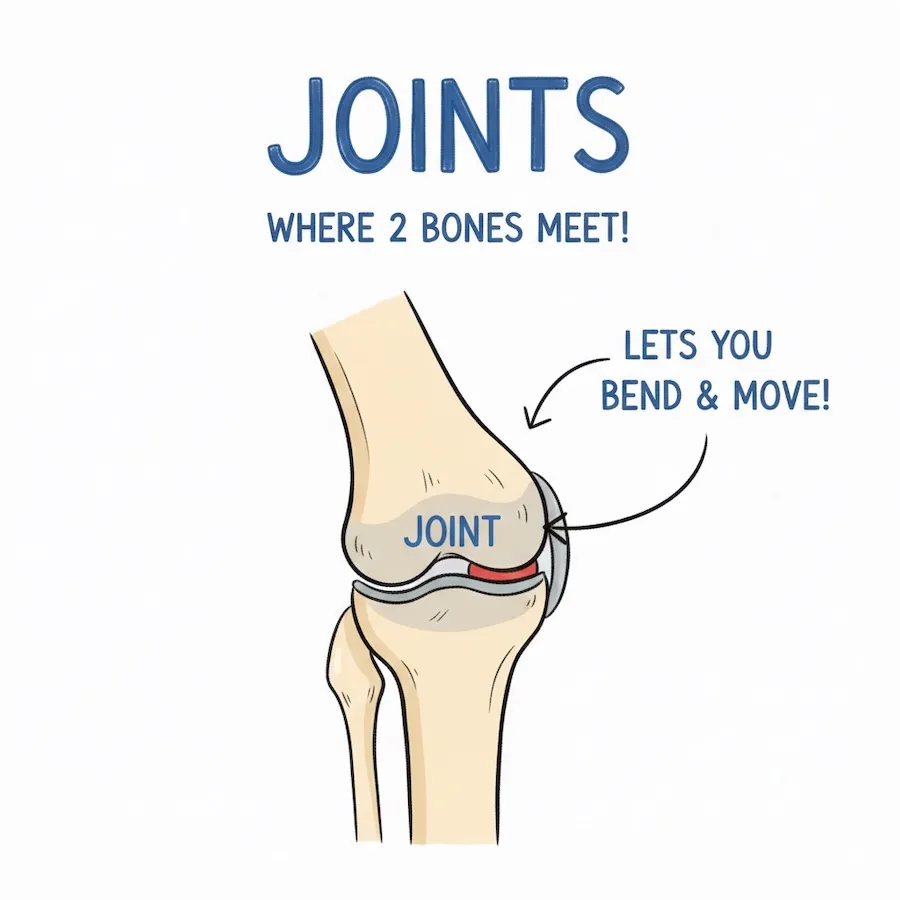
Your body has more than 200 bones that work together to help you move and stand. Joints are the places where two bones meet. Joints connect bones and allow your body to bend and move in different ways.
Different joints help your body move in different ways. The knee joint is where your thigh bone meets your lower leg bones. This joint works like a hinge on a door. It lets you bend your leg so you can walk, run, and sit down. The elbow joint connects the bones in your upper arm and lower arm. Like your knee, it bends in one direction so you can lift things and feed yourself.
Some joints can move in more ways than others. Your shoulder joint is special because it lets your arm move in many directions. You can swing your arm forward and backward, lift it up and down, and even move it in a complete circle. This is different from your knee or elbow, which can only bend one way.
Joints are very important for everyday activities. Without joints, your skeleton (all the bones in your body) would be stiff like a statue. You would not be able to walk, write, or even turn your head. Joints give your body the flexibility (ability to bend and move) it needs to do all the things you do every day.
Interesting Fact: The human body has about 360 joints! The place where you have the most joints is in your hands and feet, which is why your fingers and toes can move in so many different ways.
What are joints?
Places where two bones meetThe largest bones in the bodyMuscles that help you moveParts of the brain
How does the knee joint work?
Like a hinge on a doorLike a wheel turningLike a spring bouncingLike a ball rolling
How many bones are in the body?
About 100 bonesMore than 200 bonesExactly 50 bonesAbout 500 bones
Why is the shoulder joint special?
It is the largest jointIt never gets hurtIt moves in many directionsIt connects the most bones
What would happen without joints?
Your bones would grow biggerYour body would be stiffYou would run fasterYour muscles would be stronger
Which joint lets you write?
Knee jointAnkle jointElbow and hand jointsHip joint
Joints give the body flexibility.
TrueFalse
What does flexibility mean?
Being very strongAbility to bend and moveGrowing taller quicklyHaving many bones
Perfect For:
👩🏫 Teachers
• Reading comprehension practice
• Auto-graded assessments
• Literacy skill development
👨👩👧👦 Parents
• Reading practice at home
• Comprehension improvement
• Educational reading time
🏠 Homeschoolers
• Reading curriculum support
• Independent reading practice
• Progress monitoring
Reading Features:
📖
Reading Passage
Engaging fiction or nonfiction text
❓
Comprehension Quiz
Auto-graded questions
📊
Instant Feedback
Immediate results and scoring
📄
Printable Version
Download for offline reading
🔊
Read Aloud
Voice-over with word highlighting
Reviews & Ratings
No reviews yet. Be the first to share your experience!
Related Content
What Are Bones Made Of
This engaging 250-word reading passage introduces Grade 4 students to the structure and function of bones, aligned with ...
NGSS 4-LS1-1LS1.A
How Bones Protect Organs
This engaging 250-word reading passage helps Grade 4 students understand how bones protect organs, aligned with NGSS sta...
NGSS 4-LS1-1LS1.A
Layers of the Skin
This engaging 250-word reading passage introduces fourth-grade students to the three layers of skin and their functions....
NGSS 4-LS1-1LS1.A
Parts of Plant Stems
This engaging 250-word reading passage introduces fourth-grade students to the internal structure and function of plant ...
NGSS 4-LS1-1LS1.A
Parts of a Flower
This comprehensive 250-word reading passage introduces fourth-grade students to the essential parts of a flower and thei...
NGSS 4-LS1-1LS1.A
How Animals See Differently
This engaging 250-word reading passage introduces fourth-grade students to the fascinating world of animal vision and ey...
NGSS 4-LS1-1LS1.D
Animal Internal Structure
This engaging science passage for Grade 4-5 students explores animal internal structure and how organs work together to ...
NGSS 4-LS1-1
How Muscles Move Bones
This comprehensive 250-word reading passage introduces fourth-grade students to the fundamental concept of how muscles a...
NGSS 4-LS1-1
Two Types of Muscles
This 250-word reading passage introduces fourth-grade students to the two main types of muscles in the human body: volun...
NGSS 4-LS1-1
What Are Muscles
This engaging 250-word reading passage introduces fourth-grade students to the essential concept of muscles and how they...
NGSS 4-LS1-1
How Skin Protects Body
This audio-integrated reading passage introduces fourth-grade students to the protective functions of skin, aligned with...
NGSS 4-LS1-1
What Are Plant Structures
This engaging 250-word reading passage introduces fourth-grade students to the fundamental concept of plant structures a...
NGSS 4-LS1-1
How Water Moves Inside Plants
This 250-word reading passage introduces fourth-grade students to the concept of water transport in plants, aligned with...