This learning resource is available in interactive and printable formats. The interactive worksheet can be played online and assigned to students. The Printable PDF version can be downloaded and printed for completion by hand.
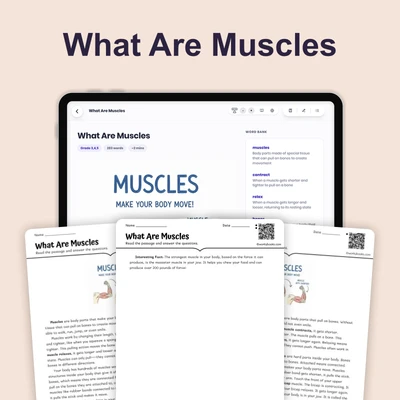
This comprehensive 250-word reading passage introduces fourth-grade students to the fundamental concept of how muscles and bones work together to create movement in the human body, aligned with NGSS 4-LS1-1 standards. Students discover that muscles can only pull, not push, which is why they must work in pairs to move bones in different directions. Using the relatable example of bending and straightening an arm, the passage explains how the biceps muscle pulls the forearm up while the triceps muscle pulls it back down. The audio-integrated content helps students understand the structure and function of the muscular and skeletal systems working together. This passage builds foundational knowledge about body systems and prepares students for hands-on investigations and deeper discussions about human anatomy. The simplified differentiated version ensures all learners can access the same core science concepts through shorter sentences and familiar language. Spanish translations of both versions support English language learners. Accompanying activities include multiple-choice comprehension questions, writing prompts that encourage application of concepts, and graphic organizers that help students visualize the cause-and-effect relationships and structure-function connections in the musculoskeletal system.
CONTENT PREVIEW
Expand content preview
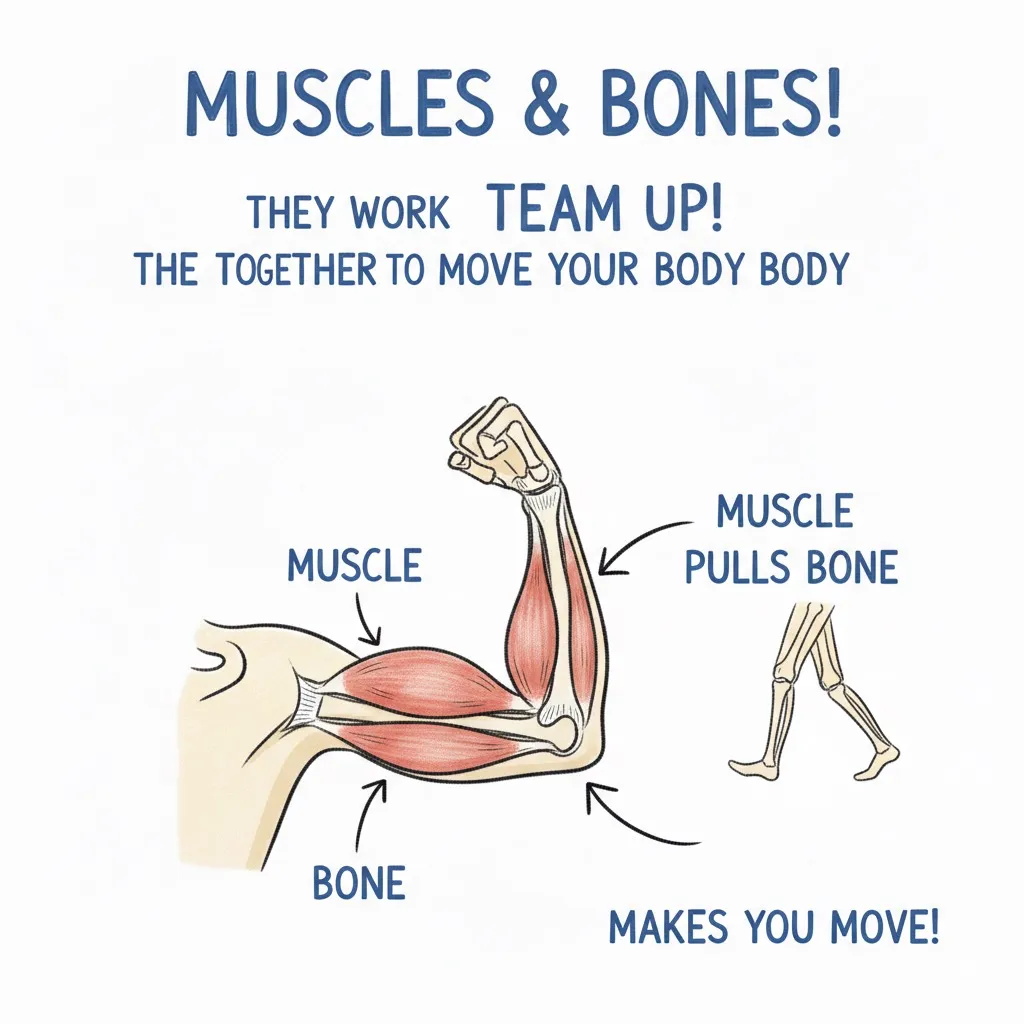
Your body moves because muscles and bones work together as a team. Muscles are body parts that can tighten and relax to create movement. Bones are the hard structures that give your body shape and support. This partnership allows you to run, jump, write, and do everything you need to do each day.
Muscles have an important rule: they can only pull, not push. A muscle works by getting shorter and tighter, which pulls on the bone it is attached to. Because muscles cannot push, your body uses muscle pairs—two muscles that work together to move a bone in different directions.
Your arm is a perfect example of muscle pairs at work. When you bend your arm, the biceps muscle on the top of your upper arm tightens and pulls your forearm up toward your shoulder. When you want to straighten your arm again, the biceps relaxes. Then the triceps muscle on the bottom of your upper arm tightens and pulls your forearm back down. One muscle pulls the bone one way, and its partner muscle pulls it back the other way.
This pulling system works all over your body. Muscle pairs in your legs help you walk and kick. Muscle pairs in your jaw help you chew food. Without muscles working in pairs, you would not be able to move your bones back and forth.
Interesting Fact: You have over 600 muscles in your body, and it takes 17 different muscles working together just to smile!
What can muscles do to bones?
Push them awayPull them closerBreak them apartMake them grow
Why do muscles work in pairs?
Because they get tired easilyBecause they can only pullBecause bones are heavyBecause they need help
Which muscle bends your arm up?
Triceps muscleLeg muscleBiceps muscleJaw muscle
What happens when you straighten your arm?
Biceps tightens and triceps relaxesBoth muscles relax completelyBiceps relaxes and triceps tightensBoth muscles tighten together
Where else do muscle pairs work?
Only in your armsIn legs and jawOnly in your backOnly in your fingers
What gives your body shape and support?
Muscles onlySkin and hairBonesBlood vessels
Muscles can push bones to create movement.
TrueFalse
What does the word 'tighten' mean?
To become loose and relaxedTo become shorter and harderTo grow longer and softerTo stop working completely
Perfect For:
👩🏫 Teachers
• Reading comprehension practice
• Auto-graded assessments
• Literacy skill development
👨👩👧👦 Parents
• Reading practice at home
• Comprehension improvement
• Educational reading time
🏠 Homeschoolers
• Reading curriculum support
• Independent reading practice
• Progress monitoring
Reading Features:
📖
Reading Passage
Engaging fiction or nonfiction text
❓
Comprehension Quiz
Auto-graded questions
📊
Instant Feedback
Immediate results and scoring
📄
Printable Version
Download for offline reading
🔊
Read Aloud
Voice-over with word highlighting
Reviews & Ratings
No reviews yet. Be the first to share your experience!
Related Content
How Animals See Differently
This engaging 250-word reading passage introduces fourth-grade students to the fascinating world of animal vision and ey...
NGSS 4-LS1-1LS1.D
Animal Internal Structure
This engaging science passage for Grade 4-5 students explores animal internal structure and how organs work together to ...
NGSS 4-LS1-1
What Are Bones Made Of
This engaging 250-word reading passage introduces Grade 4 students to the structure and function of bones, aligned with ...
NGSS 4-LS1-1LS1.A
How Bones Protect Organs
This engaging 250-word reading passage helps Grade 4 students understand how bones protect organs, aligned with NGSS sta...
NGSS 4-LS1-1LS1.A
How Joints Connect Bones
This 250-word reading passage teaches fourth-grade students about joints and their role in the human skeletal system. Al...
NGSS 4-LS1-1LS1.A
Two Types of Muscles
This 250-word reading passage introduces fourth-grade students to the two main types of muscles in the human body: volun...
NGSS 4-LS1-1
What Are Muscles
This engaging 250-word reading passage introduces fourth-grade students to the essential concept of muscles and how they...
NGSS 4-LS1-1
How Skin Protects Body
This audio-integrated reading passage introduces fourth-grade students to the protective functions of skin, aligned with...
NGSS 4-LS1-1
Layers of the Skin
This engaging 250-word reading passage introduces fourth-grade students to the three layers of skin and their functions....
NGSS 4-LS1-1LS1.A
What Are Plant Structures
This engaging 250-word reading passage introduces fourth-grade students to the fundamental concept of plant structures a...
NGSS 4-LS1-1
Parts of Plant Stems
This engaging 250-word reading passage introduces fourth-grade students to the internal structure and function of plant ...
NGSS 4-LS1-1LS1.A
How Water Moves Inside Plants
This 250-word reading passage introduces fourth-grade students to the concept of water transport in plants, aligned with...
NGSS 4-LS1-1
Parts of a Flower
This comprehensive 250-word reading passage introduces fourth-grade students to the essential parts of a flower and thei...