This learning resource is available in interactive and printable formats. The interactive worksheet can be played online and assigned to students. The Printable PDF version can be downloaded and printed for completion by hand.
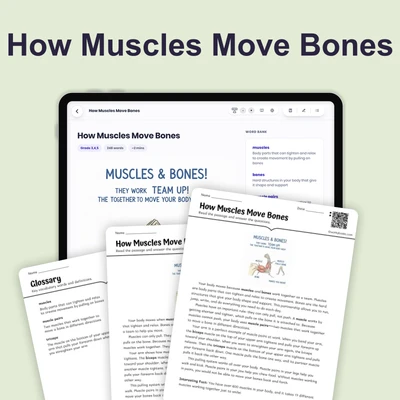
This engaging 250-word reading passage introduces fourth-grade students to the essential concept of muscles and how they create body movement. Aligned with NGSS 4-LS1-1 and the Disciplinary Core Idea LS1.A, the passage explains that muscles are body parts attached to bones that work by contracting (getting shorter) and relaxing (getting longer) to pull bones and create movement. Students learn that the human body contains hundreds of muscles and can explore this concept by feeling their own bicep muscle while bending their arm. The passage uses simple, grade-appropriate language and includes bolded key vocabulary terms with immediate definitions. A relatable hands-on example helps students connect the science concept to their own bodies. The passage includes audio integration to support diverse learners and is accompanied by a simplified differentiated version for students reading below grade level. Both English and Spanish translations are provided. Supporting activities include multiple-choice comprehension questions, writing prompts, and graphic organizers that reinforce understanding of muscle structure and function. This foundational lesson prepares students for deeper exploration of body systems and how structures support specific functions in living organisms.
CONTENT PREVIEW
Expand content preview
Muscles are body parts that make your body move. A muscle is a special type of tissue that can pull on bones to create movement. Without muscles, you would not be able to walk, run, jump, or even smile.
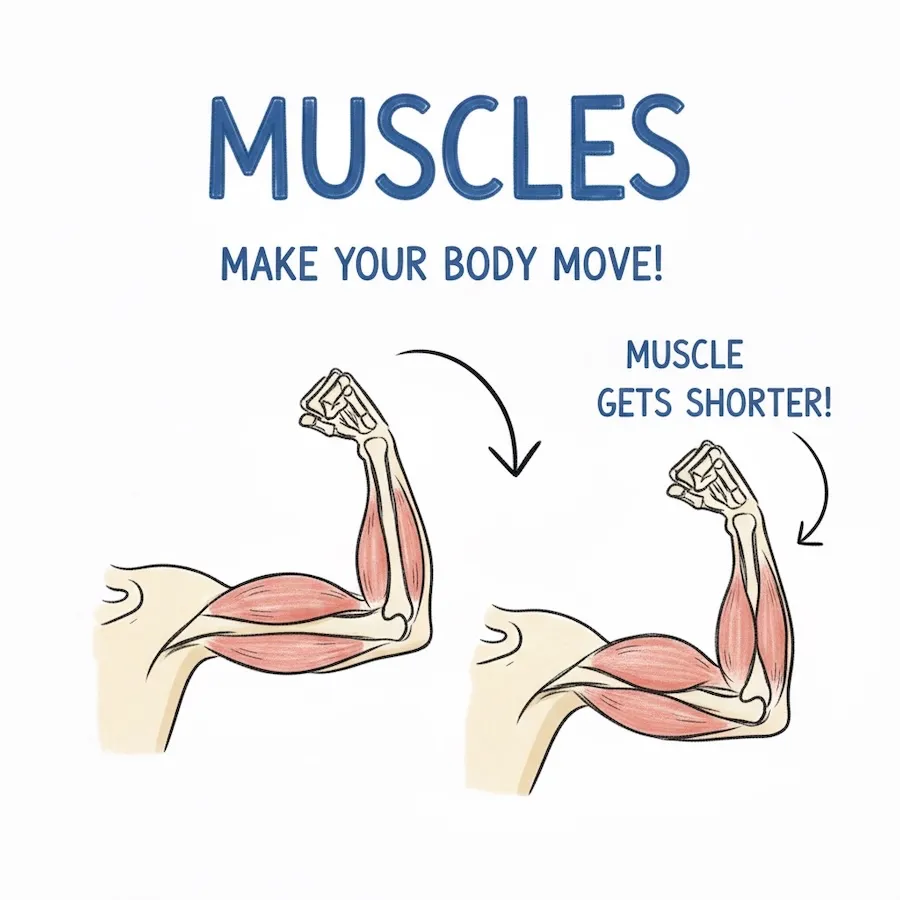
Muscles work by changing their length. When a muscle contracts, it gets shorter and tighter, like when you squeeze a sponge. Contracting means becoming smaller or tighter. This pulling action moves the bone that the muscle is attached to. When a muscle relaxes, it gets longer and looser again. Relaxing means returning to a resting state. Muscles can only pull—they cannot push—so they often work in pairs to move bones in different directions.
Your body has hundreds of muscles working together. Bones are the hard structures inside your body that give it shape and support. Muscles are attached to bones, which means they are connected firmly to them. When muscles contract, they pull on the bones they are attached to, causing your body parts to move. Think of muscles like rubber bands connected to sticks. When the rubber band gets shorter, it pulls the stick and makes it move.
You can feel muscles working in your own body. Bend your arm and touch the front part of your upper arm. The bump you feel is your bicep muscle contracting. The bicep is a muscle in your upper arm that helps you bend your elbow. When you straighten your arm, your bicep relaxes and gets longer again.
Interesting Fact: The strongest muscle in your body, based on the force it can produce, is the masseter muscle in your jaw. It helps you chew your food and can produce over 200 pounds of force!
What do muscles do in your body?
They make your body moveThey help you thinkThey digest your foodThey help you breathe only
What happens when a muscle contracts?
It gets longer and looserIt gets shorter and tighterIt pushes the bone awayIt stops working completely
Where are muscles attached in your body?
To your skinTo your brainTo your bonesTo your stomach
Why do muscles work in pairs?
Because they get tired easilyBecause they can only pullBecause they are very smallBecause they need to rest
What muscle can you feel contracting?
Your stomach muscleYour leg muscleYour bicep muscleYour back muscle
How do muscles move bones?
By pushing them forwardBy pulling on themBy spinning them aroundBy holding them still
Muscles can push and pull bones.
TrueFalse
What does the word 'relax' mean?
Getting shorter and tighterReturning to a resting statePushing on a boneBreaking apart completely
Perfect For:
👩🏫 Teachers
• Reading comprehension practice
• Auto-graded assessments
• Literacy skill development
👨👩👧👦 Parents
• Reading practice at home
• Comprehension improvement
• Educational reading time
🏠 Homeschoolers
• Reading curriculum support
• Independent reading practice
• Progress monitoring
Reading Features:
📖
Reading Passage
Engaging fiction or nonfiction text
❓
Comprehension Quiz
Auto-graded questions
📊
Instant Feedback
Immediate results and scoring
📄
Printable Version
Download for offline reading
🔊
Read Aloud
Voice-over with word highlighting
Reviews & Ratings
No reviews yet. Be the first to share your experience!
Related Content
How Animals See Differently
This engaging 250-word reading passage introduces fourth-grade students to the fascinating world of animal vision and ey...
NGSS 4-LS1-1LS1.D
Animal Internal Structure
This engaging science passage for Grade 4-5 students explores animal internal structure and how organs work together to ...
NGSS 4-LS1-1
What Are Bones Made Of
This engaging 250-word reading passage introduces Grade 4 students to the structure and function of bones, aligned with ...
NGSS 4-LS1-1LS1.A
How Bones Protect Organs
This engaging 250-word reading passage helps Grade 4 students understand how bones protect organs, aligned with NGSS sta...
NGSS 4-LS1-1LS1.A
How Joints Connect Bones
This 250-word reading passage teaches fourth-grade students about joints and their role in the human skeletal system. Al...
NGSS 4-LS1-1LS1.A
How Muscles Move Bones
This comprehensive 250-word reading passage introduces fourth-grade students to the fundamental concept of how muscles a...
NGSS 4-LS1-1
Two Types of Muscles
This 250-word reading passage introduces fourth-grade students to the two main types of muscles in the human body: volun...
NGSS 4-LS1-1
How Skin Protects Body
This audio-integrated reading passage introduces fourth-grade students to the protective functions of skin, aligned with...
NGSS 4-LS1-1
Layers of the Skin
This engaging 250-word reading passage introduces fourth-grade students to the three layers of skin and their functions....
NGSS 4-LS1-1LS1.A
What Are Plant Structures
This engaging 250-word reading passage introduces fourth-grade students to the fundamental concept of plant structures a...
NGSS 4-LS1-1
Parts of Plant Stems
This engaging 250-word reading passage introduces fourth-grade students to the internal structure and function of plant ...
NGSS 4-LS1-1LS1.A
How Water Moves Inside Plants
This 250-word reading passage introduces fourth-grade students to the concept of water transport in plants, aligned with...
NGSS 4-LS1-1
Parts of a Flower
This comprehensive 250-word reading passage introduces fourth-grade students to the essential parts of a flower and thei...