This learning resource is available in interactive and printable formats. The interactive worksheet can be played online and assigned to students. The Printable PDF version can be downloaded and printed for completion by hand.
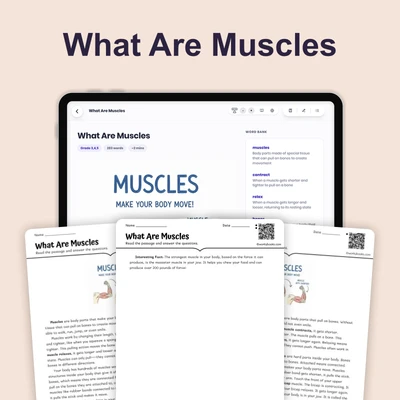
This 250-word reading passage introduces fourth-grade students to the two main types of muscles in the human body: voluntary and involuntary muscles. Aligned with NGSS 4-LS1-1 and the Disciplinary Core Idea LS1.A: Structure and Function, the passage explains how voluntary muscles like those in arms and legs are controlled consciously for activities like walking and jumping, while involuntary muscles such as the heart and stomach work automatically without conscious thought. The content uses age-appropriate language and relatable examples to help students understand how different muscle types serve different functions in keeping the body alive and active. The passage includes audio integration for enhanced accessibility and engagement. Students explore key vocabulary including voluntary muscles, involuntary muscles, automatically, and skeletal muscles. Supplementary activities include comprehension questions, writing prompts, and graphic organizers that help students compare and contrast the two muscle types and understand their structure and function in the human body system.
CONTENT PREVIEW
Expand content preview
Your body has more than 600 muscles that help you move and stay alive. These muscles can be divided into two main groups based on how they work.
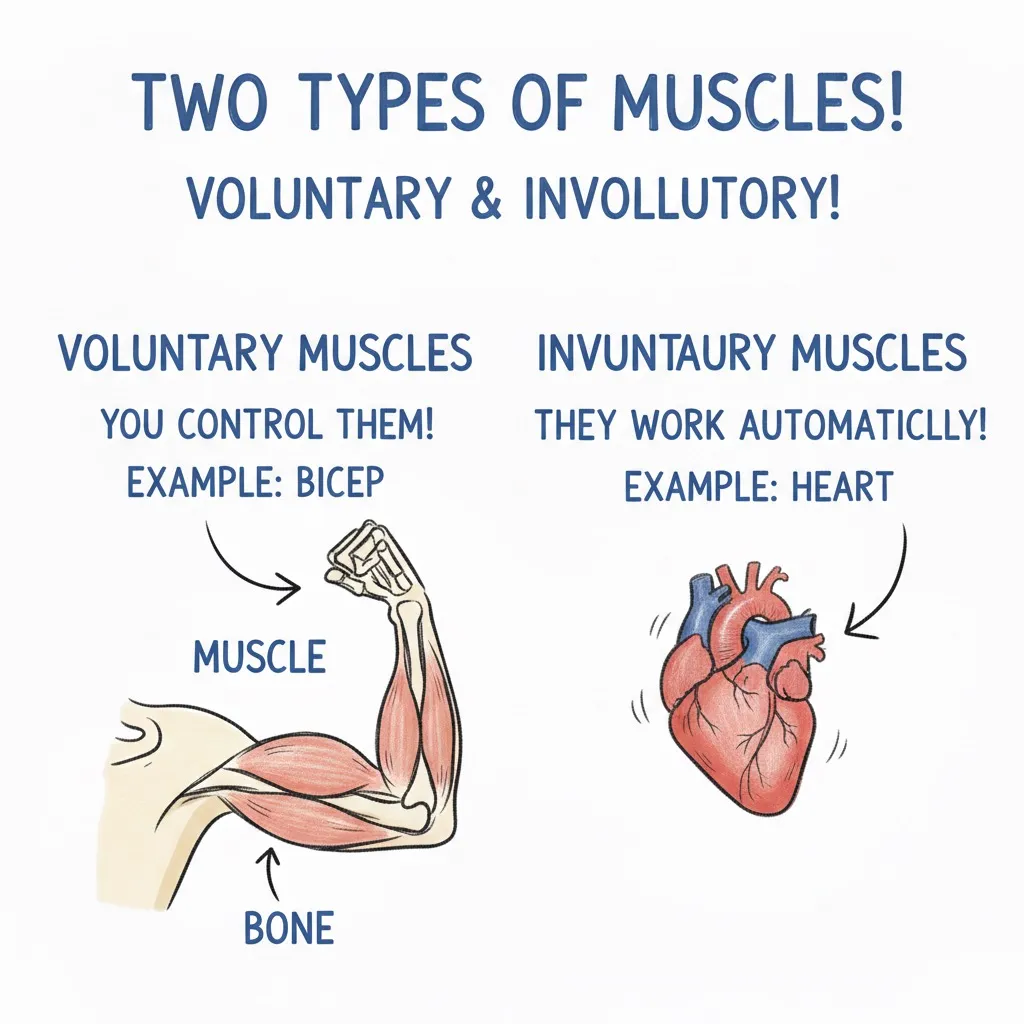
The first group is called voluntary muscles. Voluntary muscles are muscles you control on purpose. When you decide to kick a ball, wave to a friend, or write your name, you are using voluntary muscles. The muscles in your arms, legs, and face are voluntary muscles. These are also called skeletal muscles because they are attached to your bones. Think of voluntary muscles like the steering wheel in a car—you decide where they go and what they do.
The second group is called involuntary muscles. Involuntary muscles work automatically without you thinking about them. Automatically means something happens by itself without you having to control it. Your heart is made of involuntary muscle that beats all day and night, even when you sleep. Your stomach has involuntary muscles that squeeze and mix your food to help digest it. You cannot tell your heart to stop beating or your stomach to stop working—they do their jobs automatically.
Your body needs both types of muscles. Voluntary muscles let you run, play, and do activities you enjoy. Involuntary muscles keep you alive by making your heart beat, helping you breathe, and digesting your food. Both types work together to keep your body healthy and active.
Interesting Fact: Your heart is the hardest-working involuntary muscle in your body—it beats about 100,000 times every single day!
How many muscles does your body have?
About 100 musclesMore than 600 musclesExactly 500 musclesLess than 200 muscles
What are voluntary muscles attached to?
Your skinYour heartYour bonesYour stomach
Which muscle beats about 100,000 times daily?
Arm muscleLeg muscleHeart muscleFace muscle
Why do you need voluntary muscles?
To make your heart beatTo digest your foodTo run, play, and moveTo breathe while sleeping
What happens to involuntary muscles while sleeping?
They stop working completelyThey keep working automaticallyYou must control themThey only work sometimes
How do stomach muscles help your body?
They help you run fasterThey make you breathe betterThey squeeze and digest foodThey help you write
You can tell your heart to stop.
TrueFalse
What does automatically mean in the passage?
Very slowly and carefullyBy itself without your controlOnly when you are awakeWith lots of thinking
Perfect For:
👩🏫 Teachers
• Reading comprehension practice
• Auto-graded assessments
• Literacy skill development
👨👩👧👦 Parents
• Reading practice at home
• Comprehension improvement
• Educational reading time
🏠 Homeschoolers
• Reading curriculum support
• Independent reading practice
• Progress monitoring
Reading Features:
📖
Reading Passage
Engaging fiction or nonfiction text
❓
Comprehension Quiz
Auto-graded questions
📊
Instant Feedback
Immediate results and scoring
📄
Printable Version
Download for offline reading
🔊
Read Aloud
Voice-over with word highlighting
Reviews & Ratings
No reviews yet. Be the first to share your experience!
Related Content
How Animals See Differently
This engaging 250-word reading passage introduces fourth-grade students to the fascinating world of animal vision and ey...
NGSS 4-LS1-1LS1.D
Animal Internal Structure
This engaging science passage for Grade 4-5 students explores animal internal structure and how organs work together to ...
NGSS 4-LS1-1
What Are Bones Made Of
This engaging 250-word reading passage introduces Grade 4 students to the structure and function of bones, aligned with ...
NGSS 4-LS1-1LS1.A
How Bones Protect Organs
This engaging 250-word reading passage helps Grade 4 students understand how bones protect organs, aligned with NGSS sta...
NGSS 4-LS1-1LS1.A
How Joints Connect Bones
This 250-word reading passage teaches fourth-grade students about joints and their role in the human skeletal system. Al...
NGSS 4-LS1-1LS1.A
How Muscles Move Bones
This comprehensive 250-word reading passage introduces fourth-grade students to the fundamental concept of how muscles a...
NGSS 4-LS1-1
What Are Muscles
This engaging 250-word reading passage introduces fourth-grade students to the essential concept of muscles and how they...
NGSS 4-LS1-1
How Skin Protects Body
This audio-integrated reading passage introduces fourth-grade students to the protective functions of skin, aligned with...
NGSS 4-LS1-1
Layers of the Skin
This engaging 250-word reading passage introduces fourth-grade students to the three layers of skin and their functions....
NGSS 4-LS1-1LS1.A
What Are Plant Structures
This engaging 250-word reading passage introduces fourth-grade students to the fundamental concept of plant structures a...
NGSS 4-LS1-1
Parts of Plant Stems
This engaging 250-word reading passage introduces fourth-grade students to the internal structure and function of plant ...
NGSS 4-LS1-1LS1.A
How Water Moves Inside Plants
This 250-word reading passage introduces fourth-grade students to the concept of water transport in plants, aligned with...
NGSS 4-LS1-1
Parts of a Flower
This comprehensive 250-word reading passage introduces fourth-grade students to the essential parts of a flower and thei...