This learning resource is available in interactive and printable formats. The interactive worksheet can be played online and assigned to students. The Printable PDF version can be downloaded and printed for completion by hand.
This engaging history reading passage explores the ways early humans survived and spread across continents by foraging, hunting, and fishing. Students will analyze the importance of adaptation, environmental change, and technological innovation in the Paleolithic era. The text draws on archaeological evidence and primary sources, highlighting how early humans used tools and developed strategies to secure food and migrate into new territories. The passage is aligned with CA HSS 6.1 and CCSS RI.6.1-8.4 standards. It includes a glossary, timeline, and graphic organizers to encourage critical thinking and historical analysis. Activities and questions support deeper understanding of cause and effect, change over time, and the global significance of early human migration. This resource is ideal for history classrooms and includes a read aloud audio option and full Spanish translation, making it accessible for a diverse range of learners.
CONTENT PREVIEW
Expand content preview
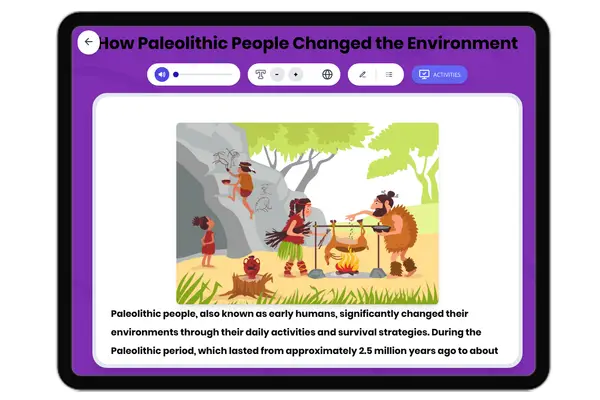
Activities of early human survival showing figures engaged in hunting and gathering food in a natural environment.
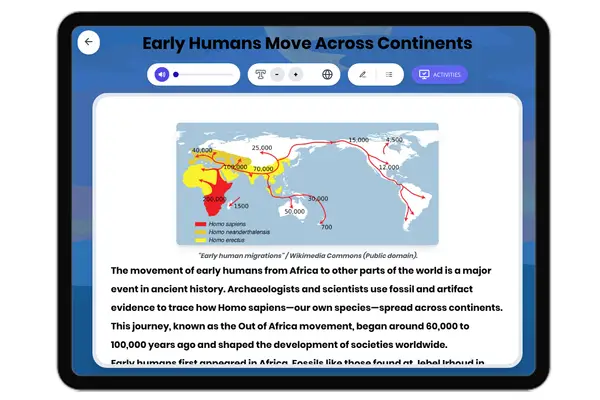
Throughout ancient history, early humans depended on foraging, hunting, and fishing to survive as they migrated across continents. Archaeological evidence shows that as early as 2 million years ago, Homo habilis in East Africa began using simple tools to obtain food. Over thousands of years, these survival strategies allowed humans to adapt to new environments and spread from Africa into Eurasia, Australia, and eventually the Americas.
Early humans lived in small, mobile groups known as bands. Their daily life revolved around searching for edible plants, nuts, fruits, and roots. This practice, called foraging, was a communal effort and required detailed knowledge of the local landscape. Archaeologists have discovered grinding stones and digging sticks at ancient sites like Ohalo II (Israel, c. 23,000 BCE) and Border Cave (South Africa), indicating the importance of plant foods in the diet. Foraging also included gathering shellfish along rivers and coasts, as seen in ancient middens (refuse heaps) in Japan and North America.
Hunting was another essential method for securing food. Early humans developed specialized tools such as hand axes, spears, and later, bows and arrows. Evidence from sites like Schöningen (Germany, c. 300,000 BCE) shows that wooden spears were used to hunt large animals such as horses and deer. The use of fire for cooking, first seen around 1 million years ago at Wonderwerk Cave (South Africa), increased the nutritional value of meat and made it safer to eat. Hunting required cooperation, planning, and communication within the group, helping to strengthen social bonds and leadership structures.
Fishing, though less well documented, played a vital role in many regions, especially near lakes, rivers, and coastal areas. Archaeological finds at Katanda (Democratic Republic of Congo, c. 90,000 BCE) include barbed bone points, some of the earliest known fishhooks. The abundance of fish and shellfish provided a reliable source of protein and allowed human populations to thrive in diverse environments. As humans migrated into new areas, they adapted their fishing techniques to different climates and water sources.
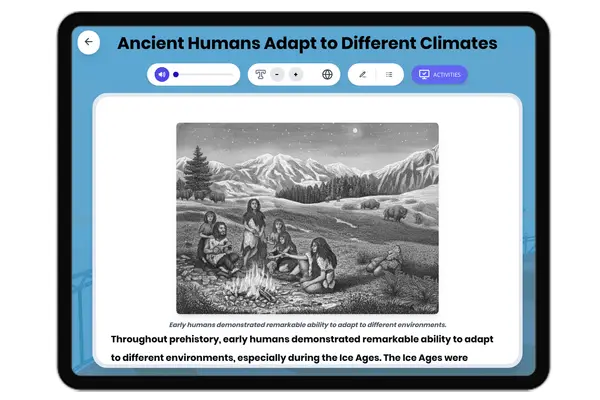
These survival strategies—foraging, hunting, and fishing—were shaped by the geography and climate of each region. Over time, humans developed more advanced technology, learned to cooperate, and passed down knowledge through oral traditions. The movement of early humans across continents was a slow process, driven by the search for food, changes in climate, and the need to escape danger or competition. This migration laid the foundation for the development of agriculture and permanent settlements thousands of years later.
Studying the survival strategies of early humans helps historians understand how adaptation and innovation influenced the course of human history. These ancient practices show the importance of the environment in shaping human society and highlight the creativity of our ancestors.
Interesting Fact:Did You Know? The earliest known stone tools, called Oldowan tools, date back over 2.6 million years and were used for cutting meat and plants.
This exploration of early human life connects to broader themes of adaptation, migration, and the development of societies studied throughout ancient history.
Where did Homo habilis first use tools?
East AfricaAustraliaNorth AmericaJapan
What was found at Katanda?
FishhooksPotteryMetal swordsWoven baskets
What food source did Ohalo II show evidence for?
Plant foodsDairy productsSaltBread
Why was fire important for early humans?
Made meat saferCreated jewelryBuilt housesPainted caves
How did hunting shape social life?
Built cooperationCaused fightsLed to farmingStopped migration
Why did humans migrate?
Search for foodTo build citiesFor funTo trade gold