Indus Valley Civilization
Interactive passage with audio narration, comprehension questions, and printable PDF.
By completing this purchase you agree to our Terms of Use and Privacy Policy. Your subscription renews automatically until you cancel. You can cancel anytime from your account settings. All sales are final and non-refundable. Digital content is available for download in your account immediately upon purchase.
What's included
Part of this bundle

Indus Valley Civilization preview and details
About this printable Indus Valley Civilization reading passage (Grades 5-8)
Sample passage and quiz from Indus Valley Civilization
Reading passage and comprehension quiz preview
Harappa and Mohenjo-Daro: Cities of the Indus Valley
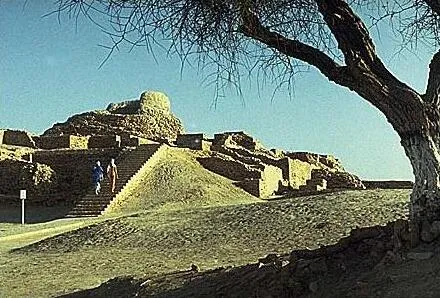
"Ghanghro location - Mohenjo-daro" Image by Ghanghro / Wikimedia Commons.
The Indus Valley Civilization developed along the Indus River in what is now Pakistan and northwest India around 2600 BCE. Two of its most well-known cities, Harappa and Mohenjo-Daro, were among the earliest examples of advanced urban planning in the ancient world. Archaeologists have uncovered evidence of organized streets, large public buildings, and sophisticated infrastructure in both cities, suggesting a highly skilled society.
Excavations at Mohenjo-Daro, which means “Mound of the Dead” in Sindhi, revealed a city with straight streets laid out in a grid pattern. The city included a massive public structure called the Great Bath, believed to have been used for religious or social gatherings. Both Mohenjo-Daro and Harappa had complex drainage and sewage systems, with brick-lined drains running beneath the streets and houses equipped with private wells and bathrooms. This level of urban engineering was rare in the ancient world and shows the importance of cleanliness and public health in Indus society.
Artifacts found at these sites, such as seals engraved with animals and mysterious symbols, provide clues about the culture’s beliefs and trade networks. Archaeologists have discovered pottery, jewelry, and tools made from materials like bronze and stone. Some of these materials, such as lapis lazuli, came from distant regions, proving that Harappa and Mohenjo-Daro were connected to long-distance trade with Mesopotamia and Central Asia. Written records, known as the Indus script, have been found on many objects, but so far, scholars have not been able to fully translate this writing system. This mystery adds to the fascination and challenges of studying the Indus Valley Civilization.
Social structure in Harappa and Mohenjo-Daro is studied through building sizes and locations. Larger houses with courtyards suggest some people held higher status, while smaller dwellings reflect a range of social classes. No evidence of palaces or large temples has been found, which is different from other ancient civilizations. This suggests that political power may have been shared or organized differently than in Egypt or Mesopotamia. Over time, the civilization declined, possibly due to environmental changes such as floods, drought, or shifting river courses, but the exact reasons remain debated among historians.
The cities of Harappa and Mohenjo-Daro are significant because they reveal the achievements and complexity of early South Asian societies. Their advanced planning, technology, and trade links influenced later cultures in India and beyond. Studying these cities helps historians understand how geography, environment, and human innovation shape civilization’s rise and fall.
Interesting Fact: Harappan cities used standardized brick sizes for building, showing a high level of organization across the Indus Valley Civilization.
Comprehension quiz (8 questions)
1. Where is Mohenjo-Daro located?
2. What is the Great Bath?
3. When did the Indus Valley Civilization decline?
4. Why are standardized bricks important?
5. What is a possible cause of decline?
6. How do we know about social structure?
7. Harappan cities had advanced plumbing. True or false?
8. What does 'infrastructure' mean?
Perfect for the way you teach
- Build comprehension skills
- Auto-graded quiz
- Differentiated reading
- Read together at home
- Improve fluency
- Quiet reading time
- Reading curriculum support
- Independent practice
- Track Lexile growth