Jacques Cartier: Exploring Canada — Reading Comprehension
Rate this
Premium Resource
Present
Present in classroom. No work saved
Assign
Classroom with student accounts, Track progress
Quick Play
No student accounts, assign with a link
Grades
3
4
5
Standards
D2.HIS.1.3-5
D2.HIS.2.3-5
RI.4.3
RI.4.4
W.4.2
PRINT+DIGITAL RESOURCE
This learning resource is available in interactive and printable formats. The interactive worksheet can be played online and assigned to students. The Printable PDF version can be downloaded and printed for completion by hand.
This engaging U.S. History reading passage explores Jacques Cartier’s brave search for the Northwest Passage. Students learn about Cartier’s expeditions, his encounters with new lands, and the impact of his discoveries on France’s role in Colonial America. The passage follows a clear chronological structure and introduces key vocabulary in context, supported by a glossary. Activities include a multiple-choice quiz, writing prompts, and a timeline to reinforce comprehension and critical thinking. The content aligns with C3 Framework and Common Core standards, ensuring students build historical understanding and literacy skills. With read aloud audio, Spanish translation, and a relevant public domain image, this resource supports diverse classroom learners and encourages connections between past events and today’s world.
CONTENT PREVIEW
Expand content preview
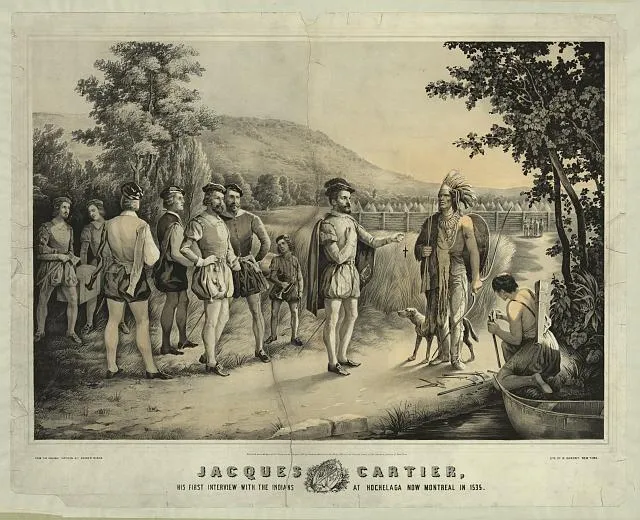
Jacques Cartier, his first interview with the Indians at Hochelaga now Montreal in 1535. Source: Library of Congress
Jacques Cartier was a French explorer who sailed across the Atlantic Ocean in the 1500s. He is remembered for exploring what is now Canada. His voyages helped France gain a foothold in North America.
In 1534, King Francis I of France sent Cartier on his first journey. The king wanted Cartier to find a new route to Asia. He also hoped to discover gold, spices, and other valuable things. Cartier sailed west and reached the coast of North America. There, he landed on land that would later be called Newfoundland.
Cartier met Indigenous people called the Iroquois. They lived near the St. Lawrence River. The river was wide and long. It led deep into the land. Cartier gave the name "Canada" to this region. The word comes from the Iroquois word "kanata," meaning village or settlement.
On his second voyage in 1535, Cartier sailed up the St. Lawrence River. He reached two important villages: Stadacona and Hochelaga. Stadacona became the city of Quebec. Hochelaga became Montreal. Cartier and his crew faced a hard winter. They ran out of fresh food and many became sick with scurvy. The Indigenous people showed them how to use tree bark to make a drink that helped them get better.
Cartier made a third voyage in 1541. This time, he tried to build a settlement, but it failed because of harsh weather and problems with supplies. Cartier did not find gold or a new way to Asia, but his journeys were important. He drew new maps and brought back stories about the land and people he met.
Cartier’s explorations gave France a claim to much of Canada. Later, French settlers built towns and traded with Indigenous people. The St. Lawrence River became a main route for travel and trade.
Jacques Cartier is remembered today as a brave explorer. His work helped shape the history of Canada and the United States.
Interesting Fact: Jacques Cartier was the first European to write down the word "Canada" and use it for this land.
Who was Jacques Cartier?
A French explorerA Spanish kingA British soldierAn Italian artist
Which river did Cartier explore?
St. Lawrence RiverMississippi RiverAmazon RiverNile River
What did Cartier name the land he found?
CanadaMexicoFloridaBrazil
Why did King Francis I send Cartier?
To find a route to AsiaTo find new musicTo become kingTo build ships
How did Indigenous people help Cartier's crew?
Shared medicine from treesGave them goldBuilt them a fortTaught them to farm
What was one result of Cartier’s journeys?
France claimed land in CanadaHe found a way to AsiaHe became king of FranceHe built a city in Florida
Cartier built a successful settlement. True or false?
TrueFalse
What does 'settlement' mean?
A place where people liveA kind of shipA tree by the riverA map of Canada
Perfect For:
👩🏫 Teachers
• Reading comprehension practice
• Auto-graded assessments
• Literacy skill development
👨👩👧👦 Parents
• Reading practice at home
• Comprehension improvement
• Educational reading time
🏠 Homeschoolers
• Reading curriculum support
• Independent reading practice
• Progress monitoring
Reading Features:
📖
Reading Passage
Engaging fiction or nonfiction text
❓
Comprehension Quiz
Auto-graded questions
📊
Instant Feedback
Immediate results and scoring
📄
Printable Version
Download for offline reading
🔊
Read Aloud
Voice-over with word highlighting
Reviews & Ratings
No reviews yet. Be the first to share your experience!
Related Content
Native American Tribes Across America
This engaging history reading passage introduces students to Native American tribes across America, focusing on their da...
D2.HIS.1.3-5D2.HIS.2.3-5RI.4.1RI.4.2
The Sioux: Warriors and Tribal Leaders
This history reading passage explores the Sioux Nation, focusing on their roles as warriors and tribal leaders. Students...
D2.HIS.1.3-5D2.HIS.2.3-5RI.4.1RI.4.3
Jamestown: The First Permanent English Colony
This engaging history passage explores the founding of Jamestown, the first permanent English colony in America. Aligned...
D2.HIS.1.3-5D2.HIS.2.3-5RI.4.3RI.4.4
Pocahontas and the Powhatan People
This engaging reading passage explores the life of Pocahontas and the Powhatan people and their important role in early ...
D2.HIS.1.3-5D2.HIS.2.3-5RI.4.1RI.4.3
Colonial Games and Entertainment
This engaging history reading passage explores the types of games and entertainment enjoyed by children and families in ...
D2.HIS.1.3-5RI.4.3RI.4.4
Colonial Towns and Village Life
This engaging history reading passage explores the daily life, work, and unity found in colonial towns and villages. Ali...
D2.HIS.1.3-5D2.HIS.2.3-5RI.4.3RI.4.4
George Washington Leads the Army
This engaging history reading passage explores how George Washington bravely led the Continental Army during the America...
D2.HIS.1.3-5D2.HIS.2.3-5RI.4.3RI.4.4
The Battle of Yorktown Ends War
This engaging U.S. history reading passage explores the Battle of Yorktown, a key event that ended the American Revoluti...
D2.HIS.1.3-5D2.HIS.2.3-5RI.4.1RI.4.3
Life as a Continental Soldier
This passage explores the daily life of a Continental Soldier during the American Revolutionary War, highlighting challe...
D2.HIS.1.3-5RI.4.1RI.4.3
Loyalists vs. Patriots: Divided Families
This engaging U.S. history reading passage explores the division between Loyalists and Patriots during the American Revo...
D2.HIS.1.3-5D2.HIS.2.3-5RI.4.3RI.4.4
Manifest Destiny: Coast to Coast
This engaging U.S. history reading passage explores Manifest Destiny and the westward expansion of the United States. St...
D2.HIS.1.3-5D2.HIS.2.3-5RI.4.3RI.4.4
Abraham Lincoln Becomes President
This engaging U.S. history reading passage introduces students to the story of Abraham Lincoln’s rise to the presidency....
D2.HIS.1.3-5D2.HIS.2.3-5RI.4.3RI.4.4
The Southern States Leave the Union
This engaging reading passage explores the key events leading up to the Southern states leaving the Union before the Civ...
D2.HIS.1.3-5D2.HIS.2.3-5RI.4.3RI.4.4
Lincoln Assassinated at Ford's Theatre
This history reading passage explores the events of President Abraham Lincoln's assassination at Ford's Theatre in 1865....
D2.HIS.1.3-5D2.HIS.2.3-5RI.4.3RI.4.4
Juan Cabrillo Explores California
This engaging U.S. history reading passage introduces students to Juan Cabrillo, the first European explorer to reach Ca...
D2.HIS.1.3-5D2.HIS.2.3-5D2.HIS.3.3-5RI.4.3
California's Early Spanish Settlements
This engaging U.S. history reading passage explores life during the early Spanish settlements in America, highlighting t...
D2.HIS.1.3-5D2.HIS.2.3-5D2.HIS.3.3-5RI.4.1
Discovery of Gold in 1848 by James Marshall
This engaging U.S. History passage introduces students to the discovery of gold in 1848 by James Marshall and the beginn...
D2.HIS.1.3-5D2.HIS.2.3-5D2.HIS.3.3-5RI.4.1
The Gold Rush Changes California Forever
This engaging U.S. History reading passage explores how the Gold Rush changed California forever. Students will learn ab...
D2.HIS.1.3-5D2.HIS.2.3-5D2.HIS.16.3-5RI.4.3
The Golden Spike: Connecting California to the Nation
This engaging U.S. history reading passage teaches students about the Golden Spike and how the first transcontinental ra...
D2.HIS.1.3-5D2.HIS.2.3-5D2.HIS.14.3-5RI.4.3
Farms, Factories, and Growing Cities
This engaging U.S. history reading passage explores the dramatic changes in America during the Progressive Era, focusing...