Julius Caesar
Interactive passage with audio narration, comprehension questions, and printable PDF.
By completing this purchase you agree to our Terms of Use and Privacy Policy. Your subscription renews automatically until you cancel. You can cancel anytime from your account settings. All sales are final and non-refundable. Digital content is available for download in your account immediately upon purchase.
What's included
Julius Caesar preview and details
About this printable Julius Caesar reading passage (Grades 6-8)
Sample passage and quiz from Julius Caesar
Reading passage and comprehension quiz preview
Julius Caesar
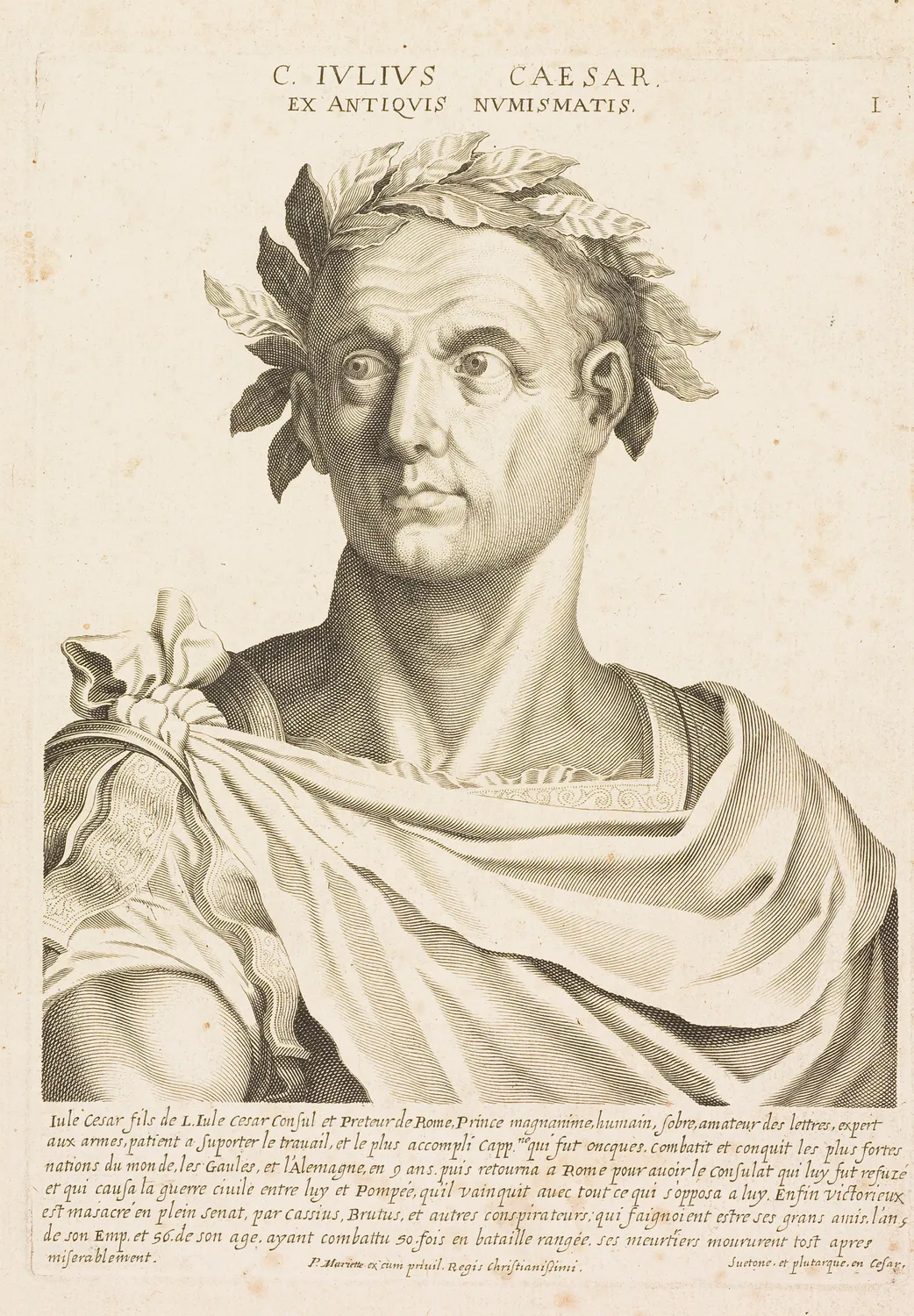
"C. Julius Caesar" by Catholic University of Leuven / Europeana (Public domain).
Julius Caesar was a Roman military general and political leader who played a vital role in the transformation of Rome from a republic to an empire. Born in 100 BCE, Caesar came from a patrician family, giving him access to power and influence in Roman society. His ambition and skill as a commander made him one of the most celebrated leaders in history.
As a young man, Caesar became known for his bravery and leadership in the Roman army. He fought in several campaigns, including a famous victory against the Gauls in what is now France. Caesar wrote about his battles in his work, Commentarii de Bello Gallico, providing historians with detailed primary sources about Roman military life and expansion. The conquest of Gaul not only increased Rome’s territory but also made Caesar extremely popular among the Roman people and his soldiers. Archaeological evidence, such as Roman camps and artifacts found in France, confirm many details from Caesar’s own accounts.
Caesar’s rise to power caused tension in the Roman Republic. The Senate, Rome’s ruling assembly, feared he was becoming too powerful. In 49 BCE, Caesar famously crossed the Rubicon River with his army, an action forbidden by Roman law. This act started a civil war. Caesar’s victory in the war allowed him to declare himself dictator for life. He introduced reforms, such as changing the calendar to the Julian system and granting Roman citizenship to more people. These actions changed the social hierarchy and daily life in Rome, but they also angered some senators who saw their traditional power slipping away.
On March 15, 44 BCE—the Ides of March—Caesar was assassinated by a group of senators including Brutus and Cassius. Their goal was to restore the Republic, but instead, Rome plunged into more civil wars. Eventually, Caesar’s adopted heir, Octavian (later Augustus), emerged as the first Roman emperor, marking the official end of the Roman Republic. The period after Caesar’s death saw great change but also continuity, as many of his reforms remained in place.
Julius Caesar’s story is significant because it demonstrates how individuals can shape history. His actions changed the geographic and political landscape of the ancient world. While some Romans saw him as a tyrant, others viewed him as a hero who brought stability. The debate around Caesar’s legacy continues today, showing how the past can influence present ideas about leadership and government.
This topic connects to broader themes in world history, such as the rise and fall of empires, the struggle for power, and the impact of individual leaders on society.
Interesting Fact: In Caesar’s time, the Roman Senate met in a building called the Curia; today, ruins of this building can still be seen in the Roman Forum.
Comprehension quiz (8 questions)
1. When was Julius Caesar born?
2. What river did Caesar cross?
3. Who became the first Roman emperor?
4. Why did some senators fear Caesar?
5. What was one reform by Caesar?
6. How did Caesar’s death affect Rome?
7. Caesar was a Roman dictator. True or false?
8. What does 'hierarchy' mean?
Perfect for the way you teach
- Build comprehension skills
- Auto-graded quiz
- Differentiated reading
- Read together at home
- Improve fluency
- Quiet reading time
- Reading curriculum support
- Independent practice
- Track Lexile growth