Medieval Monastery
Interactive passage with audio narration, comprehension questions, and printable PDF.
By completing this purchase you agree to our Terms of Use and Privacy Policy. Your subscription renews automatically until you cancel. You can cancel anytime from your account settings. All sales are final and non-refundable. Digital content is available for download in your account immediately upon purchase.
What's included
Medieval Monastery preview and details
About this printable Medieval Monastery reading passage (Grades 5-8)
Sample passage and quiz from Medieval Monastery
Reading passage and comprehension quiz preview
Life in Medieval Monastery
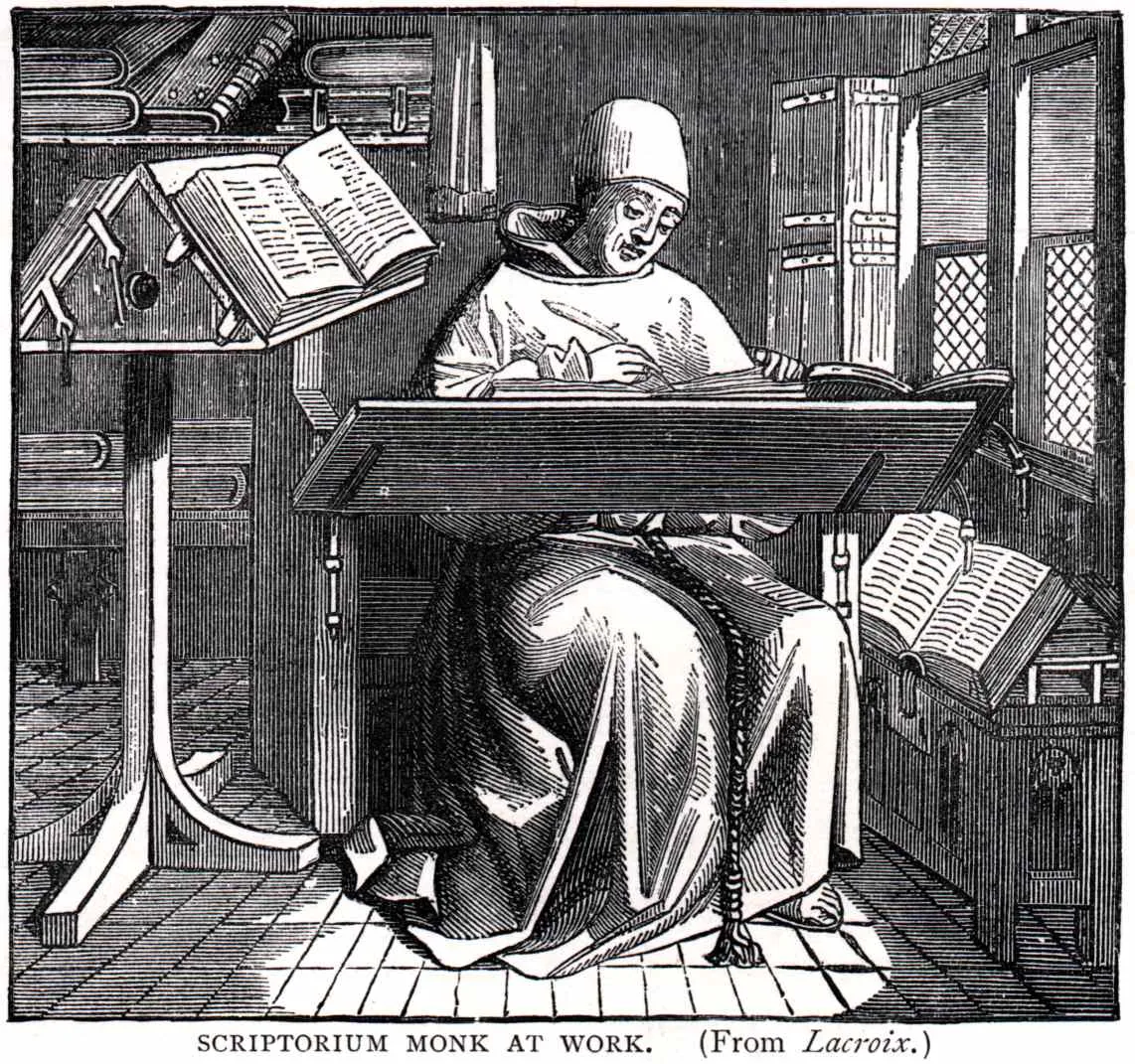
"Scriptorium-monk-at-work" / Wikimedia Commons (Public domain).
The fall of the Western Roman Empire in 476 CE marked the beginning of a period in European history known as the Middle Ages. During this time, much of the knowledge from the ancient world was at risk of being lost. However, monasteries played a critical role in preserving and transmitting this knowledge for future generations.
After the collapse of Rome, Europe experienced political instability, wars, and a decline in urban life. Many libraries and schools were destroyed or abandoned. In this challenging environment, Christian monks established monasteries in remote regions such as Ireland, Italy, and Gaul (modern France). Monasteries became centers not only of religious life but also of learning, education, and culture. Inside the monastery walls, monks dedicated their lives to prayer, study, and manual labor. One of their most important tasks was copying manuscripts—handwritten books containing religious texts, classical literature, and scientific works.
Monasteries developed special rooms called scriptoria where scribes worked for hours copying texts by hand. For example, the Benedictine monastery at Monte Cassino in Italy, founded by St. Benedict around 529 CE, became famous for its library and scriptorium. Monks there carefully reproduced works by ancient authors such as Aristotle and Cicero, as well as Christian texts like the Bible. In Ireland, the monastery at Kells produced the beautifully decorated Book of Kells, an illuminated Gospel manuscript from around 800 CE. Archaeological evidence, such as ink pots and styluses found in monastic ruins, shows the importance of this scholarly work.
By copying and safeguarding these texts, monasteries helped ensure that knowledge from the ancient Greek and Roman worlds survived into the Middle Ages and beyond. This preservation allowed later scholars in the Renaissance to rediscover and build upon ancient ideas. Monks also sometimes added commentaries explaining or interpreting difficult passages, making the works more accessible to future readers. While some knowledge was lost, the efforts of monastic communities were essential for the continuity of learning in Europe. The work of these monasteries also connected different regions, as manuscripts and ideas traveled between centers of learning.
The preservation of knowledge by monasteries demonstrates how religious communities responded to the challenges of their time and shaped the course of European history. Their dedication kept the flame of learning alive during an age of uncertainty and set the stage for the intellectual revival of later centuries.
By studying how monasteries preserved knowledge, students can better understand the connections between religion, culture, and the survival of ideas across time.
Interesting Fact: Monks sometimes included tiny drawings or jokes in the margins of manuscripts, giving us insight into their personalities and daily life.
Comprehension quiz (8 questions)
1. When did the Western Roman Empire fall?
2. Who founded Monte Cassino monastery?
3. What is the Book of Kells?
4. Why did monks copy manuscripts?
5. How did monasteries help Europe after Rome's fall?
6. What is a scriptorium?
7. Monks always worked alone. True or false?
8. What does 'preservation' mean?
Perfect for the way you teach
- Build comprehension skills
- Auto-graded quiz
- Differentiated reading
- Read together at home
- Improve fluency
- Quiet reading time
- Reading curriculum support
- Independent practice
- Track Lexile growth