New Tools for Sailing: Compass, Astrolabe, and Caravel — Reading Comprehension
Rate this
Premium Resource
Present
Present in classroom. No work saved
Assign
Classroom with student accounts, Track progress
Quick Play
No student accounts, assign with a link
Grades
3
4
5
Standards
D2.HIS.1.3-5
D2.HIS.2.3-5
RI.4.3
RI.4.4
W.4.2
PRINT+DIGITAL RESOURCE
This learning resource is available in interactive and printable formats. The interactive worksheet can be played online and assigned to students. The Printable PDF version can be downloaded and printed for completion by hand.
This engaging U.S. history reading passage explores the important new tools for sailing used during the Age of Exploration, including the compass, astrolabe, and caravel. Students will learn how these inventions helped European explorers cross the ocean and reach the Americas, changing the course of history. The passage highlights the cause-and-effect relationship between these tools and the exploration of new lands. It is structured to build foundational literacy skills, includes a glossary of key vocabulary, a Spanish translation, and activities aligned with C3 Framework and Common Core standards. Also included are comprehension questions, a writing activity, and a graphic organizer to support understanding. This passage is ideal for teachers and students seeking a history reading passage with read aloud audio and Spanish translation, meeting national history and ELA standards.
CONTENT PREVIEW
Expand content preview
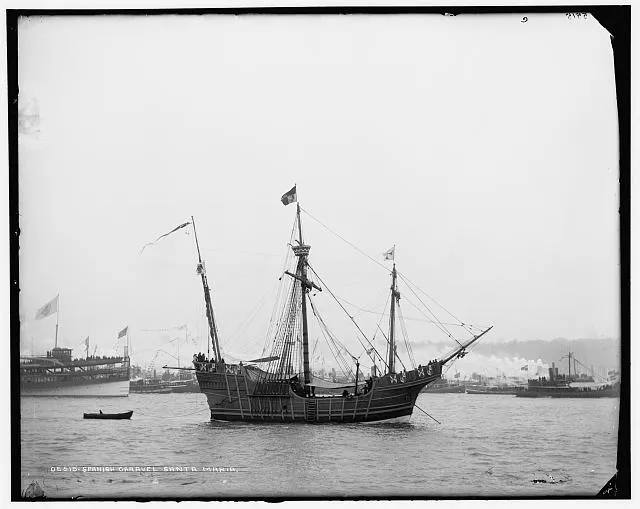
Spanish caravel Santa Maria. Source: Library of Congress - Detroit Publishing Co.
The Age of Exploration began in the 1400s when European sailors wanted to find new routes across the sea. They searched for gold, spices, and new lands. But traveling across wide oceans was dangerous. Sailors needed better ways to know where they were and where they were going.
One important tool was the compass. The compass uses a magnetized needle that always points north. Sailors could use this tool to find their direction, even when they could not see the sun or the stars. Before the compass, sailors often got lost at sea. The compass helped them feel more confident and safe during their journeys.
Another tool was the astrolabe. The astrolabe helped sailors measure how high the sun or a star was in the sky. With this information, they could figure out how far north or south they were on Earth. This made it much easier to know their exact location on the ocean.
Maps also improved during this time. Early maps were simple and not always correct. As explorers traveled, they brought back new information. Mapmakers used these discoveries to make more accurate maps. Better maps helped future explorers travel farther and find new places more quickly.
These maritime tools changed the world. Explorers like Christopher Columbus, Vasco da Gama, and Ferdinand Magellan used them to cross the Atlantic and Pacific Oceans. They visited new lands and met people living there, including Native Americans. These meetings changed life for people around the world.
The new tools made long trips faster and safer. They helped sailors solve problems and work as a team. As a result, people learned more about the world. They shared goods, ideas, and cultures. The Age of Exploration led to new trade routes and changed history forever.
Interesting Fact: Some early explorers named new places after their navigation tools, like Compass Island in the Caribbean.
What tool always points north?
CompassAstrolabeMapRudder
Who used navigation tools to cross oceans?
ExplorersFarmersTeachersDoctors
What did improved maps help sailors do?
Find new placesGrow foodBuild housesMake clothes
Why was the astrolabe important?
Find north and southCook foodMake sailsCatch fish
What happened after explorers traveled?
Maps improvedOceans frozeStars disappearedMountains moved
How did new tools affect travel?
Made trips saferMade trips longerStopped tradeMade maps disappear
The compass helped sailors find direction. True or false?
TrueFalse
What does 'maritime' mean?
About the seaAbout farmingAbout mountainsAbout forests
Perfect For:
👩🏫 Teachers
• Reading comprehension practice
• Auto-graded assessments
• Literacy skill development
👨👩👧👦 Parents
• Reading practice at home
• Comprehension improvement
• Educational reading time
🏠 Homeschoolers
• Reading curriculum support
• Independent reading practice
• Progress monitoring
Reading Features:
📖
Reading Passage
Engaging fiction or nonfiction text
❓
Comprehension Quiz
Auto-graded questions
📊
Instant Feedback
Immediate results and scoring
📄
Printable Version
Download for offline reading
🔊
Read Aloud
Voice-over with word highlighting
Reviews & Ratings
No reviews yet. Be the first to share your experience!
Related Content
Native American Tribes Across America
This engaging history reading passage introduces students to Native American tribes across America, focusing on their da...
D2.HIS.1.3-5D2.HIS.2.3-5RI.4.1RI.4.2
The Sioux: Warriors and Tribal Leaders
This history reading passage explores the Sioux Nation, focusing on their roles as warriors and tribal leaders. Students...
D2.HIS.1.3-5D2.HIS.2.3-5RI.4.1RI.4.3
Jamestown: The First Permanent English Colony
This engaging history passage explores the founding of Jamestown, the first permanent English colony in America. Aligned...
D2.HIS.1.3-5D2.HIS.2.3-5RI.4.3RI.4.4
Pocahontas and the Powhatan People
This engaging reading passage explores the life of Pocahontas and the Powhatan people and their important role in early ...
D2.HIS.1.3-5D2.HIS.2.3-5RI.4.1RI.4.3
Colonial Games and Entertainment
This engaging history reading passage explores the types of games and entertainment enjoyed by children and families in ...
D2.HIS.1.3-5RI.4.3RI.4.4
Colonial Towns and Village Life
This engaging history reading passage explores the daily life, work, and unity found in colonial towns and villages. Ali...
D2.HIS.1.3-5D2.HIS.2.3-5RI.4.3RI.4.4
George Washington Leads the Army
This engaging history reading passage explores how George Washington bravely led the Continental Army during the America...
D2.HIS.1.3-5D2.HIS.2.3-5RI.4.3RI.4.4
The Battle of Yorktown Ends War
This engaging U.S. history reading passage explores the Battle of Yorktown, a key event that ended the American Revoluti...
D2.HIS.1.3-5D2.HIS.2.3-5RI.4.1RI.4.3
Life as a Continental Soldier
This passage explores the daily life of a Continental Soldier during the American Revolutionary War, highlighting challe...
D2.HIS.1.3-5RI.4.1RI.4.3
Loyalists vs. Patriots: Divided Families
This engaging U.S. history reading passage explores the division between Loyalists and Patriots during the American Revo...
D2.HIS.1.3-5D2.HIS.2.3-5RI.4.3RI.4.4
Manifest Destiny: Coast to Coast
This engaging U.S. history reading passage explores Manifest Destiny and the westward expansion of the United States. St...
D2.HIS.1.3-5D2.HIS.2.3-5RI.4.3RI.4.4
Abraham Lincoln Becomes President
This engaging U.S. history reading passage introduces students to the story of Abraham Lincoln’s rise to the presidency....
D2.HIS.1.3-5D2.HIS.2.3-5RI.4.3RI.4.4
The Southern States Leave the Union
This engaging reading passage explores the key events leading up to the Southern states leaving the Union before the Civ...
D2.HIS.1.3-5D2.HIS.2.3-5RI.4.3RI.4.4
Lincoln Assassinated at Ford's Theatre
This history reading passage explores the events of President Abraham Lincoln's assassination at Ford's Theatre in 1865....
D2.HIS.1.3-5D2.HIS.2.3-5RI.4.3RI.4.4
Juan Cabrillo Explores California
This engaging U.S. history reading passage introduces students to Juan Cabrillo, the first European explorer to reach Ca...
D2.HIS.1.3-5D2.HIS.2.3-5D2.HIS.3.3-5RI.4.3
California's Early Spanish Settlements
This engaging U.S. history reading passage explores life during the early Spanish settlements in America, highlighting t...
D2.HIS.1.3-5D2.HIS.2.3-5D2.HIS.3.3-5RI.4.1
Discovery of Gold in 1848 by James Marshall
This engaging U.S. History passage introduces students to the discovery of gold in 1848 by James Marshall and the beginn...
D2.HIS.1.3-5D2.HIS.2.3-5D2.HIS.3.3-5RI.4.1
The Gold Rush Changes California Forever
This engaging U.S. History reading passage explores how the Gold Rush changed California forever. Students will learn ab...
D2.HIS.1.3-5D2.HIS.2.3-5D2.HIS.16.3-5RI.4.3
The Golden Spike: Connecting California to the Nation
This engaging U.S. history reading passage teaches students about the Golden Spike and how the first transcontinental ra...
D2.HIS.1.3-5D2.HIS.2.3-5D2.HIS.14.3-5RI.4.3
Farms, Factories, and Growing Cities
This engaging U.S. history reading passage explores the dramatic changes in America during the Progressive Era, focusing...