This learning resource is available in interactive and printable formats. The interactive worksheet can be played online and assigned to students. The Printable PDF version can be downloaded and printed for completion by hand.
This educational passage explores the complex relationship between Ancient Rome's Patricians and Plebeians, focusing on their struggle for power and its impact on Roman society. Students will learn about the social hierarchy, the causes and effects of the Conflict of the Orders, and the significant changes that shaped Roman government. The passage is aligned with CA HSS 6.7 and CCSS RH.6-8.2, offering a comprehensive reading with disciplinary vocabulary, primary source references, and analysis of cause and effect. Accompanying resources include a multiple-choice quiz, writing activities, graphic organizers, a timeline, and Spanish translations for accessibility. This resource is designed to help students analyze history through evidence, understand social change, and connect Ancient Rome’s legacy to broader world history themes. Read aloud audio is available for enhanced learning.
CONTENT PREVIEW
Expand content preview
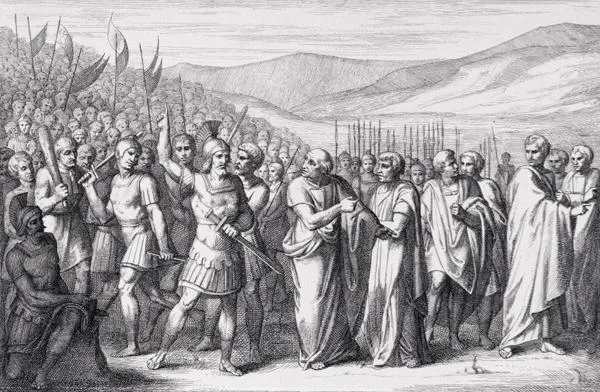
"Secessio plebis" by B. Barloccini / Source: Wikimedia Commons
The struggle between Patricians and Plebeians shaped the political and social development of Ancient Rome. By the 5th century BCE, Roman society was divided into these two classes. Patricians were wealthy landowners who claimed ancestry from the founding families of Rome. In contrast, Plebeians were the majority, including farmers, artisans, and merchants. The division between these classes influenced nearly every part of Roman life, from laws to daily customs.
The Patricians controlled the government by holding most positions in the Senate and the highest offices, such as consul. This control was justified by tradition and the belief that noble birth gave them wisdom and authority. Plebeians had few rights and were often excluded from important decisions. However, they formed the backbone of the army and contributed greatly to Rome's expansion. As Rome grew, the Plebeians began to demand more political representation and social equality.
The tension between the classes led to the Conflict of the Orders, a series of struggles from 494 BCE to 287 BCE. During this period, the Plebeians used collective action, such as seceding from the city, to pressure the Patricians. Primary sources, like the historian Livy, describe how the Plebeians gathered on the Sacred Mount in 494 BCE, refusing to serve in the army until their demands were met. This protest led to the creation of the office of Tribune of the Plebs, which gave Plebeians officials the power to veto unjust laws and protect their interests.
Over time, the Plebeians gained more rights through written laws and access to public offices. The Twelve Tables, Rome’s first written code of law, were established in 451 BCE after Plebeians demanded legal transparency. By 287 BCE, with the passage of the Lex Hortensia, decisions made by the Plebeian Assembly became binding for all Romans. Archaeological findings of public inscriptions and bronze tablets confirm that these changes had a lasting impact, making Roman politics more inclusive. Although social inequality remained, the reforms allowed talented individuals from both classes to shape Roman history.
The struggle between Patricians and Plebeians demonstrates how groups can challenge unfair systems and drive political change. Their conflict changed the structure of the Roman Republic and influenced later societies’ ideas about citizenship and equality.
This power struggle connects to broader themes in world history, such as the fight for rights and representation in government.
Interesting Fact: Some Roman families proudly displayed bronze tablets of the Twelve Tables in their homes as a symbol of justice and civic pride.
Who were the Patricians?
Wealthy ruling familiesRoman slavesForeign merchantsSoldiers only
What did Plebeians demand in 494 BCE?
More political rightsMore taxesNew emperorMore soldiers
What were the Twelve Tables?
Written Roman lawsCity gatesRoman holidaysBattle plans
Why did Plebeians leave Rome in 494 BCE?
To protest unfair treatmentTo avoid taxesTo travel for tradeTo join the Patricians
How did the Lex Hortensia change Rome?
Plebeian decisions became bindingPatricians lost all powerSlavery was endedNo more written laws
Which group controlled the Senate?
PatriciansPlebeiansTribunesSlaves
Patricians and Plebeians were equal in early Rome. True or False?
TrueFalse
What does 'social hierarchy' mean?
People ranked by statusBuilding in RomeType of armyRoman food
Perfect For:
👩🏫 Teachers
• Reading comprehension practice
• Auto-graded assessments
• Literacy skill development
👨👩👧👦 Parents
• Reading practice at home
• Comprehension improvement
• Educational reading time
🏠 Homeschoolers
• Reading curriculum support
• Independent reading practice
• Progress monitoring
Reading Features:
📖
Reading Passage
Engaging fiction or nonfiction text
❓
Comprehension Quiz
Auto-graded questions
📊
Instant Feedback
Immediate results and scoring
📄
Printable Version
Download for offline reading
🔊
Read Aloud
Voice-over with word highlighting
Reviews & Ratings
No reviews yet. Be the first to share your experience!
Related Content
Ancient Law Codes: Hammurabi to Rome
This passage explores how ancient civilizations like Babylon and Rome used law codes to govern people, maintain social o...
Geography and Early Rome
This passage, aligned to HSS 6.7 and CCSS RH.6-8.2, explores the rise of Ancient Rome with a focus on its geographical s...
Rome's Lasting Legacy
This passage explores the profound legacy of Ancient Rome and how its beliefs, innovations, and systems continue to shap...
Evidence in Ancient History
This engaging history reading passage investigates how archaeologists and historians discover clues about how ancient pe...
Livy: Historian of Early Rome
This passage introduces students to Livy, one of Ancient Rome's most significant historians, whose writings help us unde...
Germanic Invasions of Rome
This engaging history reading passage explores the causes and effects of the Germanic tribes’ invasions of the Western R...
Slavery in Ancient Rome and in the Americas
This educational passage examines the history of slavery in two distinct regions and eras: Ancient Rome and Colonial Ame...
Ancient Theocracy
This engaging history reading passage explores the concept of theocracy in ancient civilizations, where priests and reli...
Slavery in Ancient World
This passage explores the complex history of slavery in the ancient world, examining its presence in societies such as M...
Life in the Roman Empire
This rigorous history reading passage explores Life in the Roman Empire, guiding students through the social hierarchy, ...
Ancient Canaan
This educational passage explores the land of Canaan, the historical homeland of the ancient Israelites. Students will l...
Ancient Literature
This passage explores the importance of ancient stories and poems from civilizations such as Greece, India, and Israel. ...
Geography of Ancient Israel
This passage explores the rich geography of Ancient Israel, focusing on how landforms, climate, and natural resources sh...
The Etruscans
This engaging history reading passage explores the vital role of the Etruscans in shaping Ancient Rome. Students will di...
Ancient Writing Systems
This engaging history reading passage explores the origins and evolution of ancient writing systems, including cuneiform...
Ancient Agriculture Farming
This passage explores the transformative impact of farming on ancient societies, examining how the Neolithic Revolution ...
Cincinnatus
This rigorous history reading passage explores the story of Cincinnatus, a Roman farmer who became a dictator in a time ...
Ancient Mathematics
This passage explores the essential role of mathematics in ancient civilizations, including Mesopotamia, Egypt, Greece, ...
Trade Across Ancient India
This history reading passage explores Ancient India's trade networks and their impact on global connections. Students wi...
The Roman Republic
This passage explores the structure and significance of government and law in the Roman Republic, focusing on how Roman ...