Political Rivalries: Serving the King — Reading Comprehension
Rate this
Premium Resource
Present
Present in classroom. No work saved
Assign
Classroom with student accounts, Track progress
Quick Play
No student accounts, assign with a link
Grades
3
4
5
Standards
D2.HIS.1.3-5
D2.HIS.2.3-5
D2.HIS.3.3-5
RI.4.3
RI.4.4
W.4.2
PRINT+DIGITAL RESOURCE
This learning resource is available in interactive and printable formats. The interactive worksheet can be played online and assigned to students. The Printable PDF version can be downloaded and printed for completion by hand.
This engaging U.S. history reading passage explores the rivalries between Native Americans and European explorers during the Age of Exploration in the 1400s and 1500s. Students will learn about the motives of kings, the bravery of Native nations, and the causes and effects of European arrival in North America. The narrative highlights key events, such as the landing of Spanish explorers, their search for gold and glory, and the challenges faced by Native Americans. Key vocabulary words are clearly explained, and the passage is designed for foundational literacy and history skills. Activities include a timeline, multiple-choice quiz, writing prompts, and a graphic organizer. The resource is aligned with C3 Framework and Common Core standards, and features a Spanish translation and read aloud audio to support diverse learners.
CONTENT PREVIEW
Expand content preview
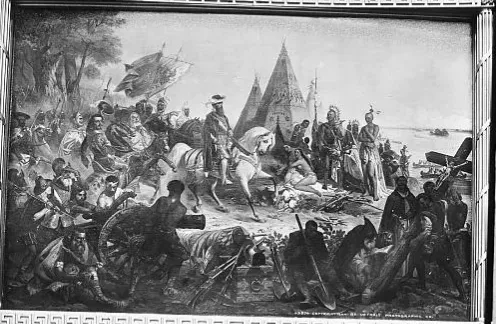
"Discovery of the Mississippi River by De Soto, May 1541" by Powell, George William, 1824-1879 / Library of Congress.
The race to explore the world began in the 1400s. Powerful European countries such as Spain, Portugal, England, and France wanted to find new lands and trade routes. Their goal was to build strong empires and become the richest and most powerful nations.
Spain and Portugal were the first to send explorers across the ocean. They wanted to find a faster way to Asia, which was famous for its silk and spices. Christopher Columbus, sailing for Spain in 1492, landed in the Americas. He thought he had reached Asia, but he had found a new world. After Columbus’s journey, Spain claimed large parts of North and South America. Portugal explored and claimed lands in South America, mainly Brazil.
Soon, other countries joined the race. England and France sent their own explorers to find new trade routes and claim land. John Cabot sailed for England and explored the coast of North America. France sent Jacques Cartier to explore parts of Canada. Each country wanted to grow its territory and gain new resources.
This competition was about more than just land. It was also about national pride. Each country wanted to be known as the best and bravest. The kings and queens hoped to bring glory to their people.
However, this race for land had big effects on the people already living in the Americas. Native American groups had lived on these lands for thousands of years. When the Europeans arrived, they brought new goods, such as horses and metal tools. But they also brought diseases and fought for control of land. Many Native Americans lost their homes or were forced to change their way of life.
Even though there was conflict, Native Americans and Europeans sometimes traded goods and learned from each other. Some Native Americans helped the newcomers survive and taught them how to grow local crops like corn and beans. But as European settlements grew, Native American communities faced many challenges.
The European race to explore and claim lands changed the world forever. It led to new maps, new ideas, and new ways of life. The Americas became a meeting place for many different peoples and cultures.
Interesting Fact: Spain and Portugal asked the Pope to help divide the new lands between them. In 1494, a line was drawn on a map, giving Spain rights to most of the Americas and Portugal to Brazil.
Who sailed for Spain in 1492?
Christopher ColumbusJohn CabotJacques CartierLeif Erikson
Which country claimed most of Brazil?
PortugalSpainFranceEngland
Why did countries want trade routes?
To buy and sell goodsTo find gold onlyTo make mapsTo meet new people
What did national pride mean?
Proud of countryProud of familyProud of shipProud of food
What was one effect on Native Americans?
Lost homesBuilt shipsTraveled to AsiaFought in Europe
Who helped divide new lands in 1494?
The PopeThe King of FranceAn explorerNative Americans
Native Americans and Europeans always fought. True or false?
TrueFalse
What is an "empire"?
A group of lands ruled by oneA kind of shipA new foodA trade route
Perfect For:
👩🏫 Teachers
• Reading comprehension practice
• Auto-graded assessments
• Literacy skill development
👨👩👧👦 Parents
• Reading practice at home
• Comprehension improvement
• Educational reading time
🏠 Homeschoolers
• Reading curriculum support
• Independent reading practice
• Progress monitoring
Reading Features:
📖
Reading Passage
Engaging fiction or nonfiction text
❓
Comprehension Quiz
Auto-graded questions
📊
Instant Feedback
Immediate results and scoring
📄
Printable Version
Download for offline reading
🔊
Read Aloud
Voice-over with word highlighting
Reviews & Ratings
No reviews yet. Be the first to share your experience!
Related Content
Native American Tribes Across America
This engaging history reading passage introduces students to Native American tribes across America, focusing on their da...
D2.HIS.1.3-5D2.HIS.2.3-5RI.4.1RI.4.2
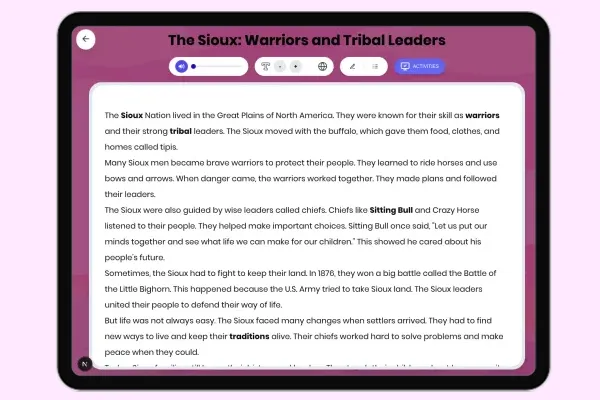
The Sioux: Warriors and Tribal Leaders
This history reading passage explores the Sioux Nation, focusing on their roles as warriors and tribal leaders. Students...
D2.HIS.1.3-5D2.HIS.2.3-5RI.4.1RI.4.3
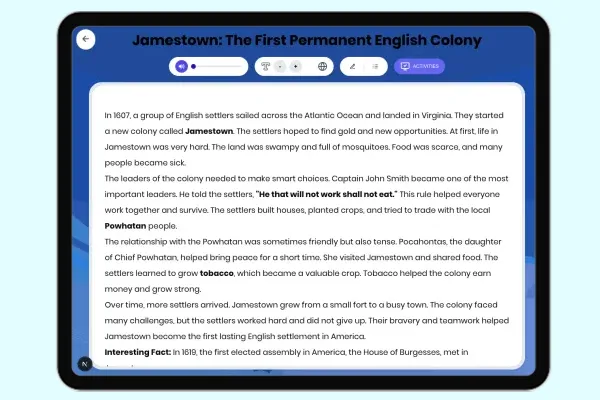
Jamestown: The First Permanent English Colony
This engaging history passage explores the founding of Jamestown, the first permanent English colony in America. Aligned...
D2.HIS.1.3-5D2.HIS.2.3-5RI.4.3RI.4.4
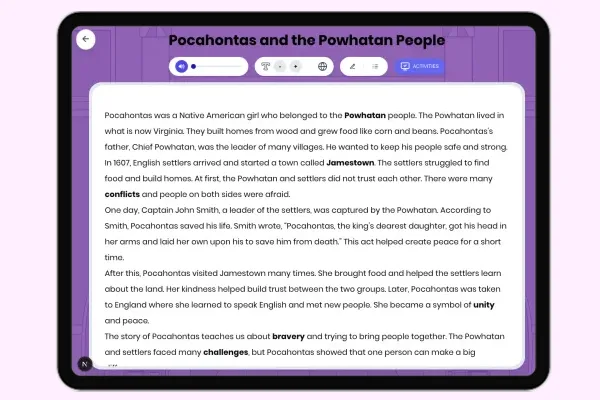
Pocahontas and the Powhatan People
This engaging reading passage explores the life of Pocahontas and the Powhatan people and their important role in early ...
D2.HIS.1.3-5D2.HIS.2.3-5RI.4.1RI.4.3
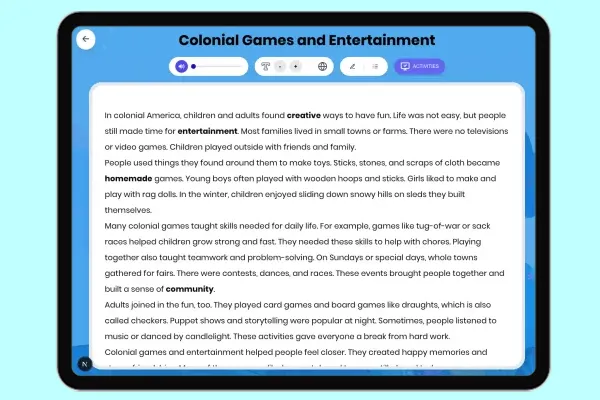
Colonial Games and Entertainment
This engaging history reading passage explores the types of games and entertainment enjoyed by children and families in ...
D2.HIS.1.3-5RI.4.3RI.4.4
Colonial Towns and Village Life
This engaging history reading passage explores the daily life, work, and unity found in colonial towns and villages. Ali...
D2.HIS.1.3-5D2.HIS.2.3-5RI.4.3RI.4.4
George Washington Leads the Army
This engaging history reading passage explores how George Washington bravely led the Continental Army during the America...
D2.HIS.1.3-5D2.HIS.2.3-5RI.4.3RI.4.4
The Battle of Yorktown Ends War
This engaging U.S. history reading passage explores the Battle of Yorktown, a key event that ended the American Revoluti...
D2.HIS.1.3-5D2.HIS.2.3-5RI.4.1RI.4.3
Life as a Continental Soldier
This passage explores the daily life of a Continental Soldier during the American Revolutionary War, highlighting challe...
D2.HIS.1.3-5RI.4.1RI.4.3
Loyalists vs. Patriots: Divided Families
This engaging U.S. history reading passage explores the division between Loyalists and Patriots during the American Revo...
D2.HIS.1.3-5D2.HIS.2.3-5RI.4.3RI.4.4
Manifest Destiny: Coast to Coast
This engaging U.S. history reading passage explores Manifest Destiny and the westward expansion of the United States. St...
D2.HIS.1.3-5D2.HIS.2.3-5RI.4.3RI.4.4
Abraham Lincoln Becomes President
This engaging U.S. history reading passage introduces students to the story of Abraham Lincoln’s rise to the presidency....
D2.HIS.1.3-5D2.HIS.2.3-5RI.4.3RI.4.4
The Southern States Leave the Union
This engaging reading passage explores the key events leading up to the Southern states leaving the Union before the Civ...
D2.HIS.1.3-5D2.HIS.2.3-5RI.4.3RI.4.4
Lincoln Assassinated at Ford's Theatre
This history reading passage explores the events of President Abraham Lincoln's assassination at Ford's Theatre in 1865....
D2.HIS.1.3-5D2.HIS.2.3-5RI.4.3RI.4.4
Juan Cabrillo Explores California
This engaging U.S. history reading passage introduces students to Juan Cabrillo, the first European explorer to reach Ca...
D2.HIS.1.3-5D2.HIS.2.3-5D2.HIS.3.3-5RI.4.3
California's Early Spanish Settlements
This engaging U.S. history reading passage explores life during the early Spanish settlements in America, highlighting t...
D2.HIS.1.3-5D2.HIS.2.3-5D2.HIS.3.3-5RI.4.1
Discovery of Gold in 1848 by James Marshall
This engaging U.S. History passage introduces students to the discovery of gold in 1848 by James Marshall and the beginn...
D2.HIS.1.3-5D2.HIS.2.3-5D2.HIS.3.3-5RI.4.1
The Gold Rush Changes California Forever
This engaging U.S. History reading passage explores how the Gold Rush changed California forever. Students will learn ab...
D2.HIS.1.3-5D2.HIS.2.3-5D2.HIS.16.3-5RI.4.3
The Golden Spike: Connecting California to the Nation
This engaging U.S. history reading passage teaches students about the Golden Spike and how the first transcontinental ra...
D2.HIS.1.3-5D2.HIS.2.3-5D2.HIS.14.3-5RI.4.3
Farms, Factories, and Growing Cities
This engaging U.S. history reading passage explores the dramatic changes in America during the Progressive Era, focusing...